English Edition
Literature
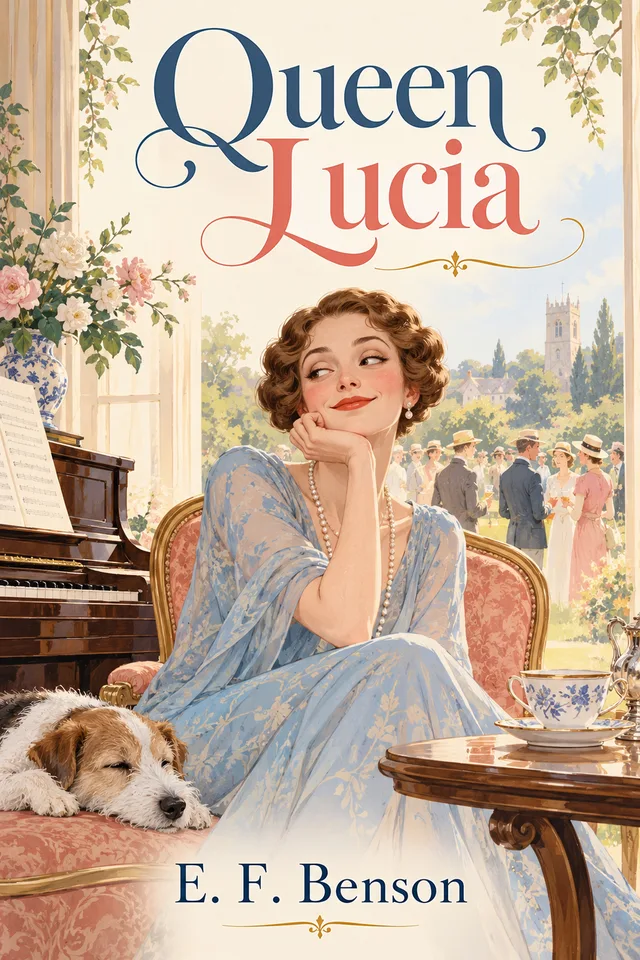
Queen Lucia
English BooksWhale Edition by E. F. Benson
Lucia’s cultural reign over an English village faces fresh challenges as neighbours compete through music, gossip, spiritualism, and social display.
- Preview
- A sample from the prepared text
- Formats
- Online reader, EPUB, PDF
- Access
- Library claim
Book introduction
Queen Lucia
Emmeline Lucas, known as Lucia, presides over the social and artistic life of Riseholme. Her carefully managed prestige depends on compliant neighbours, selective invitations, and performances of cultural sophistication. E. F. Benson turns village friendships, musical evenings, spiritual experiments, and small rivalries into a comedy of ambition. The novel introduces a community in which apparently trivial events become battles for recognition and influence.
BooksWhale edition
How this edition was prepared
This edition is based on a public domain text and has been prepared for digital reading by BooksWhale.
Public domain basis
Why this edition can be shared
E. F. Benson died in 1940. This edition uses the public-domain English original, first published in 1920, from Project Gutenberg; later editorial notes and illustrations are excluded.
Read preview
A sample from the prepared text
Preview selected from the prepared reader text.
Preview chapterFull textRead preview
Queen Lucia
Preview chapterChapter ONEPreview
Though the sun was hot on this July morning Mrs Lucas preferred to cover the half-mile that lay between the station and her house on her own brisk feet, and sent on her maid and her luggage in the fly that her husband had ordered to meet her. After those four hours in the train a short walk would be pleasant, but, though she veiled it from her conscious mind, another motive, sub-consciously engineered, prompted her action. It would, of course, be universally known to all her friends in Riseholme that she was arriving today by the 12.26, and at that hour the village street would be sure to be full of them. They would see the fly with luggage draw up at the door of The Hurst, and nobody except her maid would get out.
That would be an interesting thing for them: it would cause one of those little thrills of pleasant excitement and conjectural exercise which supplied Riseholme with its emotional daily bread. They would all wonder what had happened to her, whether she had been taken ill at the very last moment before leaving town and with her well-known fortitude and consideration for the feelings of others, had sent her maid on to assure her husband that he need not be anxious. That would clearly be Mrs Quantock's suggestion, for Mrs Quantock's mind, devoted as it was now to the study of Christian Science, and the determination to deny the existence of pain, disease and death as regards herself, was always full of the gloomiest views as regards her friends, and on the slightest excuse, pictured that they, poor blind things, were suffering from false claims. Indeed, given that the fly had already arrived at The Hurst, and that its arrival had at this moment been seen by or reported to Daisy Quantock, the chances were vastly in favour of that lady's having already started in to give Mrs Lucas absent treatment. Very likely Georgie Pillson had also seen the anticlimax of the fly's arrival, but he would hazard a much more probable though erroneous solution of her absence. He would certainly guess that she had sent on her maid with her luggage to the station in order to take a seat for her, while she herself, oblivious of the passage of time, was spending her last half hour in contemplation of the Italian masterpieces at the National Gallery, or the Greek bronzes at the British Museum. Certainly she would not be at the Royal Academy, for the culture of Riseholme, led by herself, rejected as valueless all artistic efforts later than the death of Sir Joshua Reynolds, and a great deal of what went before. Her husband with his firm grasp of the obvious, on the other hand, would be disappointingly capable even before her maid confirmed his conjecture, of concluding that she had merely walked from the station.
The motive, then, that made her send her cab on, though subconsciously generated, soon penetrated into her consciousness, and these guesses at what other people would think when they saw it arrive without her, sprang from the dramatic element that formed so large a part of her mentality, and made her always take, as by right divine, the leading part in the histrionic entertainments with which the cultured of Riseholme beguiled or rather strenuously occupied such moments as could be spared from their studies of art and literature, and their social engagements. Indeed she did not usually stop at taking the leading part, but, if possible, doubled another character with it, as well as being stage-manager and adapter, if not designer of scenery. Whatever she did—and really she did an incredible deal—she did it with all the might of her dramatic perception, did it in fact with such earnestness that she had no time to have an eye to the gallery at all, she simply contemplated herself and her own vigorous accomplishment. When she played the piano as she frequently did, (reserving an hour for practice every day), she cared not in the smallest degree for what anybody who passed down the road outside her house might be thinking of the roulades that poured from her open window: she was simply Emmeline Lucas, absorbed in glorious Bach or dainty Scarletti, or noble Beethoven. The latter perhaps was her favorite composer, and many were the evenings when with lights quenched and only the soft effulgence of the moon pouring in through the uncurtained windows, she sat with her profile, cameo-like (or like perhaps to the head on a postage stamp) against the dark oak walls of her music-room, and entranced herself and her listeners, if there were people to dinner, with the exquisite pathos of the first movement of the Moonlight Sonata. Devotedly as she worshipped the Master, whose picture hung above her Steinway Grand, she could never bring herself to believe that the two succeeding movements were on the same sublime level as the first, and besides they "went" very much faster. But she had seriously thought, as she came down in the train today and planned her fresh activities at home of trying to master them, so that she could get through their intricacies with tolerable accuracy. Until then, she would assuredly stop at the end of the first movement in these moonlit seances, and say that the other two were more like morning and afternoon. Then with a sigh she would softly shut the piano lid, and perhaps wiping a little genuine moisture from her eyes, would turn on the electric light and taking up a book from the table, in which a paper-knife marked the extent of her penetration, say:
Preview chapterChapter TWOPreview
As she traversed the smoking-parlour the cheerful sounds that had once tinkled from the collar of a Flemish horse chimed through the house, and simultaneously she became aware that there would be macaroni au gratin for lunch, which was very dear and remembering of Peppino. But before setting fork to her piled-up plate, she had to question him, for her mental craving for information was far keener than her appetite for food.
"Caro, who is an Indian," she said, "whom I saw just now with Daisy Quantock? They were the other side of il piccolo Avon."
Peppino had already begun his macaroni and must pause to shovel the outlying strings of it into his mouth. But the haste with which he did so was sufficient guaranty for his eagerness to reply as soon as it was humanly possible to do so.
"Indian, my dear?" he asked with the greatest interest.
"Yes; turban and burnous and calves and slippers," she said rather impatiently, for what was the good of Peppino having remained in Riseholme if he could not give her precise and certain information on local news when she returned. His prose-poems were all very well, but as prince-consort he had other duties of state which must not be neglected for the calls of Art.
This slight asperity on her part seemed to sharpen his wits.
"Really, I don't know for certain, Lucia," he said, "for I have not set my eyes on him. But putting two and two together, I might make a guess."
"Two and two make four," she said with that irony for which she was feared and famous. "Now for your guess. I hope it is equally accurate."
"Well, as I told you in one of my letters," said he, "Mrs Quantock showed signs of being a little off with Christian Science. She had a cold, and though she recited the True Statement of Being just as frequently as before, her cold got no better. But when I saw her on Tuesday last, unless it was Wednesday, no, it couldn't have been Wednesday, so it must have been Tuesday—"
"Whenever it was then," interrupted his wife, brilliantly summing up his indecision.
"Yes; whenever it was, as you say, on that occasion Mrs Quantock was very full of some Indian philosophy which made you quite well at once. What did she call it now? Yoga! Yes, that was it!"
"And then?" asked Lucia.
"Well, it appears you must have a teacher in Yoga or else you may injure yourself. You have to breathe deeply and say 'Om'——"
"Say what?"
"Om. I understand the ejaculation to be Om. And there are very curious physical exercises; you have to hold your ear with one hand and your toes with the other, and you may strain yourself unless you do it properly. That was the general gist of it."
"And shall we come to the Indian soon?" said Lucia.
"Carissima, you have come to him already. I suggest that Mrs Quantock has applied for a teacher and got him. Ecco!"
Mrs Lucas wore a heavily corrugated forehead at this news. Peppino had a wonderful flair in explaining unusual circumstances in the life of Riseholme and his conjectures were generally correct. But if he was right in this instance, it struck Lucia as being a very irregular thing that anyone should have imported a mystical Indian into Riseholme without consulting her. It is true that she had been away, but still there was the medium of the post.
"Ecco indeed!" she said. "It puts me in rather a difficult position, for I must send out my invitations to my garden-party today, and I really don't know whether I ought to be officially aware of this man's existence or not. I can't write to Daisy Quantock and say 'Pray bring your black friend Om or whatever his name proves to be, and on the other hand, if he is the sort of person whom one would be sorry to miss, I should not like to have passed over him."
Table of contents
Inside this edition
- 01Full text
- 02Chapter ONE
- 03Chapter TWO
- 04Chapter THREE
- 05Chapter FOUR
- 06Chapter FIVE
- 07Chapter SIX
- 08Chapter SEVEN
- 09Chapter EIGHT
- 10Chapter NINE
- 11Chapter TEN
- 12Chapter ELEVEN
- 13Chapter TWELVE
- 14Chapter THIRTEEN
- 15Chapter FOURTEEN
- 16Chapter FIFTEEN
- 17Chapter SIXTEEN
Language availability
Other languages
Additional language editions are not published yet. This section will link to other BooksWhale editions when they become available.
Request another language