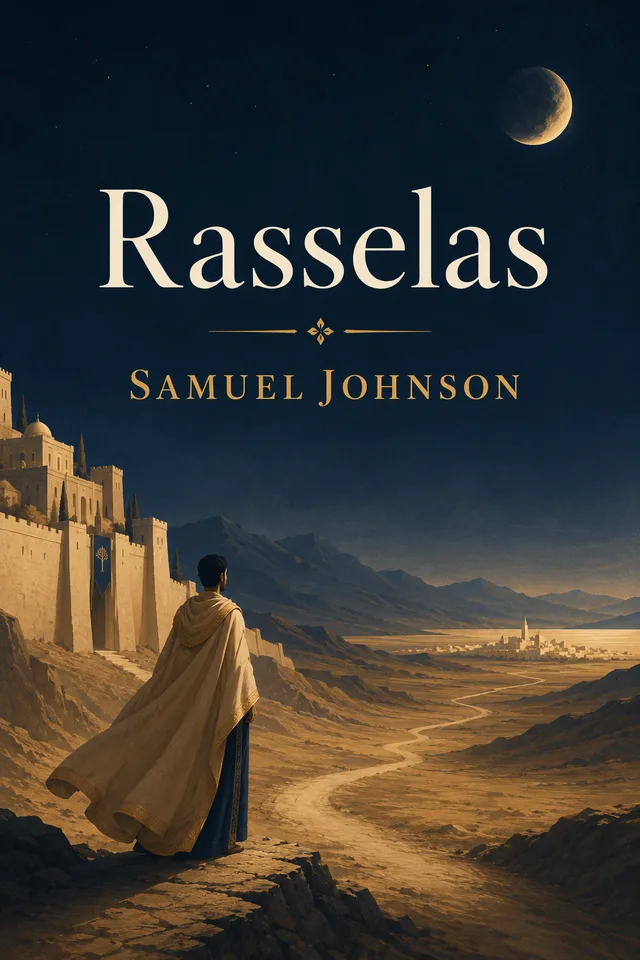
English Edition
Philosophy
Rasselas
English BooksWhale Edition by Samuel Johnson
A philosophical tale in which Prince Rasselas searches for happiness, wisdom, vocation, solitude, power, and human limits.
- Preview
- A sample from the prepared text
- Formats
- Online reader, EPUB, PDF
- Access
- Library claim
Book introduction
Rasselas
Rasselas follows a prince who leaves the Happy Valley to test different ways of life and discover whether any condition guarantees happiness. Samuel Johnson turns travel narrative into moral philosophy, examining ambition, knowledge, marriage, solitude, imagination, and the restless nature of desire.
BooksWhale edition
How this edition was prepared
This edition is based on a public domain text and has been prepared for digital reading by BooksWhale.
Public domain basis
Why this edition can be shared
Samuel Johnson died in 1784, and Rasselas was first published in 1759. These dates support the public-domain basis for the English source text used in this edition.
Read preview
A sample from the prepared text
Preview selected from the prepared reader text.
Preview chapterFull textRead preview
Rasselas
Samuel Johnson
I will give you rest.’
“I have just now read a physical book which inclines me to think that a strong infusion of the bark would do you good. Do, dear mother, try it.
“Pray, send me your blessing, and forgive all that I have done amiss to you. And whatever you would have done, and what debts you would have paid first, or anything else that you would direct, let Miss put it down; I shall endeavour to obey you.
“I have got twelve guineas to send you” [six were borrowed. There was a note in Johnson’s Diary of six guineas repaid to Allen, the printer, who had lent them when he wanted to send money to his dying mother], “but unhappily am at a loss how to send it to-night. If I cannot send it to-night, it will come by the next post.
“Pray, do not omit anything mentioned in this letter. God bless you for ever and ever.
“I am, “Your dutiful Son,
Preview chapter“SAM. JOHNSON.Preview
“_Jan._ 13, 1759.”
That is the personal side of the tale of _Rasselas_. In that way Johnson suddenly, on urgent pressure, carried out a design that had been in his mind. The success of Eastern tales, written as a form of moral essay, in the _Rambler_ and _Adventurer_, upon suggestion, no doubt, of Addison’s _Vision of Mirza_, had prompted him to express his view of life more fully than in essay form by way of Oriental apologue; and his early work on Father Lobo’s Voyage to Abyssinia, caused him to choose Abyssinia for the land in which to lay his fable.
But Johnson’s _Rasselas_ has also a close relation to the time when it was written, as Johnson himself had to the time in which he lived. From the beginning of the century—and especially, in England, since the beginning of the reign of George the Second—there had been a growing sense of the ills of life, associated in some minds with doubt whether there could be a just God ruling this unhappy world. Hard problems of humanity pressed more and more on earnest minds. The feeling expressed in Johnson’s _Vanity of Human __Wishes_ had deepened everywhere by the year 1759. This has intense expression in _Rasselas_, where all the joys of life, without active use of the energies of life, can give no joy; and where all uses of the energies of men are for the attainment of ideals worthless or delusive. This life was to Johnson, and to almost all the earnest thinkers of his time, unhappy in itself—a school-house where the rod was ever active. But in its unhappiness Johnson found no power that could overthrow his faith. To him this world was but a place of education for the happiness that would be to the faithful in the world to come. There was a great dread for him in the question, Who shall be found faithful? But there was no doubt in his mind that the happiness of
man is to be found only beyond the grave. This was a feeling spread through Europe in the darkness gathering before the outburst of the storm of the great French Revolution. Even Gray, in his _Ode on a Distant Prospect of Eton College_, regarded Eton boys at their sports as “little victims,” unconscious of the doom of miseries awaiting them in life. Thus Johnson’s _Rasselas_ is a book doubly typical. We have in it the spirit of the writer when it best expressed the spirit of his time.
H. M.
Preview chapterCHAPTER IPreview
CHAPTER I
Table of contents
Inside this edition
- 01Full text
- 02“SAM. JOHNSON.
- 03CHAPTER I
- 04DESCRIPTION OF A PALACE IN A VALLEY.
- 05CHAPTER II
- 06THE DISCONTENT OF RASSELAS IN THE HAPPY VALLEY.
- 07CHAPTER III
- 08THE WANTS OF HIM THAT WANTS NOTHING.
- 09CHAPTER IV
- 10THE PRINCE CONTINUES TO GRIEVE AND MUSE.
- 11CHAPTER V
- 12THE PRINCE MEDITATES HIS ESCAPE.
- 13CHAPTER VI
- 14A DISSERTATION ON THE ART OF FLYING.
- 15scene of land and ocean, cities and deserts; to survey with equal
- 16CHAPTER VII
- 17THE PRINCE FINDS A MAN OF LEARNING.
- 18CHAPTER VIII
- 19THE HISTORY OF IMLAC.
- 20CHAPTER IX
- 21CHAPTER X
- 22CHAPTER XI
- 23CHAPTER XII
- 24CHAPTER XIII
- 25RASSELAS DISCOVERS THE MEANS OF ESCAPE.
- 26CHAPTER XIV
- 27RASSELAS AND IMLAC RECEIVE AN UNEXPECTED VISIT.
- 28CHAPTER XV
- 29CHAPTER XVI
- 30THEY ENTER CAIRO, AND FIND EVERY MAN HAPPY.
- 31CHAPTER XVII
- 32THE PRINCE ASSOCIATES WITH YOUNG MEN OF SPIRIT AND GAIETY.
- 33CHAPTER XVIII
- 34THE PRINCE FINDS A WISE AND HAPPY MAN.
- 35CHAPTER XIX
- 36A GLIMPSE OF PASTORAL LIFE.
- 37CHAPTER XX
- 38THE DANGER OF PROSPERITY.
- 39CHAPTER XXI
- 40THE HAPPINESS OF SOLITUDE—THE HERMIT’S HISTORY.
- 41CHAPTER XXII
- 42THE HAPPINESS OF A LIFE LED ACCORDING TO NATURE.
- 43CHAPTER XXIII
- 44CHAPTER XXIV
- 45THE PRINCE EXAMINES THE HAPPINESS OF HIGH STATIONS.
- 46CHAPTER XXV
- 47CHAPTER XXVI
- 48THE PRINCESS CONTINUES HER REMARKS UPON PRIVATE LIFE.
- 49CHAPTER XXVII
- 50DISQUISITION UPON GREATNESS.
- 51CHAPTER XXVIII
- 52RASSELAS AND NEKAYAH CONTINUE THEIR CONVERSATION.
- 53CHAPTER XXIX
- 54CHAPTER XXX
- 55IMLAC ENTERS, AND CHANGES THE CONVERSATION.
- 56CHAPTER XXXI
- 57THEY VISIT THE PYRAMIDS.
- 58CHAPTER XXXII
- 59THEY ENTER THE PYRAMID.
- 60CHAPTER XXXIII
- 61THE PRINCESS MEETS WITH AN UNEXPECTED MISFORTUNE.
- 62CHAPTER XXXIV
- 63THEY RETURN TO CAIRO WITHOUT PEKUAH.
- 64CHAPTER XXXV
- 65THE PRINCESS LANGUISHES FOR WANT OF PEKUAH.
- 66CHAPTER XXXVI
- 67PEKUAH IS STILL REMEMBERED. THE PROGRESS OF SORROW.
- 68CHAPTER XXXVII
- 69THE PRINCESS HEARS NEWS OF PEKUAH.
- 70CHAPTER XXXVIII
- 71THE ADVENTURES OF THE LADY PEKUAH.
- 72CHAPTER XXXIX
- 73CHAPTER XL
- 74THE HISTORY OF A MAN OF LEARNING.
- 75CHAPTER XLI
- 76THE ASTRONOMER DISCOVERS THE CAUSE OF HIS UNEASINESS.
- 77CHAPTER XLII
- 78THE OPINION OF THE ASTRONOMER IS EXPLAINED AND JUSTIFIED.
- 79CHAPTER XLIII
- 80THE ASTRONOMER LEAVES IMLAC HIS DIRECTIONS.
- 81CHAPTER XLIV
- 82THE DANGEROUS PREVALENCE OF IMAGINATION.
- 83CHAPTER XLV
- 84THEY DISCOURSE WITH AN OLD MAN.
- 85CHAPTER XLVI
- 86THE PRINCESS AND PEKUAH VISIT THE ASTRONOMER.
- 87CHAPTER XLVII
- 88THE PRINCE ENTERS, AND BRINGS A NEW TOPIC.
- 89CHAPTER XLVIII
- 90IMLAC DISCOURSES ON THE NATURE OF THE SOUL.
- 91CHAPTER XLIX
- 92THE CONCLUSION, IN WHICH NOTHING IS CONCLUDED.
Language availability
Other languages
Additional language editions are not published yet. This section will link to other BooksWhale editions when they become available.
Request another language