English Edition
History
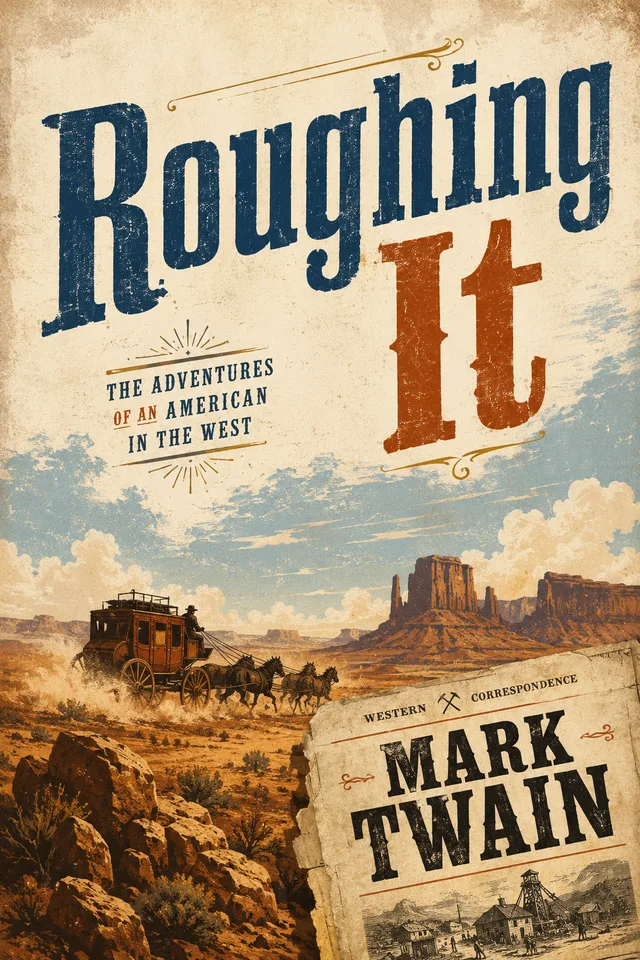
Roughing It
English BooksWhale Edition by Mark Twain
Twain’s comic memoir of the American West, mining camps, stagecoaches, newspapers, and frontier myth.
- Preview
- A sample from the prepared text
- Formats
- Online reader, EPUB, PDF
- Access
- Library claim
Book introduction
Roughing It
Roughing It turns Mark Twain’s years in Nevada, California, and the Pacific into a sprawling comic memoir. Stagecoach travel, silver mining, journalism, speculation, desert hardship, and tall tales become material for a classic portrait of the American West and the making of Twain’s public voice.
BooksWhale edition
How this edition was prepared
This edition is based on a public domain text and has been prepared for digital reading by BooksWhale.
Public domain basis
Why this edition can be shared
Mark Twain died in 1910, and Roughing It was first published in 1872. These dates support the public-domain basis for the English source text used in this edition.
Read preview
A sample from the prepared text
Preview selected from the prepared reader text.
Preview chapterFull textRead preview
Roughing It
PREFATORY.
This book is merely a personal narrative, and not a pretentious history or a philosophical dissertation. It is a record of several years of variegated vagabondizing, and its object is rather to help the resting reader while away an idle hour than afflict him with metaphysics, or goad him with science. Still, there is information in the volume; information concerning an interesting episode in the history of the Far West, about which no books have been written by persons who were on the ground in person, and saw the happenings of the time with their own eyes. I allude to the rise, growth and culmination of the silver-mining fever in Nevada—a curious episode, in some respects; the only one, of its peculiar kind, that has occurred in the land; and the only one, indeed, that is likely to occur in it.
Yes, take it all around, there is quite a good deal of information in
the book. I regret this very much; but really it could not be helped:
information appears to stew out of me naturally, like the precious ottar
of roses out of the otter. Sometimes it has seemed to me that I would
give worlds if I could retain my facts; but it cannot be. The more I
calk up the sources, and the tighter I get, the more I leak wisdom.
Therefore, I can only claim indulgence at the hands of the reader, not
justification.
THE AUTHOR.
Preview chapterCHAPTER I.Preview
My brother had just been appointed Secretary of Nevada Territory—an office of such majesty that it concentrated in itself the duties and dignities of Treasurer, Comptroller, Secretary of State, and Acting Governor in the Governor’s absence. A salary of eighteen hundred dollars a year and the title of “Mr. Secretary,” gave to the great position an air of wild and imposing grandeur. I was young and ignorant, and I envied my brother. I coveted his distinction and his financial splendor, but particularly and especially the long, strange journey he was going to make, and the curious new world he was going to explore. He was going to travel! I never had been away from home, and that word “travel” had a seductive charm for me. Pretty soon he would be hundreds and hundreds of miles away on the great plains and deserts, and among the mountains of the Far West, and would see buffaloes and Indians, and prairie dogs, and antelopes, and have all kinds of adventures, and may be get hanged or scalped, and have ever such a fine time, and write home and tell us all about it, and be a hero. And he would see the gold mines and the silver mines, and maybe go about of an afternoon when his work was done, and pick up two or three pailfuls of shining slugs, and nuggets of gold and silver on the hillside. And by and by he would become very rich, and return home by sea, and be able to talk as calmly about San Francisco and the ocean, and “the isthmus” as if it was nothing of any consequence to have seen those marvels face to face.
What I suffered in contemplating his happiness, pen cannot describe. And so, when he offered me, in cold blood, the sublime position of private secretary under him, it appeared to me that the heavens and the earth passed away, and the firmament was rolled together as a scroll! I had nothing more to desire. My contentment was complete.
At the end of an hour or two I was ready for the journey. Not much packing up was necessary, because we were going in the overland stage from the Missouri frontier to Nevada, and passengers were only allowed a small quantity of baggage apiece. There was no Pacific railroad in those fine times of ten or twelve years ago—not a single rail of it. I only proposed to stay in Nevada three months—I had no thought of staying longer than that. I meant to see all I could that was new and strange, and then hurry home to business. I little thought that I would not see the end of that three-month pleasure excursion for six or seven uncommonly long years!
I dreamed all night about Indians, deserts, and silver bars, and in due
time, next day, we took shipping at the St. Louis wharf on board a steamboat bound up the Missouri River.
We were six days going from St. Louis to “St. Jo.”—a trip that was so
dull, and sleepy, and eventless that it has left no more impression on
my memory than if its duration had been six minutes instead of that
many days. No record is left in my mind, now, concerning it, but a
confused jumble of savage-looking snags, which we deliberately walked
over with one wheel or the other; and of reefs which we butted and
butted, and then retired from and climbed over in some softer place;
and of sand-bars which we roosted on occasionally, and rested, and then
got out our crutches and sparred over.
In fact, the boat might almost as well have gone to St. Jo. by land, for she was walking most of the time, anyhow—climbing over reefs and clambering over snags patiently and laboriously all day long. The captain said she was a “bully” boat, and all she wanted was more “shear” and a bigger wheel. I thought she wanted a pair of stilts, but I had the deep sagacity not to say so.
Preview chapterCHAPTER III.Preview
About an hour and a half before daylight we were bowling along smoothly
over the road—so smoothly that our cradle only rocked in a gentle,
lulling way, that was gradually soothing us to sleep, and dulling our
consciousness—when something gave away under us! We were dimly aware of
it, but indifferent to it. The coach stopped. We heard the driver and
conductor talking together outside, and rummaging for a lantern, and
swearing because they could not find it—but we had no interest in
whatever had happened, and it only added to our comfort to think of
those people out there at work in the murky night, and we snug in our
nest with the curtains drawn. But presently, by the sounds, there seemed
to be an examination going on, and then the driver’s voice said:
“By George, the thoroughbrace is broke!”
This startled me broad awake—as an undefined sense of calamity is always apt to do. I said to myself: “Now, a thoroughbrace is probably part of a horse; and doubtless a vital part, too, from the dismay in the driver’s voice. Leg, maybe—and yet how could he break his leg waltzing along such a road as this? No, it can’t be his leg. That is impossible, unless he was reaching for the driver. Now, what can be the thoroughbrace of a horse, I wonder? Well, whatever comes, I shall not air my ignorance in this crowd, anyway.”
Just then the conductor’s face appeared at a lifted curtain, and his
lantern glared in on us and our wall of mail matter. He said: “Gents,
you’ll have to turn out a spell. Thoroughbrace is broke.”
We climbed out into a chill drizzle, and felt ever so homeless and
dreary. When I found that the thing they called a “thoroughbrace” was
the massive combination of belts and springs which the coach rocks
itself in, I said to the driver:
“I never saw a thoroughbrace used up like that, before, that I can remember. How did it happen?”
“Why, it happened by trying to make one coach carry three days’
mail—that’s how it happened,” said he. “And right here is the very
direction which is wrote on all the newspaper-bags which was to be put
out for the Injuns for to keep ’em quiet. It’s most uncommon lucky,
becuz it’s so nation dark I should ’a’ gone by unbeknowns if that air
thoroughbrace hadn’t broke.”
I knew that he was in labor with another of those winks of his, though
I could not see his face, because he was bent down at work; and wishing
him a safe delivery, I turned to and helped the rest get out the mail-sacks. It made a great pyramid by the roadside when it was all out. When they had mended the thoroughbrace we filled the two boots again, but put no mail on top, and only half as much inside as there was before. The conductor bent all the seat-backs down, and then filled the coach just half full of mail-bags from end to end. We objected loudly to this, for it left us no seats. But the conductor was wiser than we, and said a bed was better than seats, and moreover, this plan would protect his thoroughbraces. We never wanted any seats after that. The lazy bed was infinitely preferable. I had many an exciting day, subsequently, lying on it reading the statutes and the dictionary, and wondering how the characters would turn out.
The conductor said he would send back a guard from the next station to take charge of the abandoned mail-bags, and we drove on.
It was now just dawn; and as we stretched our cramped legs full length on the mail sacks, and gazed out through the windows across the wide wastes of greensward clad in cool, powdery mist, to where there was an expectant look in the eastern horizon, our perfect enjoyment took the form of a tranquil and contented ecstasy. The stage whirled along at a spanking gait, the breeze flapping curtains and suspended coats in a most exhilarating way; the cradle swayed and swung luxuriously, the pattering of the horses’ hoofs, the cracking of the driver’s whip, and his “Hi-yi! g’lang!” were music; the spinning ground and the waltzing trees appeared to give us a mute hurrah as we went by, and then slack up and look after us with interest, or envy, or something; and as we lay and smoked the pipe of peace and compared all this luxury with the years of tiresome city life that had gone before it, we felt that there was only one complete and satisfying happiness in the world, and we had found it.
Table of contents
Inside this edition
- 01Full text
- 02CHAPTER I.
- 03CHAPTER III.
- 04CHAPTER IV.
- 05CHAPTER V.
- 06CHAPTER VI.
- 07CHAPTER VII.
- 08CHAPTER VIII.
- 09CHAPTER IX.
- 10CHAPTER X.
- 11CHAPTER XI.
- 12CHAPTER XII.
- 13CHAPTER XIII.
- 14CHAPTER XIV.
- 15CHAPTER XV.
- 16CHAPTER XVI.
- 17CHAPTER XVII.
- 18CHAPTER XVIII.
- 19CHAPTER XIX.
- 20CHAPTER XX.
- 21CHAPTER XXI.
- 22CHAPTER XXII.
- 23CHAPTER XXIII.
- 24CHAPTER XXIV.
- 25CHAPTER XXV.
- 26CHAPTER XXVI.
- 27CHAPTER XXVII.
- 28CHAPTER XXVIII.
- 29CHAPTER XXIX.
- 30CHAPTER XXX.
- 31CHAPTER XXXI.
- 32CHAPTER XXXII.
- 33CHAPTER XXXIII.
- 34CHAPTER XXXIV.
- 35CHAPTER XXXV.
- 36CHAPTER XXXVI.
- 37CHAPTER XXXVII.
- 38CHAPTER XXXVIII.
- 39CHAPTER XXXIX.
- 40CHAPTER XL.
- 41CHAPTER XLI.
- 42CHAPTER XLII.
- 43CHAPTER XLIII.
- 44CHAPTER XLIV.
- 45CHAPTER XLV.
- 46CHAPTER XLVI.
- 47CHAPTER XLVII.
- 48CHAPTER XLVIII.
- 49CHAPTER XLIX.
- 50CHAPTER L.
- 51CHAPTER LI.
- 52CHAPTER LII.
- 53CHAPTER LIII.
- 54CHAPTER LIV.
- 55CHAPTER LV.
- 56CHAPTER LVI.
- 57CHAPTER LVII.
- 58CHAPTER LVIII.
- 59CHAPTER LIX.
- 60CHAPTER LX.
- 61CHAPTER LXI.
- 62CHAPTER LXII.
- 63CHAPTER LXIII.
- 64CHAPTER LXIV.
- 65CHAPTER LXV.
- 66CHAPTER LXVI.
- 67CHAPTER LXVII.
- 68CHAPTER LXVIII.
- 69CHAPTER LXIX.
- 70CHAPTER LXX.
- 71CHAPTER LXXI.
- 72CHAPTER LXXII.
- 73CHAPTER LXXIII.
- 74CHAPTER LXXIV.
- 75CHAPTER LXXV.
- 76CHAPTER LXXVI.
- 77CHAPTER LXXVII.
- 78CHAPTER LXXIII.
- 79CHAPTER LXXIX.
- 80C. CONCERNING A FRIGHTFUL ASSASSINATION THAT WAS NEVER CONSUMMATED
Language availability
Other languages
Additional language editions are not published yet. This section will link to other BooksWhale editions when they become available.
Request another language