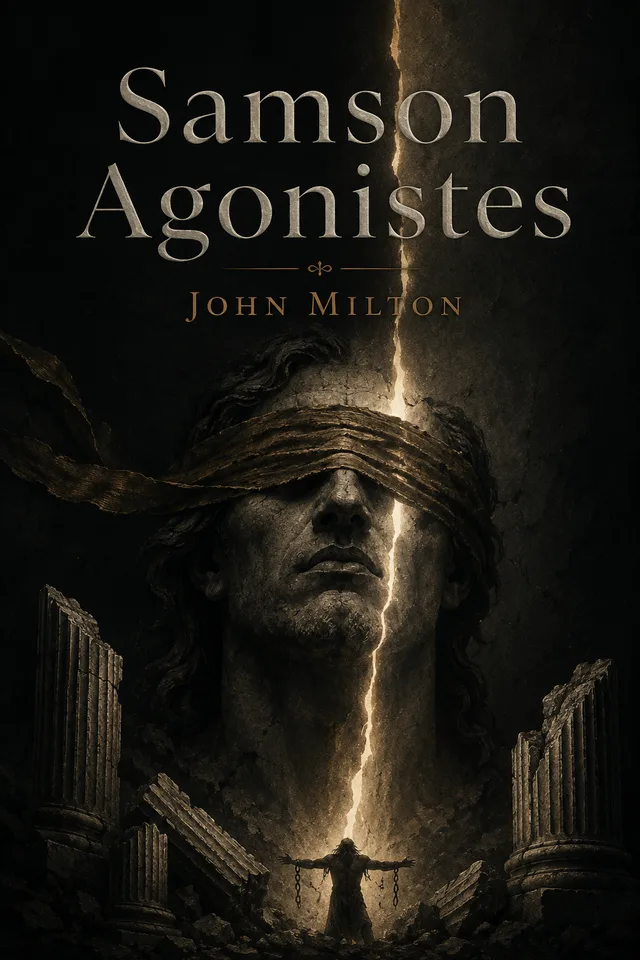
English Edition
Literature
Samson Agonistes
English BooksWhale Edition by John Milton
Milton’s tragic poem on blindness, captivity, vocation, vengeance, and spiritual trial.
- Preview
- A sample from the prepared text
- Formats
- Online reader, EPUB, PDF
- Access
- Library claim
Book introduction
Samson Agonistes
“Samson Agonistes” reworks the biblical story of Samson as a dramatic poem of suffering, temptation, and final action. Milton’s late style gives the hero’s captivity and blindness intense political and spiritual resonance.
BooksWhale edition
How this edition was prepared
This edition is based on a public domain text and has been prepared for digital reading by BooksWhale.
Public domain basis
Why this edition can be shared
Samson Agonistes is a public-domain work: the author died in 1674, and the text was first published in 1671. This edition uses the original English text.
Read preview
A sample from the prepared text
Preview selected from the prepared reader text.
Preview chapterFull textRead preview
Samson Agonistes
Preview chapterOf that sort of Dramatic Poem which is call'd Tragedy.Preview
TRAGEDY, as it was antiently compos'd, hath been ever held the gravest, moralest, and most profitable of all other Poems: therefore said by Aristotle to be of power by raising pity and fear, or terror, to purge the mind of those and such like passions, that is to temper and reduce them to just measure with a kind of delight, stirr'd up by reading or seeing those passions well imitated. Nor is Nature wanting in her own effects to make good his assertion: for so in Physic things of melancholic hue and quality are us'd against melancholy, sowr against sowr, salt to remove salt humours. Hence Philosophers and other gravest Writers, as Cicero, Plutarch and others, frequently cite out of Tragic Poets, both to adorn and illustrate thir discourse. The Apostle Paul himself thought it not unworthy to insert a verse of Euripides into the Text of Holy Scripture, I Cor. 15. 33. and Paraeus commenting on the Revelation, divides the whole Book as a Tragedy, into Acts distinguisht each by a Chorus of Heavenly Harpings and Song between. Heretofore Men in highest dignity have labour'd not a little to be thought able to compose a Tragedy. Of that honour Dionysius the elder was no less ambitious, then before of his attaining to the Tyranny. Augustus Caesar also had begun his Ajax, but unable to please his own judgment with what he had begun, left it unfinisht. Seneca the Philosopher is by some thought the Author of those Tragedies (at lest the best of them) that go under that name. Gregory Nazianzen a Father of the Church, thought it not unbeseeming the sanctity of his person to write a Tragedy which he entitl'd, Christ suffering. This is mention'd to vindicate Tragedy from the small esteem, or rather infamy, which in the account of many it undergoes at this day with other common Interludes; hap'ning through the Poets error of intermixing Comic stuff with Tragic sadness and gravity; or introducing trivial and vulgar persons, which by all judicious hath bin counted absurd; and brought in without discretion, corruptly to gratifie the people. And though antient Tragedy use no Prologue, yet using sometimes, in case of self defence, or explanation, that which Martial calls an Epistle; in behalf of this Tragedy coming forth after the antient manner, much different from what among us passes for best, thus much before-hand may be Epistl'd; that Chorus is here introduc'd after the Greek manner, not antient only but modern, and still in use among the Italians. In the modelling therefore of this Poem with good reason, the Antients and Italians are rather follow'd, as of much more authority and fame. The measure of Verse us'd in the Chorus is of all sorts, call'd by the Greeks Monostrophic, or rather Apolelymenon, without regard had to Strophe, Antistrophe or Epod, which were a kind of Stanza's fram'd only for the Music, then us'd with the Chorus that sung; not essential to the Poem, and therefore not material; or being divided into Stanza's or Pauses they may be call'd Allaeostropha. Division into Act and Scene referring chiefly to the Stage (to which this work never was intended) is here omitted.
It suffices if the whole Drama be found not produc't beyond the fift Act, of the style and uniformitie, and that commonly call'd the Plot, whether intricate or explicit, which is nothing indeed but such oeconomy, or disposition of the fable as may stand best with verisimilitude and decorum; they only will best judge who are not unacquainted with Aeschulus, Sophocles, and Euripides, the three Tragic Poets unequall'd yet by any, and the best rule to all who endeavour to write Tragedy. The circumscription of time wherein the whole Drama begins and ends, is according to antient rule, and best example, within the space of 24 hours.
Preview chapterThe Argument.Preview
Samson made Captive, Blind, and now in the Prison at Gaza, there to labour as in a common work-house, on a Festival day, in the general cessation from labour, comes forth into the open Air, to a place nigh, somewhat retir'd there to sit a while and bemoan his condition. Where he happens at length to be visited by certain friends and equals of his tribe, which make the Chorus, who seek to comfort him what they can; then by his old Father Manoa, who endeavours the like, and withal tells him his purpose to procure his liberty by ransom; lastly, that this Feast was proclaim'd by the Philistins as a day of Thanksgiving for thir deliverance from the hands of Samson, which yet more troubles him. Manoa then departs to prosecute his endeavour with the Philistian Lords for Samson's redemption; who in the mean while is visited by other persons; and lastly by a publick Officer to require coming to the Feast before the Lords and People, to play or shew his strength in thir presence; he at first refuses, dismissing the publick officer with absolute denyal to come; at length perswaded inwardly that this was from God, he yields to go along with him, who came now the second time with great threatnings to fetch him; the Chorus yet remaining on the place, Manoa returns full of joyful hope, to procure e're long his Sons deliverance: in the midst of which discourse an Ebrew comes in haste confusedly at first; and afterward more distinctly relating the Catastrophe, what Samson had done to the Philistins, and by accident to himself; wherewith the Tragedy ends.
Table of contents
Inside this edition
- 01Full text
- 02Of that sort of Dramatic Poem which is call'd Tragedy.
- 03The Argument.
- 04The Persons
- 05The Scene before the Prison in Gaza.
Language availability
Other languages
Additional language editions are not published yet. This section will link to other BooksWhale editions when they become available.
Request another language