English Edition
Philosophy
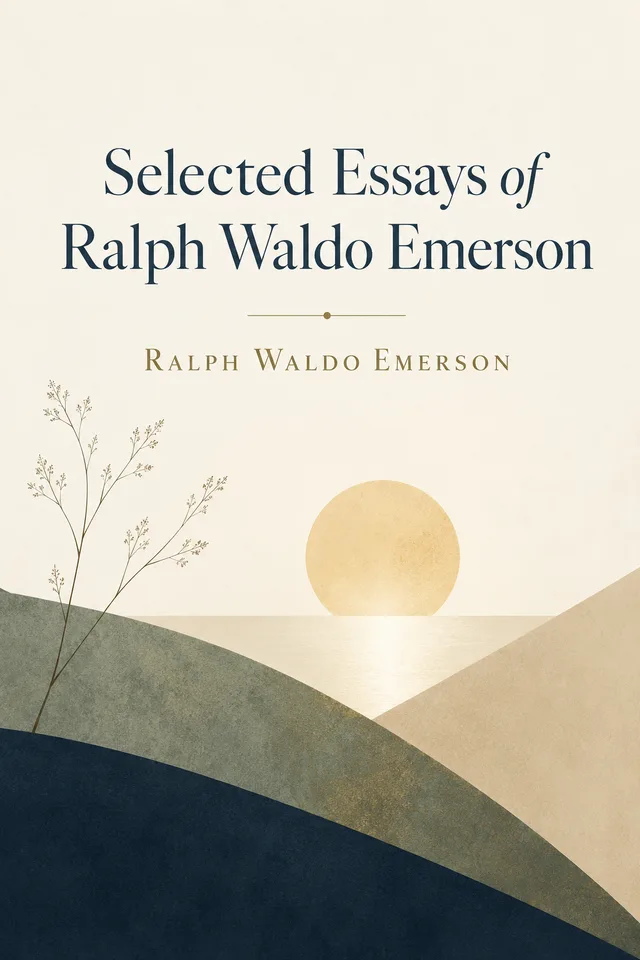
Selected Essays of Ralph Waldo Emerson
English BooksWhale Edition by Ralph Waldo Emerson
A focused Emerson essay collection on intellect, character, friendship, heroism, nature, poetry, prudence, and moral independence.
- Preview
- A sample from the prepared text
- Formats
- Online reader, EPUB, PDF
- Access
- Library claim
Book introduction
Selected Essays of Ralph Waldo Emerson
Selected Essays of Ralph Waldo Emerson brings together major nineteenth-century essays including The American Scholar, Compensation, Friendship, Heroism, Manners, Gifts, Nature, Shakespeare; or, The Poet, Prudence, and Circles. The collection shows Emerson’s transcendentalist thought at work in questions of learning, self-command, social conduct, imagination, and spiritual independence.
BooksWhale edition
How this edition was prepared
This edition is based on a public domain text and has been prepared for digital reading by BooksWhale.
Public domain basis
Why this edition can be shared
Selected Essays of Ralph Waldo Emerson is a public-domain selection: the author died in 1882, and the included essays were published in the nineteenth century. This edition keeps the original English texts and removes later editorial notes.
Read preview
A sample from the prepared text
Preview selected from the prepared reader text.
Preview chapterFull textRead preview
Selected Essays of Ralph Waldo Emerson
Preview chapterTHE AMERICAN SCHOLAR.Preview
This address was delivered at Cambridge in 1837, before the Harvard Chapter of the Phi Beta Kappa Society, a college fraternity composed of the first twenty-five men in each graduating class. The society has annual meetings, which have been the occasion for addresses from the most distinguished scholars and thinkers of the day.
Preview chapterMR. PRESIDENT AND GENTLEMEN,Preview
I greet you on the recommencement of our literary year. Our anniversary is one of hope, and, perhaps, not enough of labor. We do not meet for games of strength or skill, for the recitation of histories, tragedies, and odes, like the ancient Greeks; for parliaments of love and poesy, like the Troubadours; nor for the advancement of science, like our co-temporaries in the British and European capitals. Thus far, our holiday has been simply a friendly sign of the survival of the love of letters amongst a people too busy to give to letters any more. As such it is precious as the sign of an indestructible instinct. Perhaps the time is already come when it ought to be, and will be, something else; when the sluggard intellect of this continent will look from under its iron lids and fill the postponed expectation of the world with something better than the exertions of mechanical skill. Our day of dependence, our long apprenticeship to the learning of other lands, draws to a close. The millions that around us are rushing into life cannot always be fed on the sere remains of foreign harvests. Events, actions arise that must be sung, that will sing themselves. Who can doubt that poetry will revive and lead in a new age, as the star in the constellation Harp, which now flames in our zenith, astronomers announce, shall one day be the pole-star for a thousand years?
In the light of this hope I accept the topic which not only usage but the nature of our association seem to prescribe to this day,--the AMERICAN SCHOLAR. Year by year we come up hither to read one more chapter of his biography. Let us inquire what new lights, new events, and more days have thrown on his character, his duties, and his hopes.
It is one of those fables which out of an unknown antiquity convey an unlooked-for wisdom, that the gods, in the beginning, divided Man into men, that he might be more helpful to himself; just as the hand was divided into fingers, the better to answer its end.
The old fable covers a doctrine ever new and sublime; that there is One Man,--present to all particular men only partially, or through one faculty; and that you must take the whole society to find the whole man. Man is not a farmer, or a professor, or an engineer, but he is all. Man is priest, and scholar, and statesman, and producer, and soldier. In the _divided_ or social state these functions are parceled out to individuals, each of whom aims to do his stint of the joint work, whilst each other performs his. The fable implies that the individual, to possess himself, must sometimes return from his own labor to embrace all the other laborers. But, unfortunately, this original unit, this fountain of power, has been so distributed to multitudes, has been so minutely subdivided and peddled out, that it is spilled into drops, and cannot be gathered. The state of society is one in which the members have suffered amputation from the trunk and strut about so many walking monsters,--a good finger, a neck, a stomach, an elbow, but never a man.
Man is thus metamorphosed into a thing, into many things. The planter, who is Man sent out into the field to gather food, is seldom cheered by any idea of the true dignity of his ministry. He sees his bushel and his cart, and nothing beyond, and sinks into the farmer, instead of Man on the farm. The tradesman scarcely ever gives an ideal worth to his work, but is ridden by the routine of his craft, and the soul is subject to dollars. The priest becomes a form; the attorney a statute-book; the mechanic a machine; the sailor a rope of the ship.
In this distribution of functions the scholar is the delegated intellect. In the right state he is _Man Thinking_. In the degenerate state, when the victim of society, he tends to become a mere thinker, or, still worse, the parrot of other men's thinking.
Table of contents
Inside this edition
- 01Full text
- 02THE AMERICAN SCHOLAR.
- 03MR. PRESIDENT AND GENTLEMEN,
- 04COMPENSATION.
- 05FRIENDSHIP.
- 06DEAR FRIEND:--
- 07HEROISM
- 08MANNERS
- 09GIFTS
- 10NATURE
- 11SHAKSPEARE; OR, THE POET
- 12PRUDENCE.
- 13CIRCLES.
Language availability
Other languages
Additional language editions are not published yet. This section will link to other BooksWhale editions when they become available.
Request another language