English Edition
Literature
She
English BooksWhale Edition by H. Rider Haggard
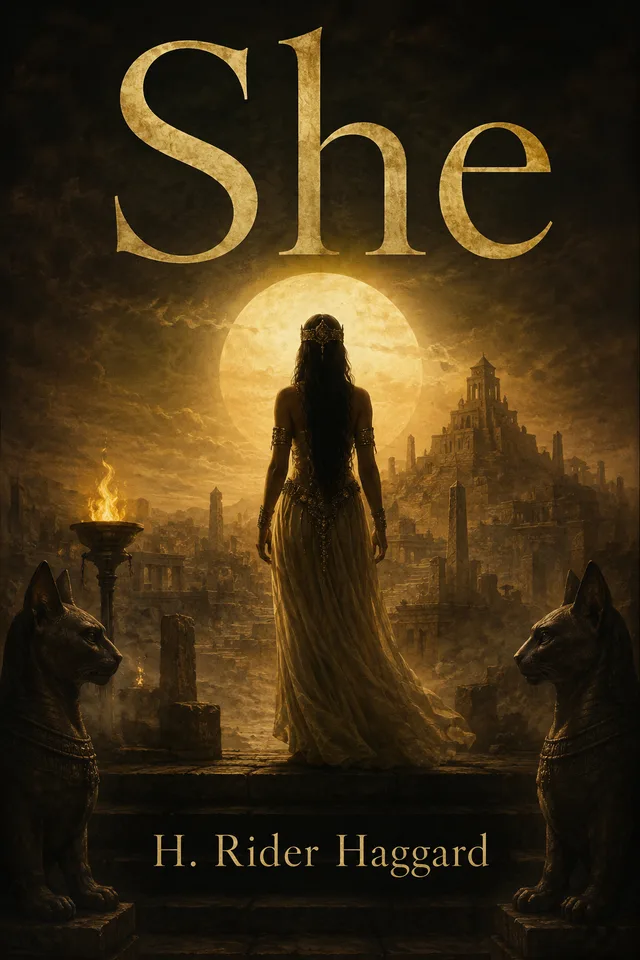
An expedition encounters Ayesha, the immortal queen whose beauty, power, and obsession dominate Haggard's fantasy romance.
- Preview
- A sample from the prepared text
- Formats
- Online reader, EPUB, PDF
- Access
- Library claim
Book introduction
She
She follows Horace Holly and Leo Vincey into a remote kingdom ruled by Ayesha, 'She-who-must-be-obeyed.' H. Rider Haggard fuses archaeological mystery, imperial fantasy, supernatural immortality, and dangerous desire in one of the most influential lost-world novels of the nineteenth century.
BooksWhale edition
How this edition was prepared
This edition is based on a public domain text and has been prepared for digital reading by BooksWhale.
Public domain basis
Why this edition can be shared
H. Rider Haggard died in 1925, and She was first published in 1887. These dates support the public-domain basis for this English original-language edition.
Read preview
A sample from the prepared text
Preview selected from the prepared reader text.
Preview chapterFull textRead preview
She
Preview chapterINTRODUCTIONPreview
In giving to the world the record of what, looked at as an adventure only, is I suppose one of the most wonderful and mysterious experiences ever undergone by mortal men, I feel it incumbent on me to explain what my exact connection with it is. And so I may as well say at once that I am not the narrator but only the editor of this extraordinary history, and then go on to tell how it found its way into my hands.
Some years ago I, the editor, was stopping with a friend, “_vir doctissimus et amicus meus_,” at a certain University, which for the purposes of this history we will call Cambridge, and was one day much struck with the appearance of two persons whom I saw going arm-in-arm down the street. One of these gentlemen was I think, without exception, the handsomest young fellow I have ever seen. He was very tall, very broad, and had a look of power and a grace of bearing that seemed as native to him as it is to a wild stag. In addition his face was almost without flaw—a good face as well as a beautiful one, and when he lifted his hat, which he did just then to a passing lady, I saw that his head was covered with little golden curls growing close to the scalp.
“Good gracious!” I said to my friend, with whom I was walking, “why, that fellow looks like a statue of Apollo come to life. What a splendid man he is!”
“Yes,” he answered, “he is the handsomest man in the University, and one of the nicest too. They call him ‘the Greek god’; but look at the other one, he’s Vincey’s (that’s the god’s name) guardian, and supposed to be full of every kind of information. They call him ‘Charon.’” I looked, and found the older man quite as interesting in his way as the glorified specimen of humanity at his side. He appeared to be about forty years of age, and was I think as ugly as his companion was handsome. To begin with, he was shortish, rather bow-legged, very deep chested, and with unusually long arms. He had dark hair and small eyes, and the hair grew right down on his forehead, and his whiskers grew right up to his hair, so that there was uncommonly little of his countenance to be seen. Altogether he reminded me forcibly of a gorilla, and yet there was something very pleasing and genial about the man’s eye. I remember saying that I should like to know him.
“All right,” answered my friend, “nothing easier. I know Vincey; I’ll introduce you,” and he did, and for some minutes we stood chatting—about the Zulu people, I think, for I had just returned from the Cape at the time. Presently, however, a stoutish lady, whose name I do not remember, came along the pavement, accompanied by a pretty fair-haired girl, and these two Mr. Vincey, who clearly knew them well, at once joined, walking off in their company. I remember being rather amused because of the change in the expression of the elder man, whose name I discovered was Holly, when he saw the ladies advancing. He suddenly stopped short in his talk, cast a reproachful look at his companion, and, with an abrupt nod to myself, turned and marched off alone across the street. I heard afterwards that he was popularly supposed to be as much afraid of a woman as most people are of a mad dog, which accounted for his precipitate retreat. I cannot say, however, that young Vincey showed much aversion to feminine society on this occasion. Indeed I remember laughing, and remarking to my friend at the time that he was not the sort of man whom it would be desirable to introduce to the lady one was going to marry, since it was exceedingly probable that the acquaintance would end in a transfer of her affections. He was altogether too good-looking, and, what is more, he had none of that consciousness and conceit about him which usually afflicts handsome men, and makes them deservedly disliked by their fellows.
Preview chapterI. MY VISITORPreview
There are some events of which each circumstance and surrounding detail seems to be graven on the memory in such fashion that we cannot forget it, and so it is with the scene that I am about to describe. It rises as clearly before my mind at this moment as though it had happened but yesterday.
It was in this very month something over twenty years ago that I, Ludwig Horace Holly, was sitting one night in my rooms at Cambridge, grinding away at some mathematical work, I forget what. I was to go up for my fellowship within a week, and was expected by my tutor and my college generally to distinguish myself. At last, wearied out, I flung my book down, and, going to the mantelpiece, took down a pipe and filled it. There was a candle burning on the mantelpiece, and a long, narrow glass at the back of it; and as I was in the act of lighting the pipe I caught sight of my own countenance in the glass, and paused to reflect. The lighted match burnt away till it scorched my fingers, forcing me to drop it; but still I stood and stared at myself in the glass, and reflected.
“Well,” I said aloud, at last, “it is to be hoped that I shall be able to do something with the inside of my head, for I shall certainly never do anything by the help of the outside.”
This remark will doubtless strike anybody who reads it as being slightly obscure, but I was in reality alluding to my physical deficiencies. Most men of twenty-two are endowed at any rate with some share of the comeliness of youth, but to me even this was denied. Short, thick-set, and deep-chested almost to deformity, with long sinewy arms, heavy features, deep-set grey eyes, a low brow half overgrown with a mop of thick black hair, like a deserted clearing on which the forest had once more begun to encroach; such was my appearance nearly a quarter of a century ago, and such, with some modification, it is to this day. Like Cain, I was branded—branded by Nature with the stamp of abnormal ugliness, as I was gifted by Nature with iron and abnormal strength and considerable intellectual powers. So ugly was I that the spruce young men of my College, though they were proud enough of my feats of endurance and physical prowess, did not even care to be seen walking with me. Was it wonderful that I was misanthropic and sullen? Was it wonderful that I brooded and worked alone, and had no friends—at least, only one? I was set apart by Nature to live alone, and draw comfort from her breast, and hers only. Women hated the sight of me. Only a week before I had heard one call me a “monster” when she thought I was out of hearing, and say that I had converted her to the monkey theory. Once, indeed, a woman pretended to care for me, and I lavished all the pent-up affection of my nature upon her. Then money that was to have come to me went elsewhere, and she discarded me. I pleaded with her as I have never pleaded with any living creature before or since, for I was caught by her sweet face, and loved her; and in the end by way of answer she took me to the glass, and stood side by side with me, and looked into it.
“Now,” she said, “if I am Beauty, who are you?” That was when I was only twenty.
And so I stood and stared, and felt a sort of grim satisfaction in the sense of my own loneliness; for I had neither father, nor mother, nor brother; and as I did so there came a knock at my door.
I listened before I went to open it, for it was nearly twelve o’clock at night, and I was in no mood to admit any stranger. I had but one friend in the College, or, indeed, in the world—perhaps it was he.
Table of contents
Inside this edition
- 01Full text
- 02INTRODUCTION
- 03I. MY VISITOR
- 04II. THE YEARS ROLL BY
- 05III. THE SHERD OF AMENARTAS
- 06IV. THE SQUALL
- 07V. THE HEAD OF THE ETHIOPIAN
- 08VI. AN EARLY CHRISTIAN CEREMONY
- 09VII. USTANE SINGS
- 10VIII. THE FEAST, AND AFTER!
- 11IX. A LITTLE FOOT
- 12X. SPECULATIONS
- 13XI. THE PLAIN OF KÔR
- 14XII. “SHE”
- 15XIII. AYESHA UNVEILS
- 16XIV. A SOUL IN HELL
- 17XV. AYESHA GIVES JUDGMENT
- 18XVI. THE TOMBS OF KÔR
- 19XVII. THE BALANCE TURNS
- 20XVIII. “GO, WOMAN!”
- 21XIX. “GIVE ME A BLACK GOAT!”
- 22XX. TRIUMPH
- 23XXI. THE DEAD AND LIVING MEET
- 24XXII. JOB HAS A PRESENTIMENT
- 25XXIII. THE TEMPLE OF TRUTH
- 26XXIV. WALKING THE PLANK
- 27XXV. THE SPIRIT OF LIFE
- 28XXVI. WHAT WE SAW
- 29XXVII. WE LEAP
- 30XXVIII. OVER THE MOUNTAIN
Language availability
Other languages
Additional language editions are not published yet. This section will link to other BooksWhale editions when they become available.
Request another language