English Edition
Literature
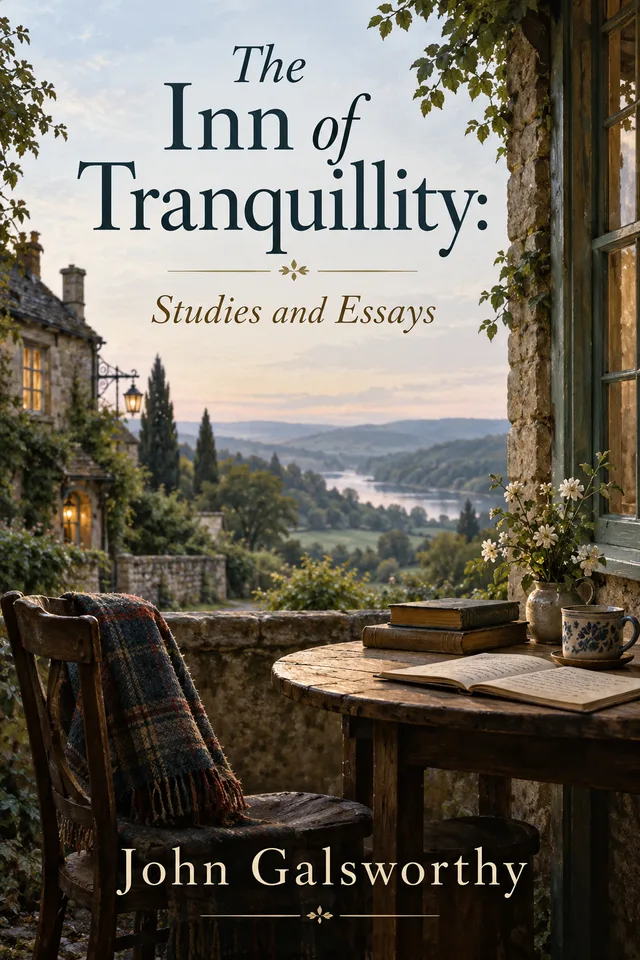
The Inn of Tranquillity: Studies and Essays
English BooksWhale Edition by John Galsworthy
Twenty-six essays turn encounters with workers, animals, landscapes, and theatre into reflections on sympathy, social judgment, and artistic freedom.
- Preview
- A sample from the prepared text
- Formats
- Online reader, EPUB, PDF
- Access
- Library claim
Book introduction
The Inn of Tranquillity: Studies and Essays
John Galsworthy observes human and animal lives with attention to the quiet consequences of prejudice and indifference. The Inn of Tranquillity, Quality, The Grand Jury, and the other pieces range from rural landscapes to work, public institutions, literature, and drama. Twenty-six essays and sketches combine narrative scenes with reflections on artistic responsibility, censorship, sympathy, and the habits that govern social judgment.
BooksWhale edition
How this edition was prepared
This edition is based on a public domain text and has been prepared for digital reading by BooksWhale.
Public domain basis
Why this edition can be shared
John Galsworthy died in 1933. The work was first published in 1912. This edition uses the historical English original from Project Gutenberg, excluding later editorial matter.
Read preview
A sample from the prepared text
Preview selected from the prepared reader text.
Preview chapterTHE INN OF TRANQUILLITYRead preview
Under a burning blue sky, among the pine-trees and junipers, the cypresses and olives of that Odyssean coast, we came one afternoon on a pink house bearing the legend: “Osteria di Tranquillita,”; and, partly because of the name, and partly because we did not expect to find a house at all in those goat-haunted groves above the waves, we tarried for contemplation. To the familiar simplicity of that Italian building there were not lacking signs of a certain spiritual change, for out of the olive-grove which grew to its very doors a skittle-alley had been formed, and two baby cypress-trees were cut into the effigies of a cock and hen. The song of a gramophone, too, was breaking forth into the air, as it were the presiding voice of a high and cosmopolitan mind. And, lost in admiration, we became conscious of the odour of a full-flavoured cigar. Yes—in the skittle-alley a gentleman was standing who wore a bowler hat, a bright brown suit, pink tie, and very yellow boots. His head was round, his cheeks fat and well-coloured, his lips red and full under a black moustache, and he was regarding us through very thick and half-closed eyelids.
Perceiving him to be the proprietor of the high and cosmopolitan mind, we accosted him.
“Good-day!” he replied: “I spik English. Been in Amurrica yes.”
“You have a lovely place here.”
Sweeping a glance over the skittle-alley, he sent forth a long puff of smoke; then, turning to my companion (of the politer sex) with the air of one who has made himself perfect master of a foreign tongue, he smiled, and spoke.
“Too-quiet!”
“Precisely; the name of your inn, perhaps, suggests——”
“I change all that—soon I call it Anglo-American hotel.”
“Ah! yes; you are very up-to-date already.”
He closed one eye and smiled.
Having passed a few more compliments, we saluted and walked on; and, coming presently to the edge of the cliff, lay down on the thyme and the crumbled leaf-dust. All the small singing birds had long been shot and eaten; there came to us no sound but that of the waves swimming in on a gentle south wind. The wanton creatures seemed stretching out white arms to the land, flying desperately from a sea of such stupendous serenity; and over their bare shoulders their hair floated back, pale in the sunshine. If the air was void of sound, it was full of scent—that delicious and enlivening perfume of mingled gum, and herbs, and sweet wood being burned somewhere a long way off; and a silky, golden warmth slanted on to us through the olives and umbrella pines. Large wine-red violets were growing near. On such a cliff might Theocritus have lain, spinning his songs; on that divine sea Odysseus should have passed. And we felt that presently the goat-god must put his head forth from behind a rock.
It seemed a little queer that our friend in the bowler hat should move and breathe within one short flight of a cuckoo from this home of Pan. One could not but at first feelingly remember the old Boer saying: “O God, what things man sees when he goes out without a gun!” But soon the infinite incongruity of this juxtaposition began to produce within one a curious eagerness, a sort of half-philosophical delight. It began to seem too good, almost too romantic, to be true. To think of the gramophone wedded to the thin sweet singing of the olive leaves in the evening wind; to remember the scent of his rank cigar marrying with this wild incense; to read that enchanted name, “Inn of Tranquillity,” and hear the bland and affable remark of the gentleman who owned it—such were, indeed, phenomena to stimulate souls to speculation. And all unconsciously one began to justify them by thoughts of the other incongruities of existence—the strange, the passionate incongruities of youth and age, wealth and poverty, life and death; the wonderful odd bedfellows of this world; all those lurid contrasts which haunt a man's spirit till sometimes he is ready to cry out: “Rather than live where such things can be, let me die!”
Preview chapterMAGPIE OVER THE HILLPreview
I lay often that summer on a slope of sand and coarse grass, close to the Cornish sea, trying to catch thoughts; and I was trying very hard when I saw them coming hand in hand.
She was dressed in blue linen, and a little cloud of honey-coloured hair; her small face had serious eyes the colour of the chicory flowers she was holding up to sniff at—a clean sober little maid, with a very touching upward look of trust. Her companion was a strong, active boy of perhaps fourteen, and he, too, was serious—his deep-set, blacklashed eyes looked down at her with a queer protective wonder; the while he explained in a soft voice broken up between two ages, that exact process which bees adopt to draw honey out of flowers. Once or twice this hoarse but charming voice became quite fervent, when she had evidently failed to follow; it was as if he would have been impatient, only he knew he must not, because she was a lady and younger than himself, and he loved her.
They sat down just below my nook, and began to count the petals of a chicory flower, and slowly she nestled in to him, and he put his arm round her. Never did I see such sedate, sweet lovering, so trusting on her part, so guardianlike on his. They were like, in miniature —-though more dewy,—those sober couples who have long lived together, yet whom one still catches looking at each other with confidential tenderness, and in whom, one feels, passion is atrophied from never having been in use.
Long I sat watching them in their cool communion, half-embraced, talking a little, smiling a little, never once kissing. They did not seem shy of that; it was rather as if they were too much each other's to think of such a thing. And then her head slid lower and lower down his shoulder, and sleep buttoned the lids over those chicory-blue eyes. How careful he was, then, not to wake her, though I could see his arm was getting stiff! He still sat, good as gold, holding her, till it began quite to hurt me to see his shoulder thus in chancery. But presently I saw him draw his arm away ever so carefully, lay her head down on the grass, and lean forward to stare at something. Straight in front of them was a magpie, balancing itself on a stripped twig of thorn-tree. The agitating bird, painted of night and day, was making a queer noise and flirting one wing, as if trying to attract attention. Rising from the twig, it circled, vivid and stealthy, twice round the tree, and flew to another a dozen paces off. The boy rose; he looked at his little mate, looked at the bird, and began quietly to move toward it; but uttering again its queer call, the bird glided on to a third thorn-tree. The boy hesitated then—but once more the bird flew on, and suddenly dipped over the hill. I saw the boy break into a run; and getting up quickly, I ran too.
When I reached the crest there was the black and white bird flying low into a dell, and there the boy, with hair streaming back, was rushing helter-skelter down the hill. He reached the bottom and vanished into the dell. I, too, ran down the hill. For all that I was prying and must not be seen by bird or boy, I crept warily in among the trees to the edge of a pool that could know but little sunlight, so thickly arched was it by willows, birch-trees, and wild hazel. There, in a swing of boughs above the water, was perched no pied bird, but a young, dark-haired girl with, dangling, bare, brown legs. And on the brink of the black water goldened, with fallen leaves, the boy was crouching, gazing up at her with all his soul. She swung just out of reach and looked down at him across the pool. How old was she, with her brown limbs, and her gleaming, slanting eyes? Or was she only the spirit of the dell, this elf-thing swinging there, entwined with boughs and the dark water, and covered with a shift of wet birch leaves. So strange a face she had, wild, almost wicked, yet so tender; a face that I could not take my eyes from. Her bare toes just touched the pool, and flicked up drops of water that fell on the boy's face.
Preview chapterSHEEP-SHEARINGPreview
From early morning there had been bleating of sheep in the yard, so that one knew the creatures were being sheared, and toward evening I went along to see. Thirty or forty naked-looking ghosts of sheep were penned against the barn, and perhaps a dozen still inhabiting their coats. Into the wool of one of these bulky ewes the farmer's small, yellow-haired daughter was twisting her fist, hustling it toward Fate; though pulled almost off her feet by the frightened, stubborn creature, she never let go, till, with a despairing cough, the ewe had passed over the threshold and was fast in the hands of a shearer. At the far end of the barn, close by the doors, I stood a minute or two before shifting up to watch the shearing. Into that dim, beautiful home of age, with its great rafters and mellow stone archways, the June sunlight shone through loopholes and chinks, in thin glamour, powdering with its very strangeness the dark cathedraled air, where, high up, clung a fog of old grey cobwebs so thick as ever were the stalactites of a huge cave. At this end the scent of sheep and wool and men had not yet routed that home essence of the barn, like the savour of acorns and withering beech leaves.
They were shearing by hand this year, nine of them, counting the postman, who, though farm-bred, “did'n putt much to the shearin',” but had come to round the sheep up and give general aid.
Sitting on the creatures, or with a leg firmly crooked over their heads, each shearer, even the two boys, had an air of going at it in his own way. In their white canvas shearing suits they worked very steadily, almost in silence, as if drowsed by the “click-clip, click-clip” of the shears. And the sheep, but for an occasional wriggle of legs or head, lay quiet enough, having an inborn sense perhaps of the fitness of things, even when, once in a way, they lost more than wool; glad too, mayhap, to be rid of their matted vestments. From time to time the little damsel offered each shearer a jug and glass, but no man drank till he had finished his sheep; then he would get up, stretch his cramped muscles, drink deep, and almost instantly sit down again on a fresh beast. And always there was the buzz of flies swarming in the sunlight of the open doorway, the dry rustle of the pollarded lime-trees in the sharp wind outside, the bleating of some released ewe, upset at her own nakedness, the scrape and shuffle of heels and sheep's limbs on the floor, together with the “click-clip, click-clip” of the shears.
As each ewe, finished with, struggled up, helped by a friendly shove, and bolted out dazedly into the pen, I could not help wondering what was passing in her head—in the heads of all those unceremoniously treated creatures; and, moving nearer to the postman, I said:
“They're really very good, on the whole.”
He looked at me, I thought, queerly.
“Yaas,” he answered; “Mr. Molton's the best of them.”
I looked askance at Mr. Molton; but, with his knee crooked round a young ewe, he was shearing calmly.
“Yes,” I admitted, “he is certainly good.”
“Yaas,” replied the postman.
Edging back into the darkness, away from that uncomprehending youth, I escaped into the air, and passing the remains of last year's stacks under the tall, toppling elms, sat down in a field under the bank. It seemed to me that I had food for thought. In that little misunderstanding between me and the postman was all the essence of the difference between that state of civilisation in which sheep could prompt a sentiment, and that state in which sheep could not.
The heat from the dropping sun, not far now above the moorline, struck full into the ferns and long grass of the bank where I was sitting, and the midges rioted on me in this last warmth. The wind was barred out, so that one had the full sweetness of the clover, fast becoming hay, over which the swallows were wheeling and swooping after flies. And far up, as it were the crown of Nature's beautiful devouring circle, a buzzard hawk, almost stationary on the air, floated, intent on something pleasant below him. A number of little hens crept through the gate one by one, and came round me. It seemed to them that I was there to feed them; and they held their neat red or yellow heads to one side and the other, inquiring with their beady eyes, surprised at my stillness. They were pretty with their speckled feathers, and as it seemed to me, plump and young, so that I wondered how many of them would in time feed me. Finding, however, that I gave them nothing to eat, they went away, and there arose, in place of their clucking, the thin singing of air passing through some long tube. I knew it for the whining of my dog, who had nosed me out, but could not get through the padlocked gate. And as I lifted him over, I was glad the postman could not see me—for I felt that to lift a dog over a gate would be against the principles of one for whom the connection of sheep with good behaviour had been too strange a thought. And it suddenly rushed into my mind that the time would no doubt come when the conduct of apples, being plucked from the mother tree, would inspire us, and we should say: “They're really very good!” And I wondered, were those future watchers of apple-gathering farther from me than I, watching sheep-shearing, from the postman? I thought, too, of the pretty dreams being dreamt about the land, and of the people who dreamed them. And I looked at that land, covered with the sweet pinkish-green of the clover, and considered how much of it, through the medium of sheep, would find its way into me, to enable me to come out here and be eaten by midges, and speculate about things, and conceive the sentiment of how good the sheep were. And it all seemed queer. I thought, too, of a world entirely composed of people who could see the sheen rippling on that clover, and feel a sort of sweet elation at the scent of it, and I wondered how much clover would be sown then? Many things I thought of, sitting there, till the sun sank below the moor line, the wind died off the clover, and the midges slept. Here and there in the iris-coloured sky a star crept out; the soft-hooting owls awoke. But still I lingered, watching how, one after another, shapes and colours died into twilight; and I wondered what the postman thought of twilight, that inconvenient state, when things were neither dark nor light; and I wondered what the sheep were thinking this first night without their coats. Then, slinking along the hedge, noiseless, unheard by my sleeping spaniel, I saw a tawny dog stealing by. He passed without seeing us, licking his lean chops.
Table of contents
Inside this edition
- 01THE INN OF TRANQUILLITY
- 02MAGPIE OVER THE HILL
- 03SHEEP-SHEARING
- 04EVOLUTION
- 05RIDING IN MIST
- 06THE PROCESSION
- 07A CHRISTIAN
- 08WIND IN THE ROCKS
- 09MY DISTANT RELATIVE
- 10THE BLACK GODMOTHER
- 11QUALITY
- 12THE GRAND JURY—IN TWO PANELS AND A FRAME
- 13GONE
- 14THRESHING
- 15THAT OLD-TIME PLACE
- 16ROMANCE—THREE GLEAMS
- 17MEMORIES
- 18FELICITY
- 19A NOVELIST'S ALLEGORY
- 20SOME PLATITUDES CONCERNING DRAMA
- 21MEDITATION ON FINALITY
- 22WANTED-SCHOOLING
- 23REFLECTIONS ON OUR DISLIKE OF THINGS AS THEY ARE
- 24THE WINDLESTRAW
- 25ABOUT CENSORSHIP
- 26VAGUE THOUGHTS ON ART
Language availability
Other languages
Additional language editions are not published yet. This section will link to other BooksWhale editions when they become available.
Request another language