English Edition
Education
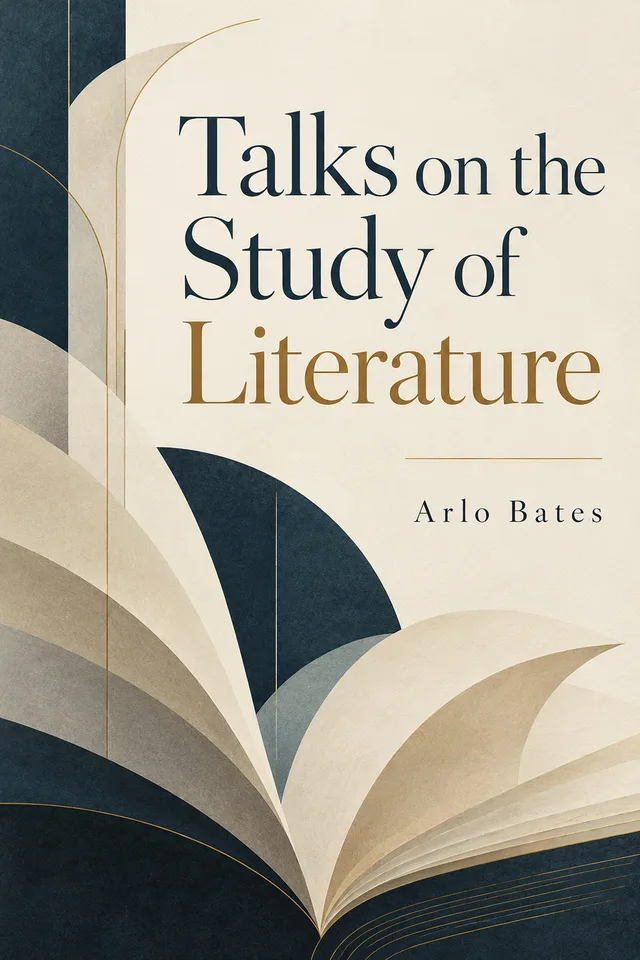
Talks on the Study of Literature
English BooksWhale Edition by Arlo Bates
Eighteen lectures explain literary expression, reading methods, the classics, fiction, and poetry through sustained attention to actual works.
- Preview
- A sample from the prepared text
- Formats
- Online reader, EPUB, PDF
- Access
- Library claim
Book introduction
Talks on the Study of Literature
Arlo Bates asks what literature is, why people study it, and how readers can develop judgment without reducing books to mechanical analysis. His eighteen talks discuss language, implied meaning, the classics, contemporary writing, fiction, and poetry. Originally developed from Lowell Institute lectures, this English work treats reading as an encounter with imaginative form and human experience.
BooksWhale edition
How this edition was prepared
This edition is based on a public domain text and has been prepared for digital reading by BooksWhale.
Public domain basis
Why this edition can be shared
Arlo Bates died in 1918; this work was first published in 1897. The edition uses the original English text digitized by Project Gutenberg, excluding later platform material and annotations.
Read preview
A sample from the prepared text
Preview selected from the prepared reader text.
Preview chapterPrefaceRead preview
This volume is made up from a course of lectures delivered under the auspices of the Lowell Institute in the autumn of 1895. These have been revised and to some extent rewritten, and the division into chapters made; but there has been no essential change.
Preview chapterI WHAT LITERATURE ISPreview
As all life proceeds from the egg, so all discussion must proceed from a definition. Indeed, it is generally necessary to follow definition by definition, fixing the meaning of the terms used in the original explanation, and again explaining the words employed in this exposition.
I once heard a learned but somewhat pedantic man begin to answer the question of a child by saying that a lynx is a wild quadruped. He was allowed to get no further, but was at once asked what a quadruped is. He responded that it is a mammal with four feet. This of course provoked the inquiry what a mammal is; and so on from one question to another, until the original subject was entirely lost sight of, and the lynx disappeared in a maze of verbal distinctions as completely as it might have vanished in the tangles of the forest primeval. I feel that I am not wholly safe from danger of repeating the experience of this well-meaning pedant if I attempt to give a definition of literature. The temptation is strong to content myself with saying: "Of course we all know what literature is." The difficulty which I have had in the endeavor to frame a satisfactory explanation of the term has convinced me, however, that it is necessary to assume that few of us do know, and has impressed upon me the need of trying to make clear what the word means to me. If my statement seem insufficient for general application, it will at least show the sense which I shall give to "literature" in these talks.
In its most extended signification literature of course might be taken to include whatever is written or printed; but our concern is with that portion only which is indicated by the name "polite literature," or by the imported term "belles-lettres,"—both antiquated though respectable phrases. In other words, I wish to confine my examination to those written works which can properly be brought within the scope of literature as one of the fine arts.
Undoubtedly we all have a general idea of the limitations which are implied by these various terms, and we are not without a more or less vague notion of what is indicated by the word literature in its most restricted and highest sense. The important point is whether our idea is clear and well realized. We have no difficulty in saying that one book belongs to art and that another does not; but we often find ourselves perplexed when it comes to telling why. We should all agree that "The Scarlet Letter" is literature and that the latest sensational novel is not,—but are we sure what makes the difference? We know that Shakespeare wrote poetry and Tupper doggerel, but it by no means follows that we can always distinguish doggerel from poetry; and while it is not perhaps of consequence whether we are able to inform others why we respect the work of one or another, it is of much importance that we be in a position to justify our tastes to ourselves. It is not hard to discover whether we enjoy a book, and it is generally possible to tell why we like it; but this is not the whole of the matter. It is necessary that we be able to estimate the justice of our preferences. We must remember that our liking or disliking is not only a test of the book,—but is a test of us as well. There is no more accurate gauge of the moral character of a man than the nature of the books which he really cares for. He who would progress by the aid of literature must have reliable standards by which to judge his literary feelings and opinions; he must be able to say: "My antipathy to such a work is justified by this or by that principle; my pleasure in that other is fine because for these reasons the book itself is noble."
Preview chapterII LITERARY EXPRESSIONPreview
So much, then, for what literature must express; it is well now to examine for a little the manner of expression. To feel genuine emotion is not all that is required of a writer. Among artists cannot be reckoned
One born with poet's heart in sad eclipse Because unmatched with poet's tongue; Whose song impassioned struggles to his lips, Yet dies, alas! unsung.
He must be able to sing the song; to make the reader share the throbbing of his heart. All men feel; the artist is he who can by the use of conventions impart his feelings to the world. The musician uses conventions of sound, the painter conventions of color, the sculptor conventions of form, and the writer must employ the means most artificial of all, the conventions of language.
Here might be considered, if there were space, the whole subject of artistic technique; but it is sufficient for our purposes to notice that the test of technical excellence is the completeness with which the means are adapted to the end sought. The crucial question in regard to artistic workmanship is: "Does it faithfully and fully convey the emotion which is the essence of the work?" A work of art must make itself felt as well as intellectually understood; it must reach the heart as well as the brain. If a picture, a statue, a piece of music, or a poem provokes your admiration without touching your sensibilities, there is something radically wrong with the work—or with you.
First of all, then, expression must be adequate. If it is slovenly, incomplete, unskillful, it fails to impart the emotion which is its purpose. We have all sat down seething with excitement and endeavored to get our feelings upon paper, only to discover that our command of ourselves and of technical means was not sufficient to allow us to phrase adequately that which yet we felt most sincerely. It is true that style is in a sense a subordinate matter, but it is none the less an essential one. It is manifestly of little consequence to the world what one has to say if one cannot say it. We cannot be thrilled by the song which the dumb would sing had he but voice.
Yet it is necessary to remember that although expression must be adequate, it must also be subordinate. It is a means and not an end, and the least suspicion of its having been put first destroys our sense of the reality of the feeling it embodies. If an actress in moments of impassioned declamation is detected arranging her draperies, her art no longer carries conviction. Nobody feeling the heart-swelling words of Queen Katharine, for instance, could while speaking them be openly concerned about the effective disposition of her petticoats. The reader of too intricate and elaborate verse, such as the French forms of triolet, rondeau, rondel, and so on, has an instinctive perception that a poet whose attention was taken up with the involved and artfully difficult versification could not have been experiencing any deep passion, no matter how strongly the verse protests that he has. Expression obviously artful instantly arouses suspicion that it has been wrought for its own sake only.
Technical excellence which displays the cleverness of the artist rather than imparts the emotion which is its object, defeats its own end. A book so elaborated that we feel that the author was absorbed in perfection of expression rather than in what he had to express leaves us cold and unmoved, if it does not tire us. The messenger has usurped the attention which belonged to the message. It is not impossible that I shall offend some of you when I say that Walter Pater's "Marius the Epicurean" seems to me a typical example of this sort of book. The author has expended his energies in exquisite excesses of language; he has refined his style until it has become artfully inanimate. It is like one of the beautiful glass flowers in the Harvard Museum. It is not a living rose. It is no longer a message spoken to the heart of mankind; it is a brilliant exercise in technique.
Table of contents
Inside this edition
- 01Preface
- 02I WHAT LITERATURE IS
- 03II LITERARY EXPRESSION
- 04III THE STUDY OF LITERATURE
- 05IV WHY WE STUDY LITERATURE
- 06V FALSE METHODS
- 07VI METHODS OF STUDY
- 08VII THE LANGUAGE OF LITERATURE
- 09VIII THE INTANGIBLE LANGUAGE
- 10IX THE CLASSICS
- 11X THE VALUE OF THE CLASSICS
- 12XI THE GREATER CLASSICS
- 13XII CONTEMPORARY LITERATURE
- 14XIII NEW BOOKS AND OLD
- 15XIV FICTION
- 16XV FICTION AND LIFE
- 17XVI POETRY
- 18XVII THE TEXTURE OF POETRY
- 19XVIII POETRY AND LIFE
Language availability
Other languages
Additional language editions are not published yet. This section will link to other BooksWhale editions when they become available.
Request another language