English Edition
Literature
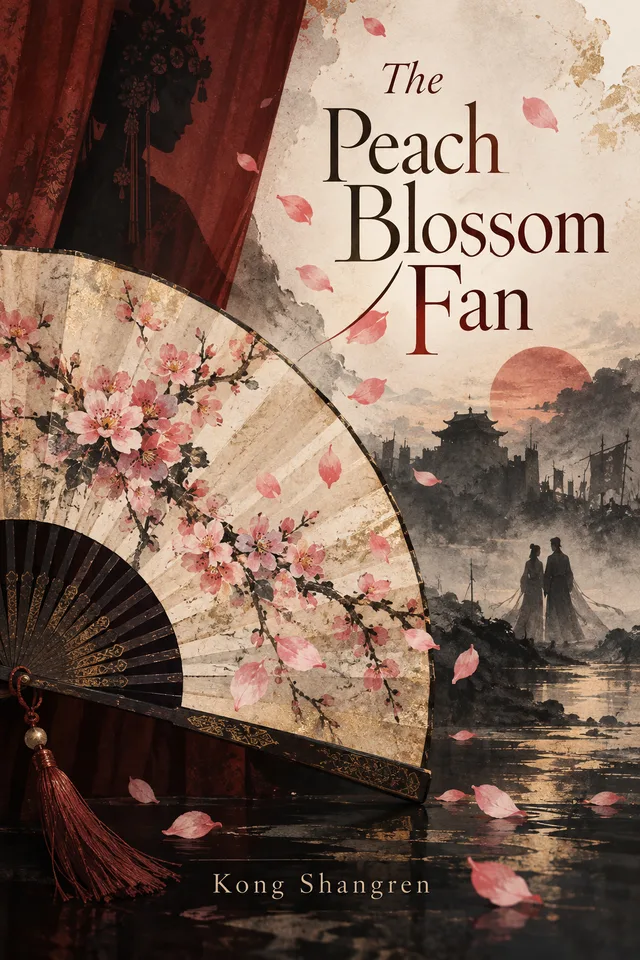
The Peach Blossom Fan
English BooksWhale Edition by Kong Shangren
Original title: 桃花扇
A major Chinese historical drama where romance, loyalty, art, and dynastic collapse meet.
- Preview
- A sample from the prepared text
- Formats
- Online reader, EPUB, PDF
- Access
- Library claim
Book introduction
The Peach Blossom Fan
The Peach Blossom Fan transforms the fall of the Ming dynasty into a dramatic world of love, music, political loyalty, betrayal, and historical memory. This English edition presents Kong Shangren’s classic play for readers of Chinese drama, late imperial history, and literary tragedy.
BooksWhale edition
How this edition was prepared
This edition is based on a public domain text and has been prepared for digital reading by BooksWhale.
Public domain basis
Why this edition can be shared
Kong Shangren died in 1718, and The Peach Blossom Fan was completed around 1699. These dates support the public-domain basis for the Chinese source text; this English edition uses an authorized translation prepared from that source.
Read preview
A sample from the prepared text
Preview selected from the prepared reader text.
Preview chapterFull textRead preview
The Peach Blossom Fan
孔尚任
Preview chapterForewordPreview
Kong Shangren’s The Peach Blossom Fan (桃花扇) stands as one of the quintessential works of Chinese classical drama. Written in the late 17th century during the early Qing dynasty, this play not only exemplifies the artistry of Chinese theater but also offers profound insights into the turbulence of Chinese history, particularly the fall of the Ming dynasty and the rise of the Qing. The play is set against the backdrop of the tragic historical events of the Ming-Qing transition, a period marked by civil strife, war, and the eventual collapse of the Ming dynasty. The central narrative revolves around the tragic love story of Hou Fangyu, a loyal Ming official, and Li Xiangjun, a beautiful and talented courtesan. Through this romance, Kong Shangren explores themes of loyalty, betrayal, patriotism, and the ravaging consequences of political upheaval. At its core, The Peach Blossom Fan is both a poignant personal tale of love and a sweeping historical epic that intertwines the fates of individuals and nations.
Kong’s writing is celebrated for its poetic quality and emotional depth. The play incorporates rich, lyrical language that is characteristic of kunqu opera, the traditional Chinese theater style in which it was originally performed. The delicate interplay of poetry, song, and dance not only highlights the emotional landscape of the characters but also enhances the audience’s understanding of the socio-political realities of the time. One of the play’s most enduring aspects is its treatment of loyalty and love. Hou Fangyu’s unyielding devotion to the fallen Ming dynasty, mirrored by his love for Li Xiangjun, provides a powerful exploration of personal and political loyalty. The titular "peach blossom fan" itself, which serves as a symbol of the characters’ unspoken love, becomes an emblem of the fleeting nature of beauty and life, as well as the unrelenting passage of time.
Preview chapterPrefacePreview
Kangxi, Jiazi Year, August [Butterfly Loves Flowers] (Secondary Male wearing a felt cap, Taoist robe, and white beard) Who among the antiques is like me? Not jade, not bronze, my face covered in patina. Left with only the remnants of soul and spirit, with no companions, and people laugh and point—why must I hide? Old resentments fill my chest, wiped clean with a single stroke. Encountering wine and song, anywhere I go, I leave traces. Filial sons, loyal ministers, all matters are settled. Do not think of eating the ginseng fruit again. In the beautiful world of the Tang and Yu eras, flowers bloom in the Jiazi Year; there are no bandits in the mountains, and immortals live on the earth. I, an old man, was once a ceremonial official in the Nanjing Taichang Temple. My rank is not high, and my name can remain hidden. I enjoy a life free from disaster, living ninety-seven years, witnessing countless rises and falls, now reaching the Jiazi Year of the Shangyuan Era. Yao and Shun are in power, Yu governs the lands; everywhere, the four people live in peace and happiness, and every year, the five grains are plentiful.
Now it is the twenty-third year of Kangxi, and I have witnessed twelve auspicious signs. [Supporting Role asks] What are these auspicious signs? [Answer] (Counting on fingers) The river brings forth the "Map of the River," the Luo brings forth the "Book of the Luo," the auspicious star shines, a cloud of celebration appears, sweet dew descends, the healing rain falls, phoenixes gather, unicorns roam, mistletoe buds, sacred herbs grow, the sea is calm, and the Yellow River is clear. All these signs are complete—how can we not celebrate? I am fortunate to live in such a prosperous time, traveling far and wide. Yesterday, in the Taiping Garden, I saw a new legendary work, titled The Peach Blossom Fan, which deals with the events of the late Ming Dynasty in Nanjing. It uses the theme of separation and reunion to write about the rise and fall of the nation, based on real events and people, with ample evidence. Not only have I heard of it, I have also witnessed it. What is even more delightful is that the play also included my old, frail appearance as a Secondary Male character, making me laugh, cry, get angry, and scold. The guests in the room had no idea that the old man in front of them was the same person portrayed in the play!
[Supporting Role asks] May I ask, who is the author of this fine play? [Answer] You don’t know? The great lyricist of the past never used their surname. Just look at how the work mixes praise and criticism; it is a work of the spring and autumn period, passed down from ancestors. It can be sung and chanted; it is elegant and appropriate, surely influenced by family traditions! [Supporting Role] From what you say, it must be the work of the Yunting Mountain Man. [Answer] Who do you think it is? [Supporting Role] Today, at this elegant gathering, the play will be performed. Since you are an old friend and have heard the new music, why not recount the beginning and end of this legend for us all to hear, and let us refresh our ears? [Answer] I have a Daoist priest’s Man Ting Fang lyric to sing for you: Man Ting Fang, the young lord Hou Sheng, from Molu, a distinguished scholar, accompanied by a southern beauty;
Rumors whisper harm, the phoenix separates in one night. Then came a great upheaval, with the Jianghuai military governors in turmoil. A ruler fell, while treacherous ministers caused chaos. A good marriage became impossible to continue, the tower swayed violently, and the prison deepened. But it was thanks to Master Su and Elder Liu, who saved him with great effort. In the dead of night, the lord fled in haste, who will mourn his loyal soul on the smoke-filled waves? The Peach Blossom Fan and the altar of fasting were shattered, I am lost in guiding the way. [Supporting Role] Wonderful, wonderful! The melody is so resounding; I can’t grasp it all at once, please summarize in a few sentences. [Answer] Let me explain: The treacherous horse, Ruan Zhong, hides a long sword; Clever Liu Su weaves the secret thread of communication; Young Lord Hou severed his ties with the fleeting beauty; Daoist Zhang concluded the case of the nation’s rise and fall.
Table of contents
Inside this edition
- 01Full text
- 02Foreword
- 03Preface
- 04Chapter 1: Listening to the Weeds
- 05Chapter 2: Singing Songs
- 06Chapter 3: The Fooling of Ding
- 07Chapter 4: The Play of Investigation
- 08Chapter 5: Visiting the Jade
- 09Chapter 6: Sleepy Fragrance
- 10Chapter 7: The Bridesmaid’s Wardrobe
- 11Chapter 8: The Festival Celebration
- 12Chapter 9: The Command of the Army
- 13Chapter 10: The Letter of Repair
- 14Chapter 11: The Letter to the General
- 15Chapter 12: Farewell to the Academy
- 16Chapter 13: The Cry of the Lord
- 17Chapter 14: Resisting Treason
- 18Chapter 15: Welcoming the Emperor
- 19Chapter 16: The Imperial Court
- 20Chapter 17: Rejecting Matchmaker
- 21Chapter 18: The Struggle for Power
- 22Chapter 19: Peace and War
- 23Chapter 20: Moving the Troops
- 24Chapter 21: Idle Talk
- 25Chapter 22: Solitary Song
- 26Chapter 23: Charming the Seat
- 27Chapter 24: Guarding the Tower
- 28Chapter 25: The Fan
- 29Chapter 26: The Scolding Banquet
- 30Chapter 27: Selecting the Best
- 31Chapter 28: Deceiving the General
- 32Chapter 29: Meeting on the Boat
- 33Chapter 30: Painting the Picture
- 34Chapter 31: The Society Meeting
- 35Chapter 32: Returning to the Mountain
- 36Chapter 33: The Grass Edict
- 37Chapter 34: The Altar Ceremony
- 38Chapter 35: The Prison
- 39Chapter 36: Interception at the Cliff
- 40Chapter 37: The Oath of the Army
- 41Chapter 38: Fleeing the Disaster
- 42Chapter 39: The Stolen Treasure
- 43Chapter 40: The River's Descent
- 44Chapter 41: Seeking Truth
- 45Chapter 42: Entering the Dao
Language availability
Other languages
Additional language editions are not published yet. This section will link to other BooksWhale editions when they become available.
Request another language