English Edition
Economics
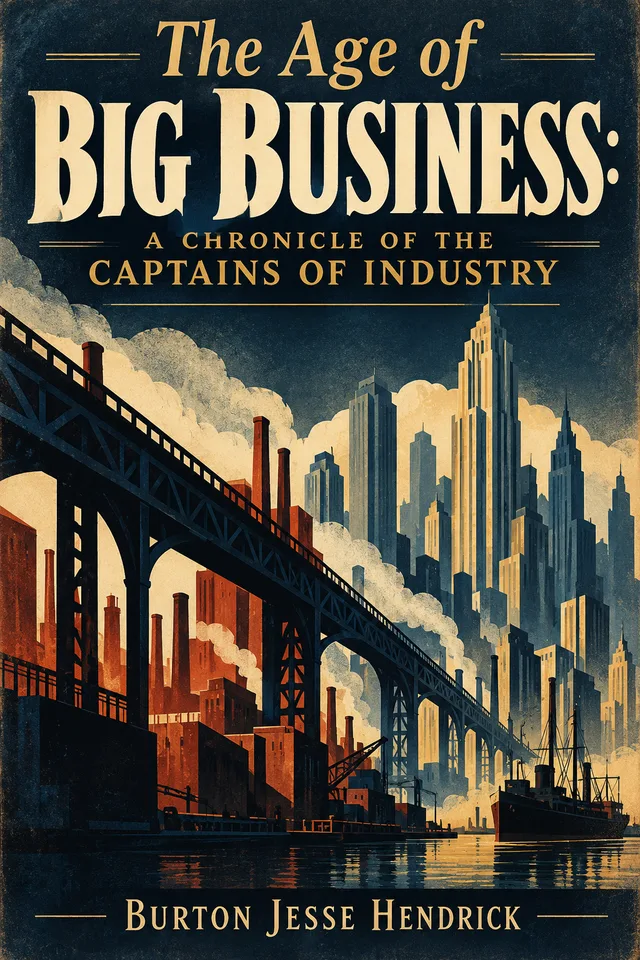
The Age of Big Business: A Chronicle of the Captains of Industry
English BooksWhale Edition by Burton Jesse Hendrick
Industrial expansion, trusts, steel, telephones, utilities, farm machinery, and automobiles transform the United States after the Civil War.
- Preview
- A sample from the prepared text
- Formats
- Online reader, EPUB, PDF
- Access
- Library claim
Book introduction
The Age of Big Business: A Chronicle of the Captains of Industry
Burton Jesse Hendrick traces the rise of large American businesses through seven accounts of industrial change. Beginning with the economy after the Civil War, he turns to oil, steel, the telephone, public utilities, agricultural machinery, and the automobile. The narrative follows entrepreneurs, technical systems, and expanding markets, offering a contemporary historical interpretation of the institutions that reshaped work and everyday life.
BooksWhale edition
How this edition was prepared
This edition is based on a public domain text and has been prepared for digital reading by BooksWhale.
Public domain basis
Why this edition can be shared
Burton Jesse Hendrick died in 1949; this work was first published in 1919. This edition uses the public-domain English original from Project Gutenberg, excluding later editorial additions.
Read preview
A sample from the prepared text
Preview selected from the prepared reader text.
Preview chapterCHAPTER I. INDUSTRIAL AMERICA AT THE END OF THE CIVIL WARRead preview
A comprehensive survey of the United States, at the end of the Civil War, would reveal a state of society which bears little resemblance to that of today. Almost all those commonplace fundamentals of existence, the things that contribute to our bodily comfort while they vex us with economic and political problems, had not yet made their appearance. The America of Civil War days was a country without transcontinental railroads, without telephones, without European cables, or wireless stations, or automobiles, or electric lights, or sky-scrapers, or million-dollar hotels, or trolley cars, or a thousand other contrivances that today supply the conveniences and comforts of what we call our American civilization. The cities of that period, with their unsewered and unpaved streets, their dingy, flickering gaslights, their ambling horse-cars, and their hideous slums, seemed appropriate settings for the unformed social life and the rough-and-ready political methods of American democracy. The railroads, with their fragile iron rails, their little wheezy locomotives, their wooden bridges, their unheated coaches, and their kerosene lamps, fairly typified the prevailing frontier business and economic organization. But only by talking with the business leaders of that time could we have understood the changes that have taken place in fifty years. For the most part we speak a business language which our fathers and grandfathers would not have comprehended. The word "trust" had not become a part of their vocabulary; "restraint of trade" was a phrase which only the antiquarian lawyer could have interpreted; "interlocking directorates," "holding companies," "subsidiaries," "underwriting syndicates," and "community of interest"—all this jargon of modern business would have signified nothing to our immediate ancestors. Our nation of 1865 was a nation of farmers, city artisans, and industrious, independent business men, and small-scale manufacturers. Millionaires, though they were not unknown, did not swarm all over the land. Luxury, though it had made great progress in the latter years of the war, had not become the American standard of well-being. The industrial story of the United States in the last fifty years is the story of the most amazing economic transformation that the world has ever known; a change which is fitly typified in the evolution of the independent oil driller of western Pennsylvania into the Standard Oil Company, and of the ancient open air forge on the banks of the Allegheny into the United States Steel Corporation.
The slow, unceasing ages had been accumulating a priceless inheritance for the American people. Nearly all of their natural resources, in 1865, were still lying fallow, and even undiscovered in many instances. Americans had begun, it is true, to exploit their more obvious, external wealth, their forests and their land; the first had made them one of the world's two greatest shipbuilding nations, while the second had furnished a large part of the resources that had enabled the Federal Government to fight what was, up to that time, the greatest war in history. But the extensive prairie plains whose settlement was to follow the railroad extensions of the sixties and the seventies—Kansas, Nebraska, Iowa, Oklahoma, Minnesota, the Dakotas—had been only slightly penetrated. This region, with a rainfall not too abundant and not too scanty, with a cultivable soil extending from eight inches to twenty feet under the ground, with hardly a rock in its whole extent, with scarcely a tree, except where it bordered on the streams, has been pronounced by competent scientists the finest farming country to which man has ever set the plow. Our mineral wealth was likewise lying everywhere ready to the uses of the new generation. The United States now supplies the world with half its copper, but in 1865 it was importing a considerable part of its own supply. It was not till 1859 that the first "oil gusher" of western Pennsylvania opened up an entirely new source of wealth. Though we had the largest coal deposits known to geologists, we were bringing large supplies of this indispensable necessity from Nova Scotia. It has been said that coal and iron are the two mineral products that have chiefly affected modern civilization. Certainly the nations that have made the greatest progress industrially and commercially—England, Germany, America—are the three that possess these minerals in largest amount. From sixty to seventy per cent of all the known coal deposits in the world were located in our national domain. Nature had given no other nation anything even remotely comparable to the four hundred and eighty square miles of anthracite in western Pennsylvania and West Virginia. Enormous fields of bituminous lay in those Appalachian ranges extending from Pennsylvania to Alabama, in Michigan, in the Rocky Mountains, and in the Pacific regions. In speaking of our iron it is necessary to use terms that are even more extravagant. From colonial times Americans had worked the iron ore plentifully scattered along the Atlantic coast, but the greatest field of all, that in Minnesota, had not been scratched. From the settlement of the country up to 1869 it had mined only 50,000,000 tons of iron ore, while up to 1910 we had produced 685,000,000 tons. The streams and waterfalls that, in the next sixty years, were to furnish the power that would light our cities, propel our street-cars, drive our transcontinental trains across the mountains, and perform numerous domestic services, were running their useless courses to the sea.
Preview chapterCHAPTER II. THE FIRST GREAT AMERICAN TRUSTPreview
When Cornelius Vanderbilt died in 1877, America's first great industrial combination had become an established fact. In that year the Standard Oil Company of Ohio controlled at least ninety per cent of the business of refining and marketing petroleum. A new portent had appeared in our economic life, a phenomenon that was destined to affect not only the social and business existence of the every-day American but even his political and legal institutions.
It seems natural enough at the present time to refer to petroleum as an indispensable commodity. At the beginning of the Civil War, however, any such description would have been absurd. Though petroleum was not unknown, millions of American households were still burning candles, whale oil, and other illuminants. Not until 1859 did our ancestors realize that, concealed in the rocky of western Pennsylvania, lay apparently inexhaustible quantities of a liquid which, when refined, would give a light exceeding in brilliancy anything they had hitherto known. The mere existence of petroleum, it is true, had been a familiar fact for centuries. Herodotus mentions the oil pits of Babylon, and Pliny informs us that this oil was actually used for lighting in certain parts of Sicily. It had never become an object of universal use, simply because no one had discovered how to obtain it in sufficient quantities. No one had suspected, indeed, that petroleum existed practically in the form of great subterranean rivers, lakes, or even seas. For ages this great natural treasure had been seeking to advertise its presence by occasionally seeping through the rocks and appearing on the surface of watercourses. It had been doing this all over the world—in China, in Russia, in Germany, in England, in our own country. Yet our obtuse ancestors had for centuries refused to take the hint. We can find much cause for self-congratulation in that it was apparently the American mind that first acted upon this obvious suggestion.
In Venango County, Pennsylvania, petroleum floated in such quantities on the surface of a branch of the Allegheny River that this small watercourse had for generations been known as Oil Creek. The neighboring farmers used to collect the oil and use it to grease their wagon axles; others, more enterprising, made a business of gathering the floating substance, packing it in bottles, and selling it broadcast as a medicine. The most famous of these concoctions, "Seneca Oil," was widely advertised as a sure cure for rheumatism, and had an extensive sale in this country. "Kier's Rock Oil" afterwards had an even more extended use. Samuel M. Kier, who exploited this comprehensive cure-all, made no lasting contributions to medical science, but his method of obtaining his medicament led indirectly to the establishment of a great industry. In this western Pennsylvania region salt manufacture had been a thriving business for many years; the salt was obtained from salt water by means of artesian wells. This salt water usually came to the surface contaminated with that same evil-smelling oil which floated so constantly on top of the rivers and brooks. The salt makers spent much time and money "purifying" their water from this substance, never apparently suspecting that the really valuable product of their wells was not the salt water they so carefully preserved, but the petroleum which they threw away. Samuel M. Kier was originally a salt manufacturer; more canny than his competitors, he sold the oil which came up with his water as a patent medicine. In order to give a mysterious virtue to this remedy, Kier printed on his labels the information that it had been "pumped up with salt water about four hundred feet below the earth's surface." His labels also contained the convincing picture of an artesian well—a rough woodcut which really laid the foundation of the Standard Oil Company.
In the late fifties Mr. George H. Bissell had become interested in rock oil, not as an embrocation and as a cure for most human ills, but as a light-giving material. A professor at Dartmouth had performed certain experiments with this substance which had sunk deeply into Bissell's imagination. So convinced was this young man that he could introduce petroleum commercially that he leased certain fields in western Pennsylvania and sent a specimen of the oil to Benjamin Silliman, Jr., Professor of Chemistry at Yale. Professor Silliman gave the product a more complete analysis than it had ever previously received and submitted a report which is still the great classic in the scientific literature of petroleum. This report informed Bissell that the substance, could be refined cheaply and easily, and that, when refined, it made a splendid illuminant, besides yielding certain byproducts, such as paraffin and naphtha, which had a great commercial value. So far, Bissell's enterprise seemed to promise success, yet the great problem still remained: how could he obtain this rock oil in amounts large enough to make his enterprise a practical one? A chance glimpse of Kier's label, with its picture of an artesian well, supplied Bissell with his answer. He at once sent E. L. Drake into the oil-fields with a complete drilling equipment, to look, not for saltwater, but for oil. Nothing seems quite so obvious today as drilling a well into the rock to discover oil, yet so strange was the idea in Drake's time that the people of Titusville, where he started work, regarded him as a lunatic and manifested a hostility to his enterprise that delayed operations for several months. Yet one day in August, 1859, the coveted liquid began flowing from "Drake's folly" at the rate of twenty-five barrels a day.
Preview chapterCHAPTER III. THE EPIC OF STEELPreview
It was the boast of a Roman Emperor that he had found the Eternal City brick and left it marble. Similarly the present generation of Americans inherited a country which was wood and have transformed it into steel. That which chiefly distinguishes the physical America of today from that of forty years ago is the extensive use of this metal. Our fathers used steel very little in railway transportation; rails and locomotives were usually made of iron, and wood was the prevailing material for railroad bridges. Steel cars, both for passengers and for freight, are now everywhere taking the place of the more flimsy substance. We travel today in steel subways, transact our business in steel buildings, and live in apartments and private houses which are made largely of steel. The steel automobile has long since supplanted the wooden carriage; the steel ship has displaced the iron and wooden vessel. The American farmer now encloses his lands with steel wire, the Southern planter binds his cotton with steel ties, and modern America could never gather her abundant harvests without her mighty agricultural implements, all of which are made of steel. Thus it is steel that shelters us, that transports us, that feeds us, and that even clothes us.
This substance is such a commonplace element in our lives that we take it for granted, like air and water and the soil itself; yet the generation that fought the Civil War knew practically nothing of steel. They were familiar with this metal only as a curiosity or as a material used for the finer kinds of cutlery. How many Americans realize that steel was used even less in 1865 than aluminum is used today? Nearly all the men who have made the American Steel Age—such as Carnegie, Phipps, Frick, and Schwab—are still living and some of them are even now extremely active. Thirty-five years ago steel manufacture was regarded, even in this country, as an almost exclusively British industry. In 1870 the American steel maker was the parvenu of the trade. American railroads purchased their first steel rails in England, and the early American steel makers went to Sheffield for their expert workmen. Yet, in little more than ten years, American mills were selling agricultural machinery in that same English town, American rails were displacing the English product in all parts of the world, American locomotives were drawing English trains on English railways, and American steel bridges were spanning the Ganges and the Nile. Indeed, the United States soon surpassed England. In the year before the World War the United Kingdom produced 7,500,000 tons of steel a year, while the United States produced 32,000,000 tons. Since the outbreak of the Great War, the United States has probably made more steel than all the rest of the world put together. "The nation that makes the cheapest steel," says Mr. Carnegie, "has the other nations at its feet." When some future Buckle analyzes the fundamental facts in the World War, he may possibly find that steel precipitated it and that steel determined its outcome.
Three circumstances contributed to the rise of this greatest of American industries: a new process for cheaply converting molten pig iron into steel, the discovery of enormous deposits of ore in several sections of the United States, and the entrance into the business of a hardy and adventurous group of manufacturers and business men. Our steel industry is thus another triumph of American inventive skill, made possible by the richness of our mineral resources and the racial energy of our people. An elementary scientific discovery introduced the great steel age. Steel, of course, is merely iron which has been refined—freed from certain impurities, such as carbon, sulphur, and phosphorus. We refine our iron and turn it into steel precisely as we refine our sugar and petroleum. From the days of Tubal Cain the iron worker had known that heat would accomplish this purification; but heat, up to almost 1865, was an exceedingly expensive commodity. For ages iron workers had obtained the finer metal by applying this heat in the form of charcoal, never once realizing that unlimited quantities of another fuel existed on every hand. The man who first suggested that so commonplace a substance as air, blown upon molten pig iron, would produce the intensest heat and destroy its impurities, made possible our steel railroads, our steel ships, and our steel cities. When William Kelly, an owner of iron works near Eddyville, Kentucky, first proposed this method in 1847, he met with the ridicule which usually greets the pioneer inventor. When Henry Bessemer, several years afterward, read a paper before the British Association for the Advancement of Science, in which he advocated the same principle, he was roared down as "a crazy Frenchman," and the savants were so humiliated by the suggestion that they voted to make no record of his "silly paper" in their official minutes. Yet these two men, the American Kelly and the Englishman Bessemer, were the creators of modern steel. The records of the American Patent Office clearly show that Kelly made "Bessemer" steel many years before Bessemer. In 1870 the American Government refused to extend Bessemer's patent in this country on the ground that William Kelly had a prior claim; in spite of this, Bessemer was undoubtedly the man who developed the mechanical details and gave the process a universal standing.
Table of contents
Inside this edition
- 01CHAPTER I. INDUSTRIAL AMERICA AT THE END OF THE CIVIL WAR
- 02CHAPTER II. THE FIRST GREAT AMERICAN TRUST
- 03CHAPTER III. THE EPIC OF STEEL
- 04CHAPTER IV. THE TELEPHONE: "AMERICA'S MOST POETICAL ACHIEVEMENT"
- 05CHAPTER V. THE DEVELOPMENT OF PUBLIC UTILITIES
- 06CHAPTER VI. MAKING THE WORLD'S AGRICULTURAL MACHINERY
- 07CHAPTER VII. THE DEMOCRATIZATION OF THE AUTOMOBILE
Language availability
Other languages
Additional language editions are not published yet. This section will link to other BooksWhale editions when they become available.
Request another language