English Edition
Science
The Age of Invention
English BooksWhale Edition by Holland Thompson
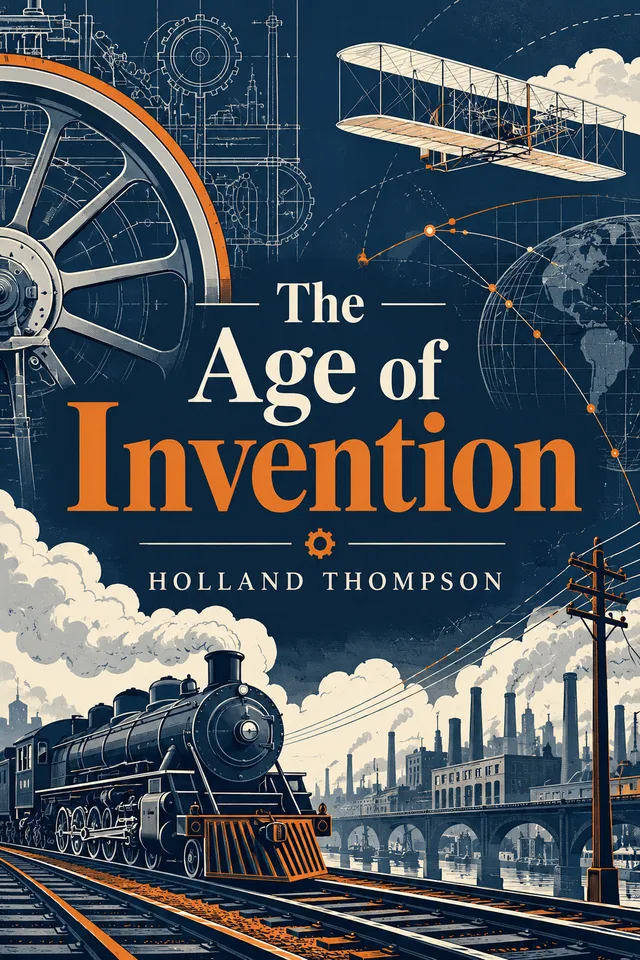
Inventors, workshops, factories, railways, communication networks, and aviation shape this account of mechanical invention and American industrial development.
- Preview
- A sample from the prepared text
- Formats
- Online reader, EPUB, PDF
- Access
- Library claim
Book introduction
The Age of Invention
Holland Thompson traces a succession of inventions from Benjamin Franklin and Eli Whitney to steam power, textile machinery, railroads, telegraphy, and flight. The narrative connects individual experimenters with the practical problems and commercial conditions surrounding their work. Ten chapters follow the expansion of mechanical power and communication, showing how inventions developed through collaboration, rivalry, persistence, and changing industrial needs.
BooksWhale edition
How this edition was prepared
This edition is based on a public domain text and has been prepared for digital reading by BooksWhale.
Public domain basis
Why this edition can be shared
Holland Thompson died in 1940. This edition uses the public-domain English original published in 1921, with later editorial notes and publisher material excluded.
Read preview
A sample from the prepared text
Preview selected from the prepared reader text.
Preview chapterFull textRead preview
The Age of Invention
Preview chapterCHAPTER I. BENJAMIN FRANKLIN AND HIS TIMESPreview
On Milk Street, in Boston, opposite the Old South Church, lived Josiah Franklin, a maker of soap and candles. He had come to Boston with his wife about the year 1682 from the parish of Ecton, Northamptonshire, England, where his family had lived on a small freehold for about three hundred years. His English wife had died, leaving him seven children, and he had married a colonial girl, Abiah Folger, whose father, Peter Folger, was a man of some note in early Massachusetts.
Josiah Franklin was fifty-one and his wife Abiah thirty-nine, when the first illustrious American inventor was born in their house on Milk Street, January 17, 1706. He was their eighth child and Josiah's tenth son and was baptized Benjamin. What little we know of Benjamin's childhood is contained in his "Autobiography", which the world has accepted as one of its best books and which was the first American book to be so accepted. In the crowded household, where thirteen children grew to manhood and womanhood, there were no luxuries. Benjamin's period of formal schooling was less than two years, though he could never remember the time when he could not read, and at the age of ten he was put to work in his father's shop.
Benjamin was restless and unhappy in the shop. He appeared to have no aptitude at all for the business of soap making. His parents debated whether they might not educate him for the ministry, and his father took him into various shops in Boston, where he might see artisans at work, in the hope that he would be attracted to some trade. But Benjamin saw nothing there that he wished to engage in. He was inclined to follow the sea, as one of his older brothers had done.
His fondness for books finally determined his career. His older brother James was a printer, and in those days a printer was a literary man as well as a mechanic. The editor of a newspaper was always a printer and often composed his articles as he set them in type; so "composing" came to mean typesetting, and one who sets type is a compositor. Now James needed an apprentice. It happened then that young Benjamin, at the age of thirteen, was bound over by law to serve his brother.
James Franklin printed the "New England Courant", the fourth newspaper to be established in the colonies. Benjamin soon began to write articles for this newspaper. Then when his brother was put in jail, because he had printed matter considered libelous, and forbidden to continue as the publisher, the newspaper appeared in Benjamin's name.
The young apprentice felt that his brother was unduly severe and, after serving for about two years, made up his mind to run away. Secretly he took passage on a sloop and in three days reached New York, there to find that the one printer in the town, William Bradford, could give him no work. Benjamin then set out for Philadelphia. By boat to Perth Amboy, on foot to Burlington, and then by boat to Philadelphia was the course of his journey, which consumed five days. On a Sunday morning in October, 1723, the tired, hungry boy landed upon the Market Street wharf, and at once set out to find food and explore America's metropolis.
Benjamin found employment with Samuel Keimer, an eccentric printer just beginning business, and lodgings at the house of Read, whose daughter Deborah was later to become his wife. The intelligent young printer soon attracted the notice of Sir William Keith, Governor of Pennsylvania, who promised to set him up in business. First, however, he must go to London to buy a printing outfit. On the Governor's promise to send a letter of credit for his needs in London, Franklin set sail; but the Governor broke his word, and Franklin was obliged to remain in London nearly two years working at his trade. It was in London that he printed the first of his many pamphlets, an attack on revealed religion, called "A Dissertation on Liberty and Necessity, Pleasure and Pain." Though he met some interesting persons, from each of whom he extracted, according to his custom, every particle of information possible, no future opened for him in London, and he accepted an offer to return to Philadelphia with employment as a clerk. But early in 1727 his employer died, and Benjamin went back to his trade, as printers always do. He found work again in Keimer's printing office. Here his mechanical ingenuity and general ability presently began to appear; he invented a method of casting type, made ink, and became, in fact, the real manager of the business.
Preview chapterCHAPTER II. ELI WHITNEY AND THE COTTON GINPreview
The cotton industry is one of the most ancient. One or more of the many species of the cotton plant is indigenous to four continents, Asia, Africa, and the Americas, and the manufacture of the fiber into yarn and cloth seems to have developed independently in each of them. We find mention of cotton in India fifteen hundred years before Christ. The East Indians, with only the crudest machinery, spun yarn and wove cloth as diaphanous as the best appliances of the present day have been able to produce.
Alexander the Great introduced the "vegetable wool" into Europe. The fable of the "vegetable lamb of Tartary" persisted almost down to modern times. The Moors cultivated cotton in Spain on an extensive scale, but after their expulsion the industry languished. The East India Company imported cotton fabrics into England early in the seventeenth century, and these fabrics made their way in spite of the bitter opposition of the woolen interests, which were at times strong enough to have the use of cotton cloth prohibited by law. But when the Manchester spinners took up the manufacture of cotton, the fight was won. The Manchester spinners, however, used linen for their warp threads, for without machinery they could not spin threads sufficiently strong from the short-fibered Indian cotton.
In the New World the Spanish explorers found cotton and cotton fabrics in use everywhere. Columbus, Cortes, Pizarro, Magellan, and others speak of the various uses to which the fiber was put, and admired the striped awnings and the colored mantles made by the natives. It seems probable that cotton was in use in the New World quite as early as in India.
The first English settlers in America found little or no cotton among the natives. But they soon began to import the fiber from the West Indies, whence came also the plant itself into the congenial soil and climate of the Southern colonies. During the colonial period, however, cotton never became the leading crop, hardly an important crop. Cotton could be grown profitably only where there was an abundant supply of exceedingly cheap labor, and labor in America, white or black, was never and could never be as cheap as in India. American slaves could be much more profitably employed in the cultivation of rice and indigo.
Three varieties of the cotton plant were grown in the South. Two kinds of the black-seed or long-staple variety thrived in the sea-islands and along the coast from Delaware to Georgia, but only the hardier and more prolific green-seed or short-staple cotton could be raised inland. The labor of cultivating and harvesting cotton of any kind was very great. The fiber, growing in bolls resembling a walnut in size and shape, had to be taken by hand from every boll, as it has to be today, for no satisfactory cotton harvester has yet been invented. But in the case of the green-seed or upland cotton, the only kind which could ever be cultivated extensively in the South, there was another and more serious obstacle in the way, namely, the difficulty of separating the fiber from the seeds. No machine yet devised could perform this tedious and unprofitable task. For the black-seed or sea-island cotton, the churka, or roller gin, used in India from time immemorial, drawing the fiber slowly between a pair of rollers to push out the seeds, did the work imperfectly, but this churka was entirely useless for the green-seed variety, the fiber of which clung closely to the seed and would yield only to human hands. The quickest and most skillful pair of hands could separate only a pound or two of lint from its three pounds of seeds in an ordinary working day. Usually the task was taken up at the end of the day, when the other work was done. The slaves sat round an overseer who shook the dozing and nudged the slow. It was also the regular task for a rainy day. It is not surprising, then, that cotton was scarce, that flax and wool in that day were the usual textiles, that in 1783 wool furnished about seventy-seven per cent, flax about eighteen per cent, and cotton only about five per cent of the clothing of the people of Europe and the United States.
Table of contents
Inside this edition
- 01Full text
- 02CHAPTER I. BENJAMIN FRANKLIN AND HIS TIMES
- 03CHAPTER II. ELI WHITNEY AND THE COTTON GIN
- 04CHAPTER III. STEAM IN CAPTIVITY
- 05CHAPTER IV. SPINDLE, LOOM, AND NEEDLE IN NEW ENGLAND
- 06CHAPTER V. THE AGRICULTURAL REVOLUTION
- 07CHAPTER VI. AGENTS OF COMMUNICATION
- 08CHAPTER VII. THE STORY OF RUBBER
- 09CHAPTER VIII. PIONEERS OF THE MACHINE SHOP
- 10CHAPTER IX. THE FATHERS OF ELECTRICITY
- 11CHAPTER X. THE CONQUEST OF THE AIR
Language availability
Other languages
Additional language editions are not published yet. This section will link to other BooksWhale editions when they become available.
Request another language