English Edition
Literature
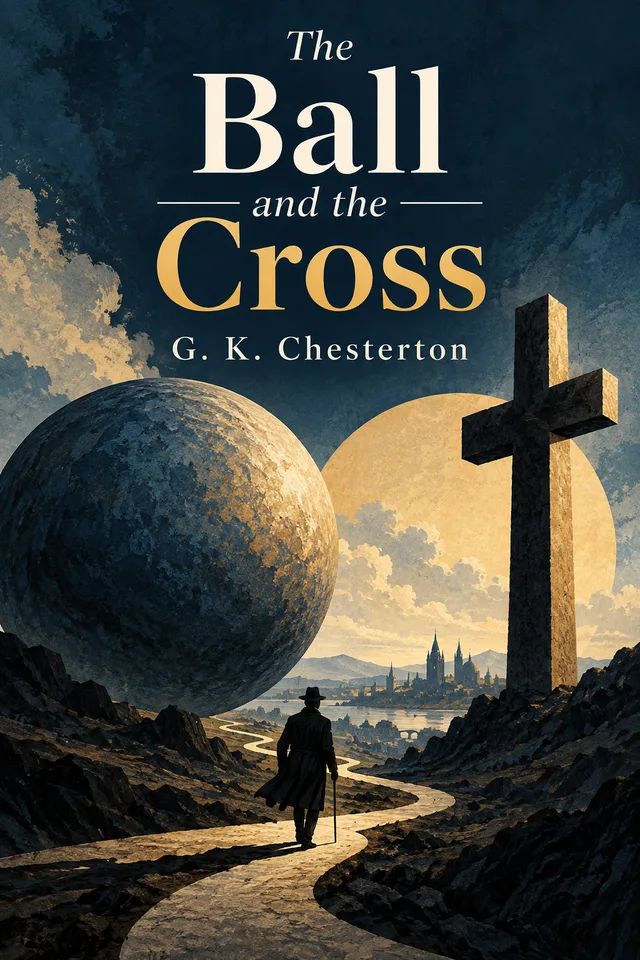
The Ball and the Cross
English BooksWhale Edition by G. K. Chesterton
A paradox-filled Chesterton novel about faith, doubt, friendship, and a duel that becomes a pilgrimage.
- Preview
- A sample from the prepared text
- Formats
- Online reader, EPUB, PDF
- Access
- Library claim
Book introduction
The Ball and the Cross
The Ball and the Cross stages a wandering contest between a militant Catholic and a determined atheist. Chesterton blends satire, fantasy, theology, and adventure into a lively debate about belief and modern society.
BooksWhale edition
How this edition was prepared
This edition is based on a public domain text and has been prepared for digital reading by BooksWhale.
Public domain basis
Why this edition can be shared
G. K. Chesterton died in 1936; the work was first published in 1909. These dates support the public-domain basis for this edition.
Read preview
A sample from the prepared text
Preview selected from the prepared reader text.
Preview chapterFull textRead preview
The Ball and the Cross
G. K. Chesterton
Preview chapterI. A DISCUSSION SOMEWHAT IN THE AIRPreview
The flying ship of Professor Lucifer sang through the skies like a silver arrow; the bleak white steel of it, gleaming in the bleak blue emptiness of the evening. That it was far above the earth was no expression for it; to the two men in it, it seemed to be far above the stars. The professor had himself invented the flying machine, and had also invented nearly everything in it. Every sort of tool or apparatus had, in consequence, to the full, that fantastic and distorted look which belongs to the miracles of science. For the world of science and evolution is far more nameless and elusive and like a dream than the world of poetry and religion; since in the latter images and ideas remain themselves eternally, while it is the whole idea of evolution that identities melt into each other as they do in a nightmare.
All the tools of Professor Lucifer were the ancient human tools gone mad, grown into unrecognizable shapes, forgetful of their origin, forgetful of their names. That thing which looked like an enormous key with three wheels was really a patent and very deadly revolver. That object which seemed to be created by the entanglement of two corkscrews was really the key. The thing which might have been mistaken for a tricycle turned upside-down was the inexpressibly important instrument to which the corkscrew was the key. All these things, as I say, the professor had invented; he had invented everything in the flying ship, with the exception, perhaps, of himself. This he had been born too late actually to inaugurate, but he believed at least, that he had considerably improved it.
There was, however, another man on board, so to speak, at the time. Him, also, by a curious coincidence, the professor had not invented, and him he had not even very greatly improved, though he had fished him up with a lasso out of his own back garden, in Western Bulgaria, with the pure object of improving him. He was an exceedingly holy man, almost entirely covered with white hair. You could see nothing but his eyes, and he seemed to talk with them. A monk of immense learning and acute intellect he had made himself happy in a little stone hut and a little stony garden in the Balkans, chiefly by writing the most crushing refutations of exposures of certain heresies, the last professors of which had been burnt (generally by each other) precisely 1,119 years previously. They were really very plausible and thoughtful heresies, and it was really a creditable or even glorious circumstance, that the old monk had been intellectual enough to detect their fallacy; the only misfortune was that nobody in the modern world was intellectual enough even to understand their argument. The old monk, one of whose names was Michael, and the other a name quite impossible to remember or repeat in our Western civilization, had, however, as I have said, made himself quite happy while he was in a mountain hermitage in the society of wild animals. And now that his luck had lifted him above all the mountains in the society of a wild physicist, he made himself happy still.
“I have no intention, my good Michael,” said Professor Lucifer, “of endeavouring to convert you by argument. The imbecility of your traditions can be quite finally exhibited to anybody with mere ordinary knowledge of the world, the same kind of knowledge which teaches us not to sit in draughts or not to encourage friendliness in impecunious people. It is folly to talk of this or that demonstrating the rationalist philosophy. Everything demonstrates it. Rubbing shoulders with men of all kinds----”
“You will forgive me,” said the monk, meekly from under loads of white beard, “but I fear I do not understand; was it in order that I might rub my shoulder against men of all kinds that you put me inside this thing?”
Preview chapterII. THE RELIGION OF THE STIPENDIARY MAGISTRATEPreview
The editorial office of _The Atheist_ had for some years past become less and less prominently interesting as a feature of Ludgate Hill. The paper was unsuited to the atmosphere. It showed an interest in the Bible unknown in the district, and a knowledge of that volume to which nobody else on Ludgate Hill could make any conspicuous claim. It was in vain that the editor of _The Atheist_ filled his front window with fierce and final demands as to what Noah in the Ark did with the neck of the giraffe. It was in vain that he asked violently, as for the last time, how the statement “God is Spirit” could be reconciled with the statement “The earth is His footstool.” It was in vain that he cried with an accusing energy that the Bishop of London was paid L12,000 a year for pretending to believe that the whale swallowed Jonah. It was in vain that he hung in conspicuous places the most thrilling scientific calculations about the width of the throat of a whale. Was it nothing to them all they that passed by? Did his sudden and splendid and truly sincere indignation never stir any of the people pouring down Ludgate Hill? Never. The little man who edited _The Atheist_ would rush from his shop on starlit evenings and shake his fist at St. Paul's in the passion of his holy war upon the holy place. He might have spared his emotion. The cross at the top of St. Paul's and _The Atheist_ shop at the foot of it were alike remote from the world. The shop and the Cross were equally uplifted and alone in the empty heavens.
To the little man who edited _The Atheist_, a fiery little Scotchman, with fiery, red hair and beard, going by the name of Turnbull, all this decline in public importance seemed not so much sad or even mad, but merely bewildering and unaccountable. He had said the worst thing that could be said; and it seemed accepted and ignored like the ordinary second best of the politicians. Every day his blasphemies looked more glaring, and every day the dust lay thicker upon them. It made him feel as if he were moving in a world of idiots. He seemed among a race of men who smiled when told of their own death, or looked vacantly at the Day of Judgement. Year after year went by, and year after year the death of God in a shop in Ludgate became a less and less important occurrence. All the forward men of his age discouraged Turnbull. The socialists said he was cursing priests when he should be cursing capitalists. The artists said that the soul was most spiritual, not when freed from religion, but when freed from morality. Year after year went by, and at least a man came by who treated Mr. Turnbull's secularist shop with a real respect and seriousness. He was a young man in a grey plaid, and he smashed the window.
He was a young man, born in the Bay of Arisaig, opposite Rum and the Isle of Skye. His high, hawklike features and snaky black hair bore the mark of that unknown historic thing which is crudely called Celtic, but which is probably far older than the Celts, whoever they were. He was in name and stock a Highlander of the Macdonalds; but his family took, as was common in such cases, the name of a subordinate sept as a surname, and for all the purposes which could be answered in London, he called himself Evan MacIan. He had been brought up in some loneliness and seclusion as a strict Roman Catholic, in the midst of that little wedge of Roman Catholics which is driven into the Western Highlands. And he had found his way as far as Fleet Street, seeking some half-promised employment, without having properly realized that there were in the world any people who were not Roman Catholics. He had uncovered himself for a few moments before the statue of Queen Anne, in front of St. Paul's Cathedral, under the firm impression that it was a figure of the Virgin Mary. He was somewhat surprised at the lack of deference shown to the figure by the people bustling by. He did not understand that their one essential historical principle, the one law truly graven on their hearts, was the great and comforting statement that Queen Anne is dead. This faith was as fundamental as his faith, that Our Lady was alive. Any persons he had talked to since he had touched the fringe of our fashion or civilization had been by a coincidence, sympathetic or hypocritical. Or if they had spoken some established blasphemies, he had been unable to understand them merely owing to the preoccupied satisfaction of his mind.
Table of contents
Inside this edition
- 01Full text
- 02I. A DISCUSSION SOMEWHAT IN THE AIR
- 03II. THE RELIGION OF THE STIPENDIARY MAGISTRATE
- 04III. SOME OLD CURIOSITIES
- 05IV. A DISCUSSION AT DAWN
- 06V. THE PEACEMAKER
- 07VI. THE OTHER PHILOSOPHER
- 08VII. THE VILLAGE OF GRASSLEY-IN-THE-HOLE
- 09VIII. AN INTERLUDE OF ARGUMENT
- 10IX. THE STRANGE LADY
- 11X. THE SWORDS REJOINED
- 12XI. A SCANDAL IN THE VILLAGE
- 13XII. THE DESERT ISLAND
- 14XIII. THE GARDEN OF PEACE
- 15XIV. A MUSEUM OF SOULS
- 16XV. THE DREAM OF MACIAN
- 17XVI. THE DREAM OF TURNBULL
- 18XVII. THE IDIOT
- 19XVIII. A RIDDLE OF FACES
- 20XIX. THE LAST PARLEY
- 21XX. DIES IRAE
Language availability
Other languages
Additional language editions are not published yet. This section will link to other BooksWhale editions when they become available.
Request another language