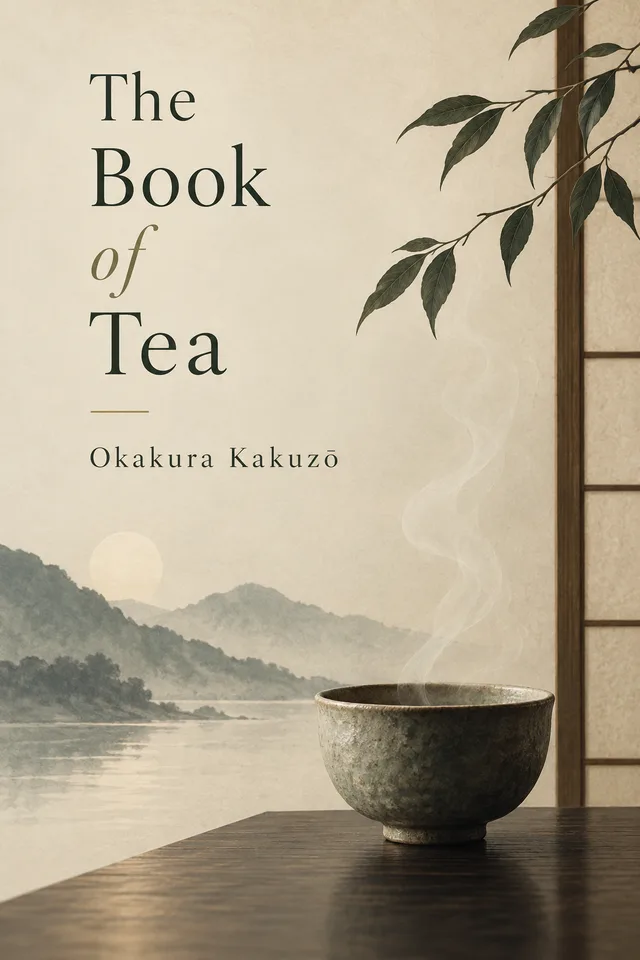
English Edition
Art
The Book of Tea
English BooksWhale Edition by Okakura Kakuzō
The Book of Tea is a public-domain classic of tea culture, Japanese aesthetics, Taoism and Zen.
- Preview
- A sample from the prepared text
- Formats
- Online reader, EPUB, PDF
- Access
- Library claim
Book introduction
The Book of Tea
The Book of Tea by Okakura Kakuzō is an original English public-domain work focused on tea culture, Japanese aesthetics, Taoism and Zen. This edition is selected for BooksWhale readers seeking globally safer classic texts with clear authorship, early publication, and enduring literary or intellectual value.
BooksWhale edition
How this edition was prepared
This edition is based on a public domain text and has been prepared for digital reading by BooksWhale.
Public domain basis
Why this edition can be shared
The author died in 1913, and this original English work was first published in 1906; selected under a conservative global public-domain screen using author death not later than 1925 and first publication not later than 1930.
Read preview
A sample from the prepared text
Preview selected from the prepared reader text.
Preview chapterPart 1Read preview
The Book of Tea
Okakura Kakuzō
By Kakuzo Okakura
I. The Cup of Humanity
Tea began as a medicine and grew into a beverage. In China, in the eighth century, it entered the realm of poetry as one of the polite amusements. The fifteenth century saw Japan ennoble it into a religion of aestheticism--Teaism. Teaism is a cult founded on the adoration of the beautiful among the sordid facts of everyday existence. It inculcates purity and harmony, the mystery of mutual charity, the romanticism of the social order. It is essentially a worship of the Imperfect, as it is a tender attempt to accomplish something possible in this impossible thing we know as life.
The Philosophy of Tea is not mere aestheticism in the ordinary acceptance of the term, for it expresses conjointly with ethics and religion our whole point of view about man and nature. It is hygiene, for it enforces cleanliness; it is economics, for it shows comfort in simplicity rather than in the complex and costly; it is moral geometry, inasmuch as it defines our sense of proportion to the universe. It represents the true spirit of Eastern democracy by making all its votaries aristocrats in taste.
The long isolation of Japan from the rest of the world, so conducive to introspection, has been highly favourable to the development of Teaism. Our home and habits, costume and cuisine, porcelain, lacquer, painting--our very literature--all have been subject to its influence. No student of Japanese culture could ever ignore its presence. It has permeated the elegance of noble boudoirs, and entered the abode of the humble. Our peasants have learned to arrange flowers, our meanest labourer to offer his salutation to the rocks and waters. In our common parlance we speak of the man "with no tea" in him, when he is insusceptible to the serio-comic interests of the personal drama. Again we stigmatise the untamed aesthete who, regardless of the mundane tragedy, runs riot in the springtide of emancipated emotions, as one "with too much tea" in him.
The outsider may indeed wonder at this seeming much ado about nothing. What a tempest in a tea-cup! he will say. But when we consider how small after all the cup of human enjoyment is, how soon overflowed with tears, how easily drained to the dregs in our quenchless thirst for infinity, we shall not blame ourselves for making so much of the tea-cup. Mankind has done worse. In the worship of Bacchus, we have sacrificed too freely; and we have even transfigured the gory image of Mars. Why not consecrate ourselves to the queen of the Camelias, and revel in the warm stream of sympathy that flows from her altar? In the liquid amber within the ivory-porcelain, the initiated may touch the sweet reticence of Confucius, the piquancy of Laotse, and the ethereal aroma of Sakyamuni himself.
Those who cannot feel the littleness of great things in themselves are apt to overlook the greatness of little things in others. The average Westerner, in his sleek complacency, will see in the tea ceremony but another instance of the thousand and one oddities which constitute the quaintness and childishness of the East to him. He was wont to regard Japan as barbarous while she indulged in the gentle arts of peace: he calls her civilised since she began to commit wholesale slaughter on Manchurian battlefields. Much comment has been given lately to the Code of the Samurai,--the Art of Death which makes our soldiers exult in self-sacrifice; but scarcely any attention has been drawn to Teaism, which represents so much of our Art of Life. Fain would we remain barbarians, if our claim to civilisation were to be based on the gruesome glory of war. Fain would we await the time when due respect shall be paid to our art and ideals.
When will the West understand, or try to understand, the East? We Asiatics are often appalled by the curious web of facts and fancies which has been woven concerning us. We are pictured as living on the perfume of the lotus, if not on mice and cockroaches. It is either impotent fanaticism or else abject voluptuousness. Indian spirituality has been derided as ignorance, Chinese sobriety as stupidity, Japanese patriotism as the result of fatalism. It has been said that we are less sensible to pain and wounds on account of the callousness of our nervous organisation!
Preview chapterPart 2Preview
It needed the genius of the Tang dynasty to emancipate Tea from its crude state and lead to its final idealization. With Luwuh in the middle of the eighth century we have our first apostle of tea. He was born in an age when Buddhism, Taoism, and Confucianism were seeking mutual synthesis. The pantheistic symbolism of the time was urging one to mirror the Universal in the Particular. Luwuh, a poet, saw in the Tea-service the same harmony and order which reigned through all things. In his celebrated work, the "Chaking" (The Holy Scripture of Tea) he formulated the Code of Tea. He has since been worshipped as the tutelary god of the Chinese tea merchants.
The "Chaking" consists of three volumes and ten chapters. In the first chapter Luwuh treats of the nature of the tea-plant, in the second of the implements for gathering the leaves, in the third of the selection of the leaves. According to him the best quality of the leaves must have "creases like the leathern boot of Tartar horsemen, curl like the dewlap of a mighty bullock, unfold like a mist rising out of a ravine, gleam like a lake touched by a zephyr, and be wet and soft like fine earth newly swept by rain."
The fourth chapter is devoted to the enumeration and description of the twenty-four members of the tea-equipage, beginning with the tripod brazier and ending with the bamboo cabinet for containing all these utensils. Here we notice Luwuh's predilection for Taoist symbolism. Also it is interesting to observe in this connection the influence of tea on Chinese ceramics. The Celestial porcelain, as is well known, had its origin in an attempt to reproduce the exquisite shade of jade, resulting, in the Tang dynasty, in the blue glaze of the south, and the white glaze of the north. Luwuh considered the blue as the ideal colour for the tea-cup, as it lent additional greenness to the beverage, whereas the white made it look pinkish and distasteful. It was because he used cake-tea. Later on, when the tea masters of Sung took to the powdered tea, they preferred heavy bowls of blue-black and dark brown. The Mings, with their steeped tea, rejoiced in light ware of white porcelain.
In the fifth chapter Luwuh describes the method of making tea. He eliminates all ingredients except salt. He dwells also on the much-discussed question of the choice of water and the degree of boiling it. According to him, the mountain spring is the best, the river water and the spring water come next in the order of excellence. There are three stages of boiling: the first boil is when the little bubbles like the eye of fishes swim on the surface; the second boil is when the bubbles are like crystal beads rolling in a fountain; the third boil is when the billows surge wildly in the kettle. The Cake-tea is roasted before the fire until it becomes soft like a baby's arm and is shredded into powder between pieces of fine paper. Salt is put in the first boil, the tea in the second. At the third boil, a dipperful of cold water is poured into the kettle to settle the tea and revive the "youth of the water." Then the beverage was poured into cups and drunk. O nectar! The filmy leaflet hung like scaly clouds in a serene sky or floated like waterlilies on emerald streams. It was of such a beverage that Lotung, a Tang poet, wrote: "The first cup moistens my lips and throat, the second cup breaks my loneliness, the third cup searches my barren entrail but to find therein some five thousand volumes of odd ideographs. The fourth cup raises a slight perspiration,--all the wrong of life passes away through my pores. At the fifth cup I am purified; the sixth cup calls me to the realms of the immortals. The seventh cup--ah, but I could take no more! I only feel the breath of cool wind that rises in my sleeves. Where is Horaisan? Let me ride on this sweet breeze and waft away thither."
Preview chapterPart 3Preview
The virility of the idea lies not less in its power of breaking through contemporary thought than in its capacity for dominating subsequent movements. Taoism was an active power during the Shin dynasty, that epoch of Chinese unification from which we derive the name China. It would be interesting had we time to note its influence on contemporary thinkers, the mathematicians, writers on law and war, the mystics and alchemists and the later nature-poets of the Yangtse-Kiang. We should not even ignore those speculators on Reality who doubted whether a white horse was real because he was white, or because he was solid, nor the Conversationalists of the Six dynasties who, like the Zen philosophers, revelled in discussions concerning the Pure and the Abstract. Above all we should pay homage to Taoism for what it has done toward the formation of the Celestial character, giving to it a certain capacity for reserve and refinement as "warm as jade." Chinese history is full of instances in which the votaries of Taoism, princes and hermits alike, followed with varied and interesting results the teachings of their creed. The tale will not be without its quota of instruction and amusement. It will be rich in anecdotes, allegories, and aphorisms. We would fain be on speaking terms with the delightful emperor who never died because he had never lived. We may ride the wind with Liehtse and find it absolutely quiet because we ourselves are the wind, or dwell in mid-air with the Aged one of the Hoang-Ho, who lived betwixt Heaven and Earth because he was subject to neither the one nor the other. Even in that grotesque apology for Taoism which we find in China at the present day, we can revel in a wealth of imagery impossible to find in any other cult.
But the chief contribution of Taoism to Asiatic life has been in the realm of aesthetics. Chinese historians have always spoken of Taoism as the "art of being in the world," for it deals with the present--ourselves. It is in us that God meets with Nature, and yesterday parts from to-morrow. The Present is the moving Infinity, the legitimate sphere of the Relative. Relativity seeks Adjustment; Adjustment is Art. The art of life lies in a constant readjustment to our surroundings. Taoism accepts the mundane as it is and, unlike the Confucians or the Buddhists, tries to find beauty in our world of woe and worry. The Sung allegory of the Three Vinegar Tasters explains admirably the trend of the three doctrines. Sakyamuni, Confucius, and Laotse once stood before a jar of vinegar--the emblem of life--and each dipped in his finger to taste the brew. The matter-of-fact Confucius found it sour, the Buddha called it bitter, and Laotse pronounced it sweet.
The Taoists claimed that the comedy of life could be made more interesting if everyone would preserve the unities. To keep the proportion of things and give place to others without losing one's own position was the secret of success in the mundane drama. We must know the whole play in order to properly act our parts; the conception of totality must never be lost in that of the individual. This Laotse illustrates by his favourite metaphor of the Vacuum. He claimed that only in vacuum lay the truly essential. The reality of a room, for instance, was to be found in the vacant space enclosed by the roof and the walls, not in the roof and walls themselves. The usefulness of a water pitcher dwelt in the emptiness where water might be put, not in the form of the pitcher or the material of which it was made. Vacuum is all potent because all containing. In vacuum alone motion becomes possible. One who could make of himself a vacuum into which others might freely enter would become master of all situations. The whole can always dominate the part.
Table of contents
Inside this edition
- 01Part 1
- 02Part 2
- 03Part 3
- 04Part 4
- 05Part 5
- 06Part 6
Language availability
Other languages
Additional language editions are not published yet. This section will link to other BooksWhale editions when they become available.
Request another language