English Edition
Literature
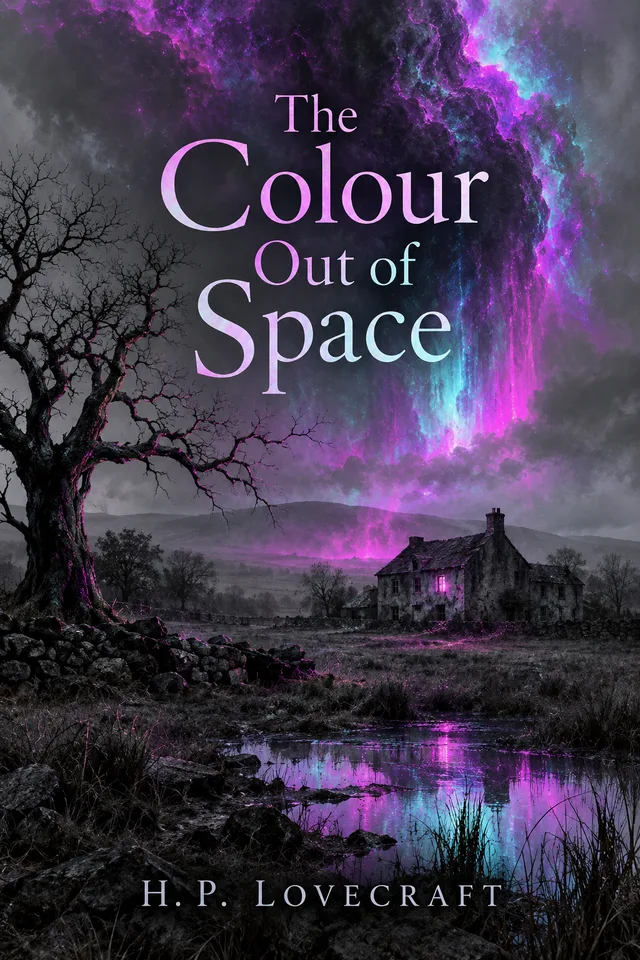
The Colour Out of Space
English BooksWhale Edition by H. P. Lovecraft
A rural New England tragedy caused by an influence that falls from the sky and resists every ordinary explanation.
- Preview
- A sample from the prepared text
- Formats
- Online reader, EPUB, PDF
- Access
- Library claim
Book introduction
The Colour Out of Space
Lovecraft turns a meteorite impact into a slow environmental and psychological nightmare. The story’s fading landscape, ruined farm, and unknowable colour create a precise portrait of contamination by something outside the human world.
BooksWhale edition
How this edition was prepared
This edition is based on a public domain text and has been prepared for digital reading by BooksWhale.
Public domain basis
Why this edition can be shared
The author died before 1955 and the work was first published before 1931; the original English text is treated as public-domain source material for this edition.
Read preview
A sample from the prepared text
Preview selected from the prepared reader text.
Preview chapterPart 1Read preview
The Colour Out of Space
H. P. Lovecraft
West of Arkham the hills rise wild, and there are valleys with deep woods that no axe has ever cut. There are dark narrow glens where the trees slope fantastically, and where thin brooklets trickle without ever having caught the glint of sunlight. On the gentler slopes there are farms, ancient and rocky, with squat, moss-coated cottages brooding eternally over old New England secrets in the lee of great ledges; but these are all vacant now, the wide chimneys crumbling and the shingled sides bulging perilously beneath low gambrel roofs.
The old folk have gone away, and foreigners do not like to live there. French-Canadians have tried it, Italians have tried it, and the Poles have come and departed. It is not because of anything that can be seen or heard or handled, but because of something that is imagined. The place is not good for imagination, and does not bring restful dreams at night. It must be this which keeps the foreigners away, for old Ammi Pierce has never told them of anything he recalls from the strange days. Ammi, whose head has been a little queer for years, is the only one who still remains, or who ever talks of the strange days; and he dares to do this because his house is so near the open fields and the travelled roads around Arkham.
There was once a road over the hills and through the valleys, that ran straight where the blasted heath is now; but people ceased to use it and a new road was laid curving far toward the south. Traces of the old one can still be found amidst the weeds of a returning wilderness, and some of them will doubtless linger even when half the hollows are flooded for the new reservoir. Then the dark woods will be cut down and the blasted heath will slumber far below blue waters whose surface will mirror the sky and ripple in the sun. And the secrets of the strange days will be one with the deep's secrets; one with the hidden lore of old ocean, and all the mystery of primal earth.
When I went into the hills and vales to survey for the new reservoir they told me the place was evil. They told me this in Arkham, and because that is a very old town full of witch legends I thought the evil must be something which grandmas had whispered to children through centuries. The name "blasted heath" seemed to me very odd and theatrical, and I wondered how it had come into the folklore of a Puritan people. Then I saw that dark westward tangle of glens and slopes for myself, and ceased to wonder at anything besides its own elder mystery. It was morning when I saw it, but shadow lurked always there. The trees grew too thickly, and their trunks were too big for any healthy New England wood. There was too much silence in the dim alleys between them, and the floor was too soft with the dank moss and mattings of infinite years of decay.
In the open spaces, mostly along the line of the old road, there were little hillside farms; sometimes with all the buildings standing, sometimes with only one or two, and sometimes with only a lone chimney or fast-filling cellar. Weeds and briers reigned, and furtive wild things rustled in the undergrowth. Upon everything was a haze of restlessness and oppression; a touch of the unreal and the grotesque, as if some vital element of perspective or chiaroscuro were awry. I did not wonder that the foreigners would not stay, for this was no region to sleep in. It was too much like a landscape of Salvator Rosa; too much like some forbidden woodcut in a tale of terror.
But even all this was not so bad as the blasted heath. I knew it the moment I came upon it at the bottom of a spacious valley; for no other name could fit such thing, or any other thing fit such a name. It was as if the poet had coined the phrase from having seen this one particular region. It must, I thought as I viewed it, be the outcome of a fire; but why had nothing new ever grown over those five acres of grey desolation that sprawled open to the sky like a great spot eaten by acid in the woods and fields? It lay largely to the north of the ancient road line, but encroached a little on the other side. I felt an odd reluctance about approaching, and did so at last only because my business took me through and past it. There was no vegetation of any kind on that broad expanse, but only a fine grey dust or ash which no wind seemed ever to blow about. The trees near it were sickly and stunted, and many dead trunks stood or lay rotting at the rim. As I walked hurriedly by I saw the tumbled bricks and stones of an old chimney and cellar on my right, and the yawning black maw of an abandoned well whose stagnant vapours played strange tricks with the hues of the sunlight. Even the long, dark woodland climb beyond seemed welcome in contrast, and I marvelled no more at the frightened whispers of Arkham people. There had been no house or ruin near; even in the old days the place must have been lonely and remote. And at twilight, dreading to repass that ominous spot, I walked circuitously back to the town by the curving road on the south. I vaguely wished some clouds would gather, for an odd timidity about the deep skyey voids above had crept into my soul.
Preview chapterPart 2Preview
Then fell the time of fruit and harvest. The pears and apples slowly ripened, and Nahum vowed that his orchards were prospering as never before. The fruit was growing to phenomenal size and unwonted gloss, and in such abundance that extra barrels were ordered to handle the future crop. But with the ripening came sore disappointment, for of all that gorgeous array of specious lusciousness not one single jot was fit to eat. Into the fine flavour of the pears and apples had crept a stealthy bitterness and sickishness, so that even the smallest of bites induced a lasting disgust. It was the same with the melons and tomatoes, and Nahum sadly saw that his entire crop was lost. Quick to connect events, he declared that the meteorite had poisoned the soil, and thanked Heaven that most of the other crops were in the upland lot along the road.
Winter came early, and was very cold. Ammi saw Nahum less often than usual, and observed that he had begun to look worried. The rest of his family too, seemed to have grown taciturn; and were far from steady in their churchgoing or their attendance at the various social events of the countryside. For this reserve or melancholy no cause could be found, though all the household confessed now and then to poorer health and a feeling of vague disquiet. Nahum himself gave the most definite statement of anyone when he said he was disturbed about certain footprints in the snow. They were the usual winter prints of red squirrels, white rabbits, and foxes, but the brooding farmer professed to see something not quite right about their nature and arrangement. He was never specific, but appeared to think that they were not as characteristic of the anatomy and habits of squirrels and rabbits and foxes as they ought to be. Ammi listened without interest to this talk until one night when he drove past Nahum's house in his sleigh on the way back from Clark's Corners. There had been a moon, and a rabbit had run across the road; and the leaps of that rabbit were longer than either Ammi or his horse liked. The latter, indeed, had almost run away when brought up by a firm rein. Thereafter Ammi gave Nahum's tales more respect, and wondered why the Gardner dogs seemed so cowed and quivering every morning. They had, it developed, nearly lost the spirit to bark.
In February the McGregor boys from Meadow Hill were out shooting woodchucks, and not far from the Gardner place bagged a very peculiar specimen. The proportions of its body seemed slightly altered in a queer way impossible to describe, while its face had taken on an expression which no one ever saw in a woodchuck before. The boys were genuinely frightened, and threw the thing away at once, so that only their grotesque tales of it ever reached the people of the countryside. But the shying of horses near Nahum's house had now become an acknowledged thing, and all the basis for a cycle of whispered legend was fast taking form.
People vowed that the snow melted faster around Nahum's than it did anywhere else, and early in March there was an awed discussion in Potter's general store at Clark's Corners. Stephen Rice had driven past Gardner's in the morning, and had noticed the skunk-cabbages coming up through the mud by the woods across the road. Never were things of such size seen before, and they held strange colours that could not be put into any words. Their shapes were monstrous, and the horse had snorted at an odour which struck Stephen as wholly unprecedented. That afternoon several persons drove past to see the abnormal growth, and all agreed that plants of that kind ought never to sprout in a healthy world. The bad fruit of the fall before was freely mentioned, and it went from mouth to mouth that there was poison in Nahum's ground. Of course it was the meteorite; and remembering how strange the men from the college had found that stone to be, several farmers spoke about the matter to them.
Preview chapterPart 3Preview
Three days later Nahum burst into Ammi's kitchen in the early morning, and in the absence of his host stammered out a desperate tale once more, while Mrs. Pierce listened in a clutching fright. It was little Merwin this time. He was gone. He had gone out late at night with a lantern and pail for water, and had never come back. He'd been going to pieces for days, and hardly knew what he was about. Screamed at everything. There had been a frantic shriek from the yard then, but before the father could get to the door the boy was gone. There was no glow from the lantern he had taken, and of the child himself no trace. At the time Nahum thought the lantern and pail were gone too; but when dawn came, and the man had plodded back from his all-night search of the woods and fields, he had found some very curious things near the well. There was a crushed and apparently somewhat melted mass of iron which had certainly been the lantern; while a bent pail and twisted iron hoops beside it, both half-fused, seemed to hint at the remnants of the pail. That was all. Nahum was past imagining, Mrs. Pierce was blank, and Ammi, when he had reached home and heard the tale, could give no guess. Merwin was gone, and there would be no use in telling the people around, who shunned all Gardners now. No use, either, in telling the city people at Arkham who laughed at everything. Thad was gone, and now Merwin was gone. Something was creeping and creeping and waiting to be seen and heard. Nahum would go soon, and he wanted Ammi to look after his wife and Zenas if they survived him. It must all be a judgment of some sort; though he could not fancy what for, since he had always walked uprightly in the Lord's ways so far as he knew.
For over two weeks Ammi saw nothing of Nahum; and then, worried about what might have happened, he overcame his fears and paid the Gardner place a visit. There was no smoke from the great chimney, and for a moment the visitor was apprehensive of the worst. The aspect of the whole farm was shocking—greyish withered grass and leaves on the ground, vines falling in brittle wreckage from archaic walls and gables, and great bare trees clawing up at the grey November sky with a studied malevolence which Ammi could not but feel had come from some subtle change in the tilt of the branches. But Nahum was alive, after all. He was weak, and lying in a couch in the low-ceiled kitchen, but perfectly conscious and able to give simple orders to Zenas. The room was deadly cold; and as Ammi visibly shivered, the host shouted huskily to Zenas for more wood. Wood, indeed, was sorely needed; since the cavernous fireplace was unlit and empty, with a cloud of soot blowing about in the chill wind that came down the chimney. Presently Nahum asked him if the extra wood had made him any more comfortable, and then Ammi saw what had happened. The stoutest cord had broken at last, and the hapless farmer's mind was proof against more sorrow.
Questioning tactfully, Ammi could get no clear data at all about the missing Zenas. "In the well—he lives in the well—" was all that the clouded father would say. Then there flashed across the visitor's mind a sudden thought of the mad wife, and he changed his line of inquiry. "Nabby? Why, here she is!" was the surprised response of poor Nahum, and Ammi soon saw that he must search for himself. Leaving the harmless babbler on the couch, he took the keys from their nail beside the door and climbed the creaking stairs to the attic. It was very close and noisome up there, and no sound could be heard from any direction. Of the four doors in sight, only one was locked, and on this he tried various keys on the ring he had taken. The third key proved the right one, and after some fumbling Ammi threw open the low white door.
Table of contents
Inside this edition
- 01Part 1
- 02Part 2
- 03Part 3
- 04Part 4
Language availability
Other languages
Additional language editions are not published yet. This section will link to other BooksWhale editions when they become available.
Request another language