English Edition
Literature
The Deerslayer
English BooksWhale Edition by James Fenimore Cooper
A Leatherstocking tale of frontier conflict, initiation, wilderness, and moral testing.
- Preview
- A sample from the prepared text
- Formats
- Online reader, EPUB, PDF
- Access
- Library claim
Book introduction
The Deerslayer
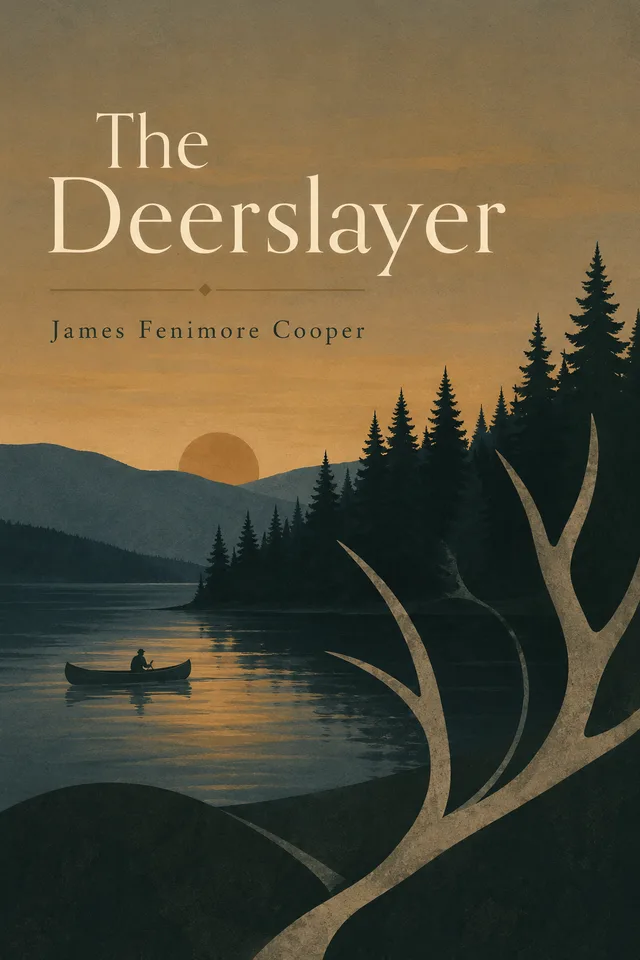
“The Deerslayer” presents Natty Bumppo at the beginning of his frontier life, set beside Glimmerglass amid danger, loyalty, and war. Cooper’s novel combines adventure, landscape, and moral trial in early American historical romance.
BooksWhale edition
How this edition was prepared
This edition is based on a public domain text and has been prepared for digital reading by BooksWhale.
Public domain basis
Why this edition can be shared
The Deerslayer is a public-domain work: the author died in 1851, and the text was first published in 1841. This edition uses the original English text.
Read preview
A sample from the prepared text
Preview selected from the prepared reader text.
Preview chapterFull textRead preview
The Deerslayer
By James Fenimore Cooper
Preview chapterChapter I.Preview
“There is a pleasure in the pathless woods, There is a rapture on the lonely shore. There is society where none intrudes, By the deep sea, and music in its roar: I love not man the less, but nature more, From these our interviews, in which I steal From all I may be, or have been before, To mingle with the universe, and feel What I can ne'er express, yet cannot all conceal”
Childe Harold.
On the human imagination events produce the effects of time. Thus, he who has travelled far and seen much is apt to fancy that he has lived long; and the history that most abounds in important incidents soonest assumes the aspect of antiquity. In no other way can we account for the venerable air that is already gathering around American annals. When the mind reverts to the earliest days of colonial history, the period seems remote and obscure, the thousand changes that thicken along the links of recollections, throwing back the origin of the nation to a day so distant as seemingly to reach the mists of time; and yet four lives of ordinary duration would suffice to transmit, from mouth to mouth, in the form of tradition, all that civilized man has achieved within the limits of the republic. Although New York alone possesses a population materially exceeding that of either of the four smallest kingdoms of Europe, or materially exceeding that of the entire Swiss Confederation, it is little more than two centuries since the Dutch commenced their settlement, rescuing the region from the savage state. Thus, what seems venerable by an accumulation of changes is reduced to familiarity when we come seriously to consider it solely in connection with time.
This glance into the perspective of the past will prepare the reader to look at the pictures we are about to sketch, with less surprise than he might otherwise feel; and a few additional explanations may carry him back in imagination to the precise condition of society that we desire to delineate. It is matter of history that the settlements on the eastern shores of the Hudson, such as Claverack, Kinderhook, and even Poughkeepsie, were not regarded as safe from Indian incursions a century since; and there is still standing on the banks of the same river, and within musket-shot of the wharves of Albany, a residence of a younger branch of the Van Rensselaers, that has loopholes constructed for defence against the same crafty enemy, although it dates from a period scarcely so distant. Other similar memorials of the infancy of the country are to be found, scattered through what is now deemed the very centre of American civilization, affording the plainest proofs that all we possess of security from invasion and hostile violence is the growth of but little more than the time that is frequently fulfilled by a single human life.
The incidents of this tale occurred between the years 1740 and 1745, when the settled portions of the colony of New York were confined to the four Atlantic counties, a narrow belt of country on each side of the Hudson, extending from its mouth to the falls near its head, and to a few advanced “neighborhoods” on the Mohawk and the Schoharie. Broad belts of the virgin wilderness not only reached the shores of the first river, but they even crossed it, stretching away into New England, and affording forest covers to the noiseless moccasin of the native warrior, as he trod the secret and bloody war-path. A bird's-eye view of the whole region east of the Mississippi must then have offered one vast expanse of woods, relieved by a comparatively narrow fringe of cultivation along the sea, dotted by the glittering surfaces of lakes, and intersected by the waving lines of river. In such a vast picture of solemn solitude, the district of country we design to paint sinks into insignificance, though we feel encouraged to proceed by the conviction that, with slight and immaterial distinctions, he who succeeds in giving an accurate idea of any portion of this wild region must necessarily convey a tolerably correct notion of the whole.
Preview chapterChapter II.Preview
“Thou'rt passing from the lake's green side, And the hunter's hearth away; For the time of flowers, for the summer's pride, Daughter! thou canst not stay.”
Mrs. Hemans, “Edith. A Tale of the Woods” II. 191-94
Our two adventurers had not far to go. Hurry knew the direction, as soon as he had found the open spot and the spring, and he now led on with the confident step of a man assured of his object. The forest was dark, as a matter of course, but it was no longer obstructed by underbrush, and the footing was firm and dry. After proceeding near a mile, March stopped, and began to cast about him with an inquiring look, examining the different objects with care, and occasionally turning his eyes on the trunks of the fallen trees, with which the ground was well sprinkled, as is usually the case in an American wood, especially in those parts of the country where timber has not yet become valuable.
“This must be the place, Deerslayer,” March at length observed; “here is a beech by the side of a hemlock, with three pines at hand, and yonder is a white birch with a broken top; and yet I see no rock, nor any of the branches bent down, as I told you would be the case.”
“Broken branches are onskilful landmarks, as the least exper'enced know that branches don't often break of themselves,” returned the other; “and they also lead to suspicion and discoveries. The Delawares never trust to broken branches, unless it is in friendly times, and on an open trail. As for the beeches, and pines, and hemlocks, why, they are to be seen on all sides of us, not only by twos and threes, but by forties, and fifties, and hundreds.”
“Very true, Deerslayer, but you never calculate on position. Here is a beech and a hemlock--”
“Yes, and there is another beech and a hemlock, as loving as two brothers, or, for that matter, more loving than some brothers; and yonder are others, for neither tree is a rarity in these woods. I fear me, Hurry, you are better at trapping beaver and shooting bears, than at leading on a blindish sort of a trail. Ha! there's what you wish to find, a'ter all!”
“Now, Deerslayer, this is one of your Delaware pretensions, for hang me if I see anything but these trees, which do seem to start up around us in a most onaccountable and perplexing manner.”
“Look this-a-way, Hurry--here, in a line with the black oak--don't you see the crooked sapling that is hooked up in the branches of the bass-wood, near it? Now, that sapling was once snow-ridden, and got the bend by its weight; but it never straightened itself, and fastened itself in among the bass-wood branches in the way you see. The hand of man did that act of kindness for it.”
“That hand was mine!” exclaimed Hurry; “I found the slender young thing bent to the airth, like an unfortunate creatur' borne down by misfortune, and stuck it up where you see it. After all, Deerslayer, I must allow, you're getting to have an oncommon good eye for the woods!”
“'Tis improving, Hurry--'tis improving I will acknowledge; but 'tis only a child's eye, compared to some I know. There's Tamenund, now, though a man so old that few remember when he was in his prime, Tamenund lets nothing escape his look, which is more like the scent of a hound than the sight of an eye. Then Uncas, the father of Chingachgook, and the lawful chief of the Mohicans, is another that it is almost hopeless to pass unseen. I'm improving, I will allow--I'm improving, but far from being perfect, as yet.”
“And who is this Chingachgook, of whom you talk so much, Deerslayer!” asked Hurry, as he moved off in the direction of the righted sapling; “a loping red-skin, at the best, I make no question.”
Table of contents
Inside this edition
- 01Full text
- 02Chapter I.
- 03Chapter II.
- 04Chapter III.
- 05Chapter IV.
- 06Chapter V.
- 07Chapter VI.
- 08Chapter VII.
- 09BYRON.
- 10Chapter VIII.
- 11Chapter IX.
- 12Chapter X.
- 13Chapter XI.
- 14Chapter XII.
- 15Chapter XIII.
- 16Chapter XIV.
- 17Chapter XV.
- 18Chapter XVI
- 19Chapter XVII.
- 20Chapter XVIII
- 21Chapter XIX
- 22Chapter XX
- 23Chapter XXI.
- 24Chapter XXII.
- 25Chapter XXIII.
- 26Chapter XXIV
- 27Chapter XXV
- 28Chapter XXVI.
- 29Chapter XXVII.
- 30Chapter XXVIII.
- 31Chapter XXIX.
- 32Chapter XXX.
- 33Chapter XXXI.
- 34Chapter XXXII
Language availability
Other languages
Additional language editions are not published yet. This section will link to other BooksWhale editions when they become available.
Request another language