English Edition
Literature
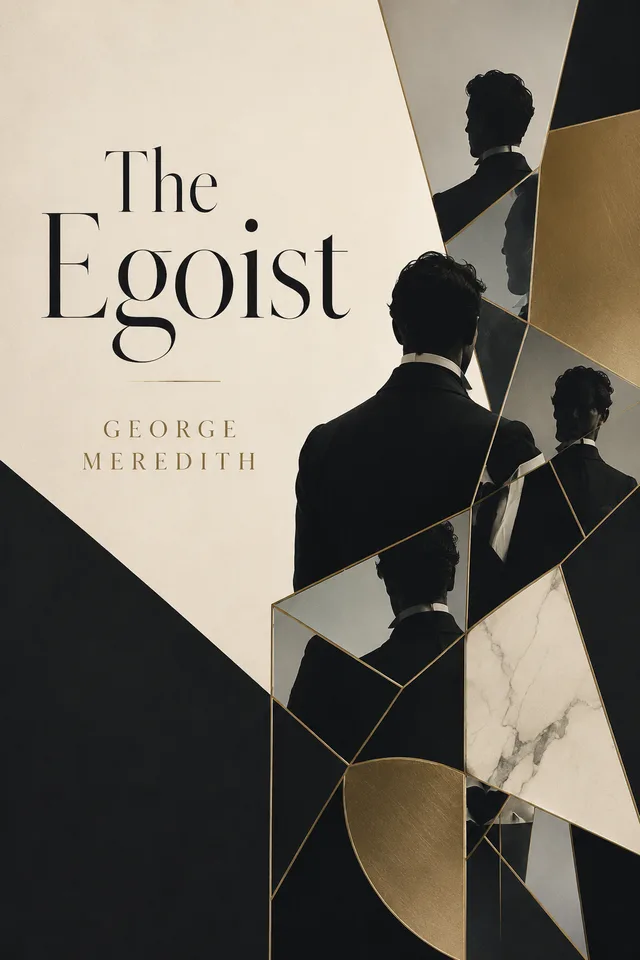
The Egoist
English BooksWhale Edition by George Meredith
Meredith’s comedy studies vanity, courtship, wit, and the social theater of choosing a husband.
- Preview
- A sample from the prepared text
- Formats
- Online reader, EPUB, PDF
- Access
- Library claim
Book introduction
The Egoist
The Egoist centers on Sir Willoughby Patterne, whose charm and self-love trap the women around him in a comedy of manners. George Meredith uses brilliant dialogue and psychological irony to examine marriage, freedom, reputation, and masculine vanity.
BooksWhale edition
How this edition was prepared
This edition is based on a public domain text and has been prepared for digital reading by BooksWhale.
Public domain basis
Why this edition can be shared
George Meredith died in 1909; the work was first published around 1879. These dates support the public-domain basis for this English edition.
Read preview
A sample from the prepared text
Preview selected from the prepared reader text.
Preview chapterFull textRead preview
The Egoist
A Comedy in Narrative
by GEORGE MEREDITH
PRELUDE
A CHAPTER OF WHICH THE LAST PAGE ONLY IS OF ANY IMPORTANCE
Comedy is a game played to throw reflections upon social life, and it deals with human nature in the drawing-room of civilized men and women, where we have no dust of the struggling outer world, no mire, no violent crashes, to make the correctness of the representation convincing. Credulity is not wooed through the impressionable senses; nor have we recourse to the small circular glow of the watchmaker's eye to raise in bright relief minutest grains of evidence for the routing of incredulity. The Comic Spirit conceives a definite situation for a number of characters, and rejects all accessories in the exclusive pursuit of them and their speech. For being a spirit, he hunts the spirit in men; vision and ardour constitute his merit; he has not a thought of persuading you to believe in him. Follow and you will see. But there is a question of the value of a run at his heels.
Now the world is possessed of a certain big book, the biggest book on earth; that might indeed be called the Book of Earth; whose title is the Book of Egoism, and it is a book full of the world's wisdom. So full of it, and of such dimensions is this book, in which the generations have written ever since they took to writing, that to be profitable to us the Book needs a powerful compression.
Who, says the notable humourist, in allusion to this Book, who can studiously travel through sheets of leaves now capable of a stretch from the Lizard to the last few poor pulmonary snips and shreds of leagues dancing on their toes for cold, explorers tell us, and catching breath by good luck, like dogs at bones about a table, on the edge of the Pole? Inordinate unvaried length, sheer longinquity, staggers the heart, ages the very heart of us at a view. And how if we manage finally to print one of our pages on the crow-scalp of that solitary majestic outsider? We may get him into the Book; yet the knowledge we want will not be more present with us than it was when the chapters hung their end over the cliff you ken of at Dover, where sits our great lord and master contemplating the seas without upon the reflex of that within!
In other words, as I venture to translate him (humourists are difficult: it is a piece of their humour to puzzle our wits), the inward mirror, the embracing and condensing spirit, is required to give us those interminable milepost piles of matter (extending well-nigh to the very Pole) in essence, in chosen samples, digestibly. I conceive him to indicate that the realistic method of a conscientious transcription of all the visible, and a repetition of all the audible, is mainly accountable for our present branfulness, and that prolongation of the vasty and the noisy, out of which, as from an undrained fen, steams the malady of sameness, our modern malady. We have the malady, whatever may be the cure or the cause. We drove in a body to Science the other day for an antidote; which was as if tired pedestrians should mount the engine-box of headlong trains; and Science introduced us to our o'er-hoary ancestry--them in the Oriental posture; whereupon we set up a primaeval chattering to rival the Amazon forest nigh nightfall, cured, we fancied. And before daybreak our disease was hanging on to us again, with the extension of a tail. We had it fore and aft. We were the same, and animals into the bargain. That is all we got from Science.
Art is the specific. We have little to learn of apes, and they may be left. The chief consideration for us is, what particular practice of Art in letters is the best for the perusal of the Book of our common wisdom; so that with clearer minds and livelier manners we may escape, as it were, into daylight and song from a land of fog-horns. Shall we read it by the watchmaker's eye in luminous rings eruptive of the infinitesimal, or pointed with examples and types under the broad Alpine survey of the spirit born of our united social intelligence, which is the Comic Spirit? Wise men say the latter. They tell us that there is a constant tendency in the Book to accumulate excess of substance, and such repleteness, obscuring the glass it holds to mankind, renders us inexact in the recognition of our individual countenances: a perilous thing for civilization. And these wise men are strong in their opinion that we should encourage the Comic Spirit, who is after all our own offspring, to relieve the Book. Comedy, they say, is the true diversion, as it is likewise the key of the great Book, the music of the Book. They tell us how it condenses whole sections of the book in a sentence, volumes in a character; so that a fair pan of a book outstripping thousands of leagues when unrolled may be compassed in one comic sitting.
Preview chapterCHAPTER IPreview
A MINOR INCIDENT SHOWING AN HEREDITARY APTITUDE IN THE USE OF THE KNIFE
There was an ominously anxious watch of eyes visible and invisible over the infancy of Willoughby, fifth in descent from Simon Patterne, of Patterne Hall, premier of this family, a lawyer, a man of solid acquirements and stout ambition, who well understood the foundation-work of a House, and was endowed with the power of saying No to those first agents of destruction, besieging relatives. He said it with the resonant emphasis of death to younger sons. For if the oak is to become a stately tree, we must provide against the crowding of timber. Also the tree beset with parasites prospers not. A great House in its beginning lives, we may truly say, by the knife. Soil is easily got, and so are bricks, and a wife, and children come of wishing for them, but the vigorous use of the knife is a natural gift and points to growth. Pauper Patternes were numerous when the fifth head of the race was the hope of his county. A Patterne was in the Marines.
The country and the chief of this family were simultaneously informed of the existence of one Lieutenant Crossjay Patterne, of the corps of the famous hard fighters, through an act of heroism of the unpretending cool sort which kindles British blood, on the part of the modest young officer, in the storming of some eastern riverain stronghold, somewhere about the coast of China. The officer's youth was assumed on the strength of his rank, perhaps likewise from the tale of his modesty: "he had only done his duty". Our Willoughby was then at College, emulous of the generous enthusiasm of his years, and strangely impressed by the report, and the printing of his name in the newspapers. He thought over it for several months, when, coming to his title and heritage, he sent Lieutenant Crossjay Patterne a cheque for a sum of money amounting to the gallant fellow's pay per annum, at the same time showing his acquaintance with the first, or chemical, principles of generosity, in the remark to friends at home, that "blood is thicker than water". The man is a Marine, but he is a Patterne. How any Patterne should have drifted into the Marines, is of the order of questions which are senselessly asked of the great dispensary. In the complimentary letter accompanying his cheque, the lieutenant was invited to present himself at the ancestral Hall, when convenient to him, and he was assured that he had given his relative and friend a taste for a soldier's life. Young Sir Willoughby was fond of talking of his "military namesake and distant cousin, young Patterne--the Marine". It was funny; and not less laughable was the description of his namesake's deed of valour: with the rescued British sailor inebriate, and the hauling off to captivity of the three braves of the black dragon on a yellow ground, and the tying of them together back to back by their pigtails, and driving of them into our lines upon a newly devised dying-top style of march that inclined to the oblique, like the astonished six eyes of the celestial prisoners, for straight they could not go. The humour of gentlemen at home is always highly excited by such cool feats. We are a small island, but you see what we do. The ladies at the Hall, Sir Willoughby's mother, and his aunts Eleanor and Isabel, were more affected than he by the circumstance of their having a Patterne in the Marines. But how then! We English have ducal blood in business: we have, genealogists tell us, royal blood in common trades. For all our pride we are a queer people; and you may be ordering butcher's meat of a Tudor, sitting on the cane-bottom chairs of a Plantagenet. By and by you may . . . but cherish your reverence. Young Willoughby made a kind of shock-head or football hero of his gallant distant cousin, and wondered occasionally that the fellow had been content to dispatch a letter of effusive thanks without availing himself of the invitation to partake of the hospitalities of Patterne.
Preview chapterCHAPTER IIPreview
THE YOUNG SIR WILLOUGHBY
These little scoundrel imps, who have attained to some respectability as the dogs and pets of the Comic Spirit, had been curiously attentive three years earlier, long before the public announcement of his engagement to the beautiful Miss Durham, on the day of Sir Willoughby's majority, when Mrs. Mountstuart Jenkinson said her word of him. Mrs. Mountstuart was a lady certain to say the remembered, if not the right, thing. Again and again was it confirmed on days of high celebration, days of birth or bridal, how sure she was to hit the mark that rang the bell; and away her word went over the county: and had she been an uncharitable woman she could have ruled the county with an iron rod of caricature, so sharp was her touch. A grain of malice would have sent county faces and characters awry into the currency. She was wealthy and kindly, and resembled our mother Nature in her reasonable antipathies to one or two things which none can defend, and her decided preference of persons that shone in the sun. Her word sprang out of her. She looked at you, and forth it came: and it stuck to you, as nothing laboured or literary could have adhered. Her saying of Laetitia Dale: "Here she comes with a romantic tale on her eyelashes," was a portrait of Laetitia. And that of Vernon Whitford: "He is a Phoebus Apollo turned fasting friar," painted the sunken brilliancy of the lean long-walker and scholar at a stroke.
Of the young Sir Willoughby, her word was brief; and there was the merit of it on a day when he was hearing from sunrise to the setting of the moon salutes in his honour, songs of praise and Ciceronian eulogy. Rich, handsome, courteous, generous, lord of the Hall, the feast and the dance, he excited his guests of both sexes to a holiday of flattery. And, says Mrs. Mountstuart, while grand phrases were mouthing round about him, "You see he has a leg."
That you saw, of course. But after she had spoken you saw much more. Mrs. Mountstuart said it just as others utter empty nothings, with never a hint of a stress. Her word was taken up, and very soon, from the extreme end of the long drawing-room, the circulation of something of Mrs. Mountstuart's was distinctly perceptible. Lady Patterne sent a little Hebe down, skirting the dancers, for an accurate report of it; and even the inappreciative lips of a very young lady transmitting the word could not damp the impression of its weighty truthfulness. It was perfect! Adulation of the young Sir Willoughby's beauty and wit, and aristocratic bearing and mien, and of his moral virtues, was common; welcome if you like, as a form of homage; but common, almost vulgar, beside Mrs. Mountstuart's quiet little touch of nature. In seeming to say infinitely less than others, as Miss Isabel Patterne pointed out to Lady Busshe, Mrs. Mountstuart comprised all that the others had said, by showing the needlessness of allusions to the saliently evident. She was the aristocrat reproving the provincial. "He is everything you have had the goodness to remark, ladies and dear sirs, he talks charmingly, dances divinely, rides with the air of a commander-in-chief, has the most natural grand pose possible without ceasing for a moment to be the young English gentleman he is. Alcibiades, fresh from a Louis IV perruquier, could not surpass him: whatever you please; I could outdo you in sublime comparisons, were I minded to pelt him. Have you noticed that he has a leg?"
So might it be amplified. A simple-seeming word of this import is the triumph of the spiritual, and where it passes for coin of value, the society has reached a high refinement: Arcadian by the aesthetic route. Observation of Willoughby was not, as Miss Eleanor Patterne pointed out to Lady Culmer, drawn down to the leg, but directed to estimate him from the leg upward. That, however, is prosaic. Dwell a short space on Mrs. Mountstuart's word; and whither, into what fair region, and with how decorously voluptuous a sensation, do not we fly, who have, through mournful veneration of the Martyr Charles, a coy attachment to the Court of his Merrie Son, where the leg was ribanded with love-knots and reigned. Oh! it was a naughty Court. Yet have we dreamed of it as the period when an English cavalier was grace incarnate; far from the boor now hustling us in another sphere; beautifully mannered, every gesture dulcet. And if the ladies were . . . we will hope they have been traduced. But if they were, if they were too tender, ah! gentlemen were gentlemen then--worth perishing for! There is this dream in the English country; and it must be an aspiration after some form of melodious gentlemanliness which is imagined to have inhabited the island at one time; as among our poets the dream of the period of a circle of chivalry here is encouraged for the pleasure of the imagination.
Table of contents
Inside this edition
- 01Full text
- 02CHAPTER I
- 03CHAPTER II
- 04CHAPTER III
- 05CHAPTER IV
- 06CHAPTER V
- 07CHAPTER VI
- 08CHAPTER VII
- 09CHAPTER VIII
- 10CHAPTER IX
- 11CHAPTER X
- 12I will make some sacrifices to detain him."
- 13CHAPTER XI
- 14I want to be free . . ."
- 15I'll play chess at night."
- 16CHAPTER XII
- 17CHAPTER XIII
- 18CHAPTER XIV
- 19CHAPTER XV
- 20I beg you to be generous and release me."
- 21I have said."
- 22I was incapable of really choosing. I consented."
- 23CHAPTER XVI
- 24I have injured."
- 25CHAPTER XVII
- 26CHAPTER XVIII
- 27CHAPTER XIX
- 28CHAPTER XX
- 29CHAPTER XXI
- 30CHAPTER XXII
- 31CHAPTER XXIII
- 32CHAPTER XXIV
- 33CHAPTER XXV
- 34I talked English."
- 35CHAPTER XXVI
- 36CHAPTER XXVII
- 37I'll put you in the hands of the landlady."
- 38CHAPTER XXVIII
- 39CHAPTER XXIX
- 40CHAPTER XXX
- 41CHAPTER XXXI
- 42I cannot tell. I should like to say yes."
- 43CHAPTER XXXII
- 44CHAPTER XXXIII
- 45CHAPTER XXXIV
- 46CHAPTER XXXV
- 47I mean my wedding-present to be to your taste."
- 48CHAPTER XXXVI
- 49CHAPTER XXXVII
- 50CHAPTER XXXVIII
- 51CHAPTER XXXIX
- 52CHAPTER XL
- 53CHAPTER XLI
- 54I do not love him."
- 55CHAPTER XLII
- 56I could see Mr. Whitford."
- 57CHAPTER XLIII
- 58CHAPTER XLIV
- 59CHAPTER XLV
- 60I saw it; I predicted it."
- 61CHAPTER XLVI
- 62CHAPTER XLVII
- 63CHAPTER XLVIII
- 64CHAPTER XLIX
- 65CHAPTER L
Language availability
Other languages
Additional language editions are not published yet. This section will link to other BooksWhale editions when they become available.
Request another language