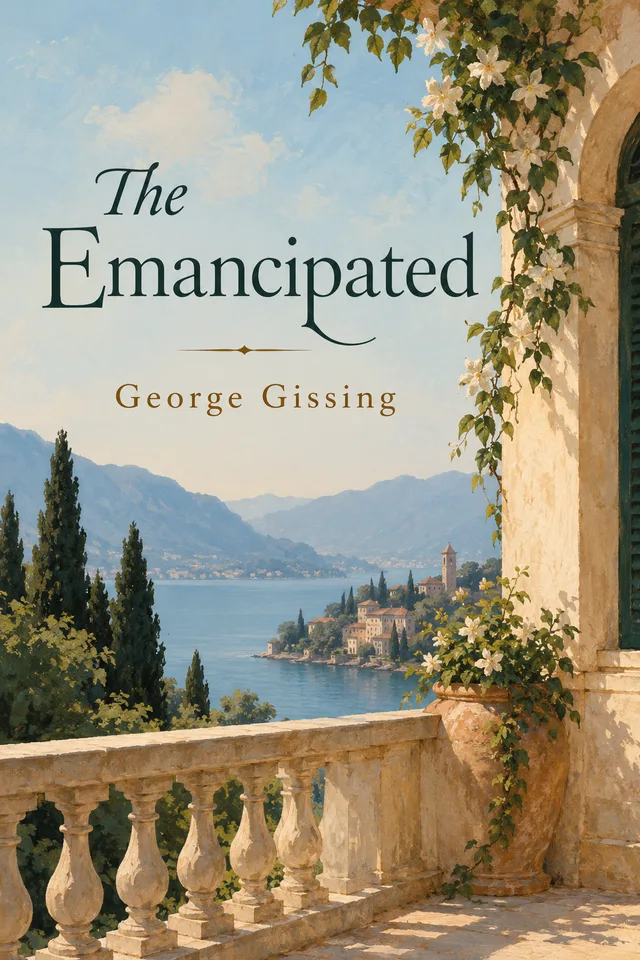
English Edition
Literature
The Emancipated
English BooksWhale Edition by George Gissing
English expatriates in Italy confront the promises of artistic freedom and the pressures of marriage, religion, and convention.
- Preview
- A sample from the prepared text
- Formats
- Online reader, EPUB, PDF
- Access
- Library claim
Book introduction
The Emancipated
George Gissing brings together English travellers and residents in Naples and Rome, where the beauty of the surroundings offers no simple escape from inherited beliefs. Artists, doubters, and ambitious young people seek independence while remaining entangled in money, desire, and social judgment. Across its two parts, the novel asks what emancipation can mean when private feeling and public expectations pull in different directions.
BooksWhale edition
How this edition was prepared
This edition is based on a public domain text and has been prepared for digital reading by BooksWhale.
Public domain basis
Why this edition can be shared
George Gissing died in 1903; this work was first published in 1890. This edition uses the public-domain English original from Project Gutenberg, excluding later editorial additions.
Read preview
A sample from the prepared text
Preview selected from the prepared reader text.
Preview chapterPART I. — CHAPTER I — NORTHERNERS IN SUNLIGHTRead preview
By a window looking from Posillipo upon the Bay of Naples sat an English lady, engaged in letter-writing. She was only in her four-and-twentieth year, but her attire of subdued mourning indicated widowhood already at the stage when it is permitted to make quiet suggestion of freedom rather than distressful reference to loss; the dress, however, was severely plain, and its grey coldness, which would well have harmonized with an English sky in this month of November, looked alien in the southern sunlight. There was no mistaking her nationality; the absorption, the troubled earnestness with which she bent over her writing, were peculiar to a cast of features such as can be found only in our familiar island; a physiognomy not quite pure in outline, vigorous in general effect and in detail delicate; a proud young face, full of character and capacity, beautiful in chaste control. Sorrowful it was not, but its paleness and thinness expressed something more than imperfect health of body; the blue-grey eyes, when they wandered for a moment in an effort of recollection, had a look of weariness, even of ennui; the lips moved as if in nervous impatience until she had found the phrase or the thought for which her pen waited. Save for these intervals, she wrote with quick decision, in a large clear hand, never underlining, but frequently supplying the emphasis of heavy stroke in her penning of a word. At the end of her letters came a signature excellent in individuality: "Miriam Baske."
The furniture of her room was modern, and of the kind demanded by wealthy forestieri in the lodgings they condescend to occupy. On the variegated tiles of the floor were strewn rugs and carpets; the drapery was bright, without much reference to taste in the ordering of hues; a handsome stove served at present to support leafy plants, a row of which also stood on the balcony before the window. Round the ceiling ran a painted border of foliage and flowers. The chief ornament of the walls was a large and indifferent copy of Raphael's "St. Cecilia;" there were, too, several gouache drawings of local scenery: a fiery night-view of Vesuvius, a panorama of the Bay, and a very blue Blue Grotto. The whole was blithe, sunny, Neapolitan; sufficiently unlike a sitting-room in Redbeck House, Bartles, Lancashire, which Mrs. Baske had in her mind as she wrote.
A few English books lay here and there, volumes of unattractive binding, and presenting titles little suggestive of a holiday in Campania; works which it would be misleading to call theological; the feeblest modern echoes of fierce old Puritans, half shame-faced modifications of logic which, at all events, was wont to conceal no consequence of its savage premises. More noticeable were some architectural plans unrolled upon a settee; the uppermost represented the elevation of a building designed for religious purposes, painfully recognizable by all who know the conventicles of sectarian England. On the blank space beneath the drawing were a few comments, lightly pencilled.
Having finished and addressed some half a dozen brief letters, Mrs. Baske brooded for several minutes before she began to write on the next sheet of paper. It was intended for her sister-in-law, a lady of middle age, who shared in the occupancy of Redbeck House. At length she penned the introductory formula, but again became absent, and sat gazing at the branches of a pine-tree which stood in strong relief against cloudless blue. A sigh, an impatient gesture, and she went on with her task.
"It is very kind of you to be so active in attending to the things which you know I have at heart. You say I shall find everything as I could wish it on my return, but you cannot think what a stranger to Bartles I already feel. It will soon be six months since I lived my real life there; during my illness I might as well have been absent, then came those weeks in the Isle of Wight, and now this exile. I feel it as exile, bitterly. To be sure Naples is beautiful, but it does not interest me. You need not envy me the bright sky, for it gives me no pleasure. There is so much to pain and sadden; so much that makes me angry. On Sunday I was miserable. The Spences are as kind as any one could be, but—I won't write about it; no doubt you understand me.
Preview chapterCHAPTER II — CECILY DORANPreview
Villa Sannazaro had no architectural beauty; it was a building of considerable size, irregular, in need of external repair. Through the middle of it ran a great archway, guarded by copies of the two Molossian hounds which stand before the Hall of Animals in the Vatican; beneath the arch, on the right-hand side, was the main entrance to the house. If you passed straight through, you came out upon a terrace, where grew a magnificent stone-pine and some robust agaves. The view hence was uninterrupted, embracing the line of the bay from Posillipo to Cape Minerva. From the parapet bordering the platform you looked over a descent of twenty feet, into a downward sloping vineyard. Formerly the residence of an old Neapolitan family, the villa had gone the way of many such ancestral abodes, and was now let out among several tenants.
The Spences were established here for the winter. On the occasion of his marriage, three years ago, Edward Spence relinquished his connection with a shipping firm, which he represented in Manchester, and went to live in London; a year and a half later he took his wife to Italy, where they had since remained. He was not wealthy, but had means sufficient to his demands and prospects. Thinking for himself in most matters, he chose to abandon money-making at the juncture when most men deem it incumbent upon them to press their efforts in that direction; business was repugnant to him, and he saw no reason why he should sacrifice his own existence to put a possible family in more than easy circumstances, He had the inclinations of a student, but was untroubled by any desire to distinguish himself, freedom from the demands of the office meant to him the possibility of living where he chose, and devoting to his books the best part of the day instead of its fragmentary leisure. His choice in marriage was most happy. Eleanor Spence had passed her maiden life in Manchester, but with parents of healthy mind and of more literature than generally falls to the lot of a commercial family. Pursuing a natural development, she allied herself with her husband's freedom of intellect, and found her nature's opportunities in the life which was to him most suitable. By a rare chance, she was the broader-minded of the two, the more truly impartial. Her emancipation from dogma had been so gradual, so unconfused by external pressure, that from her present standpoint she could look back with calmness and justice on all the stages she had left behind. With her cousin Miriam she could sympathize in a way impossible to Spence, who, by-the-bye, somewhat misrepresented his wife in the account he gave to Mallard of their Sunday experiences. Puritanism was familiar to her by more than speculation; in the compassion with which she regarded Miriam there was no mixture of contempt, as in her husband's case. On the other hand, she did not pretend to read completely her cousin's heart and mind; she knew that there was no simple key to Miriam's character, and the quiet study of its phases from day to day deeply interested her.
Cecily Doran had been known to Spence from childhood; her father was his intimate friend. But Eleanor had only made the girl's acquaintance in London, just after her marriage, when Cecily was spending a season there with her aunt, Mrs. Lessingham. Mallard's ward was then little more than fifteen; after several years of weak health, she had entered upon a vigorous maidenhood, and gave such promise of free, joyous, aspiring life as could not but strongly affect the sympathies of a woman like Eleanor. Three years prior to that, at the time of her father's death, Cecily was living with Mrs. Elgar, a widow, and her daughter Miriam, the latter on the point of marrying (at eighteen) one Mr. Baske, a pietistic mill-owner, aged fifty. It then seemed very doubtful whether Cecily would live to mature years; she had been motherless from infancy, and the difficulty with those who brought her up was to repress an activity of mind which seemed to be one cause of her bodily feebleness. In those days there was a strong affection between her and Miriam Elgar, and it showed no sign of diminution in either when, on Mrs. Elgar's death, a year and a half after Miriam's marriage, Cecily passed into the care of her father's sister, a lady of moderate fortune, of parts and attainments, and with a great love of cosmopolitan life. A few months more and Mrs. Baske was to be a widow, childless, left in possession of some eight hundred a year, her house at Bartles, and a local importance to which she was not indifferent. With the exception of her brother, away in London, she had no near kin. It would now have been a great solace to her if Cecily Doran could have been her companion; but the young girl was in Paris, or Berlin, or St. Petersburg, and, as Miriam was soon to learn, the material distance between them meant little in comparison with the spiritual remoteness which resulted from Cecily's education under Mrs. Lessingham. They corresponded, however, and at first frequently; but letters grew shorter on both sides, and arrived less often. The two were now to meet for the first time since Cecily was a child of fourteen.
Preview chapterCHAPTER III — THE BOARDING-HOUSE ON THE MERGELLINAPreview
The year was 1878. A tourist searching his Baedeker for a genteel but not oppressively aristocratic pension in the open parts of Naples would have found himself directed by an asterisk to the establishment kept by Mrs. Gluck on the Mergellina;—frequented by English and Germans, and very comfortable. The recommendation was a just one. Mrs. Gluck enjoyed the advantage of having lived as many years in England as she had in Germany; her predilections leaned, if anything, to the English side, and the arrival of a "nice" English family always put her in excellent spirits. She then exhibited herself as an Anglicized matron, perfectly familiar with all the requirements, great and little, of her guests, and, when minutiae were once settled, capable of meeting ladies and gentlemen on terms of equality in her drawing-room or at her table, where she always presided. Indeed, there was much true refinement in Mrs. Gluck. You had not been long in her house before she found an opportunity of letting you know that she prided herself on connection with the family of the great musician, and under her roof there was generally some one who played or sang well. It was her desire that all who sat at her dinner-table—the English people, at all events—should be in evening dress. She herself had no little art in adorning herself so as to appear, what she was, a lady, and yet not to conflict with the ladies whose presence honoured her.
In the drawing-room, a few days after the arrival of Mrs. Lessingham and her niece, several members of the house hold were assembled in readiness for the second dinner-bell. There was Frau Wohlgemuth, a middle-aged lady with severe brows, utilizing spare moments over a German work on Greek sculpture. Certain plates in the book had caught the eye of Mrs. Bradshaw, with the result that she regarded this innocent student as a person of most doubtful character, who, if in ignorance admitted to a respectable boardinghouse, should certainly have been got rid of as soon as the nature of her reading had been discovered. Frau Wohlgemuth had once or twice been astonished at the severe look fixed upon her by the buxom English lady, but happily would never receive an explanation of this silent animus. Then there was Fraulein Kriel, who had unwillingly incurred even more of Mrs. Bradshaw's displeasure, in that she, an unmarried person, had actually looked over the volume together with its possessor, not so much as blushing when she found herself observed by strangers. The remaining persons were an English family, a mother and three daughters, their name Denyer.
Mrs. Denyer was florid, vivacious, and of a certain size. She had seen much of the world, and prided herself on cosmopolitanism; the one thing with which she could not dispense was intellectual society. This would be her second winter at Naples, but she gave her acquaintances to understand that Italy was by no means the country of her choice; she preferred the northern latitudes, because there the intellectual atmosphere was more bracing. But for her daughters' sake she abode here: "You know, my gills adore Italy."
Of these young ladies, the two elder—Barbara and Madeline were their seductive names—had good looks. Barbara, perhaps twenty-two years old, was rather colourless, somewhat too slim, altogether a trifle limp; but she had a commendable taste in dress. Madeline, a couple of years younger, presented a more healthy physique and a less common comeliness, but in the matter of costume she lacked her sister's discretion. Her colours were ill-matched, her ornaments awkwardly worn; even her hair sought more freedom than was consistent with grace. The youngest girl, Zillah, who was about nineteen, had been less kindly dealt with by nature; like Barbara, she was of very light complexion, and this accentuated her plainness. She aimed at no compensation in attire, unless it were that her sober garments exhibited perfect neatness and complete inoffensiveness. Zillah's was a good face, in spite of its unattractive features; she had a peculiarly earnest look, a reflective manner, and much conscientiousness of speech.
Table of contents
Inside this edition
- 01PART I. — CHAPTER I — NORTHERNERS IN SUNLIGHT
- 02CHAPTER II — CECILY DORAN
- 03CHAPTER III — THE BOARDING-HOUSE ON THE MERGELLINA
- 04CHAPTER IV — MIRIAM'S BROTHER
- 05CHAPTER V — THE ARTIST ASTRAY
- 06CHAPTER VI — CAPTIVE TRAVELLERS
- 07CHAPTER VII — THE MARTYR
- 08CHAPTER VIII — PROOF AGAINST ILLUSION
- 09CHAPTER IX — IN THE DEAD CITY
- 10CHAPTER X — THE DECLARATION
- 11CHAPTER XI — THE APPEAL TO AUTHORITY
- 12CHAPTER XII — ON THE HEIGHTS
- 13CHAPTER XIII — ECHO AND PRELUDE
- 14CHAPTER XIV — ON THE WINGS OF THE MORNING
- 15CHAPTER XV — "WOLF!"
- 16CHAPTER XVI — LETTERS
- 17PART II. — CHAPTER I — A CORNER OF SOCIETY
- 18CHAPTER II — THE PROPRIETIES DEFENDED
- 19CHAPTER III — GRADATION
- 20CHAPTER IV — THE DENYERS IN ENGLAND
- 21CHAPTER V — MULTUM IN PARVO
- 22CHAPTER VI — AT PAESTUM
- 23CHAPTER VII — LEARNING AND TEACHING
- 24CHAPTER VIII — STUMBLINGS
- 25CHAPTER IX — SILENCES
- 26CHAPTER X — ELGAR AT WORK
- 27CHAPTER XI — IN DUE COURSE
- 28CHAPTER XII — CECILY'S RETURN
- 29CHAPTER XIII — ONWARD TO THE VAGUE
- 30CHAPTER XIV — SUGGESTION AND ASSURANCE
- 31CHAPTER XV — PEACE IN SHOW AND PEACE IN TRUTH
- 32CHAPTER XVI — THE TWO FACES
- 33CHAPTER XVII — END AND BEGINNING
Language availability
Other languages
Additional language editions are not published yet. This section will link to other BooksWhale editions when they become available.
Request another language