English Edition
Science
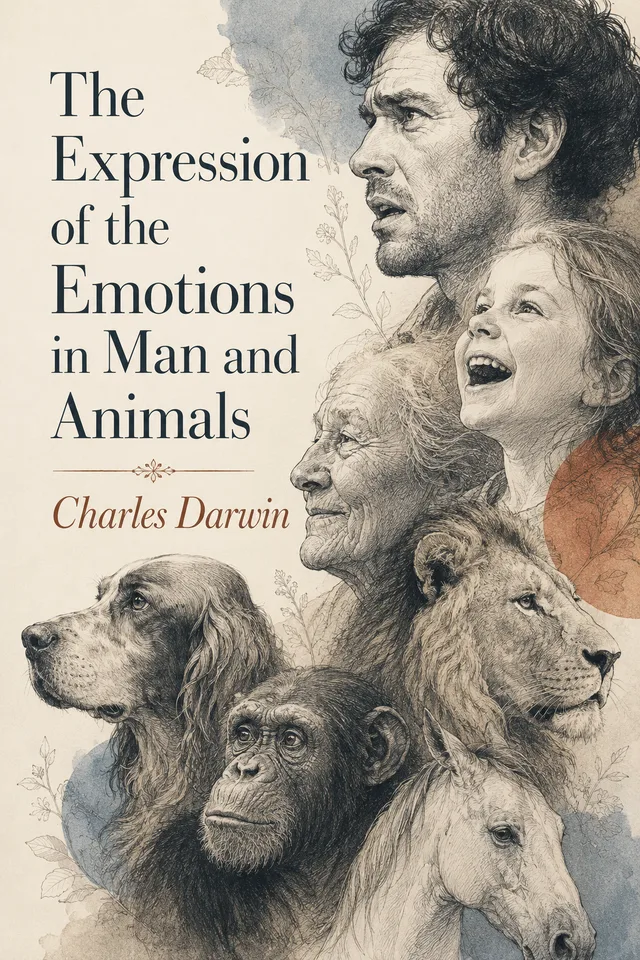
The Expression of the Emotions in Man and Animals
English BooksWhale Edition by Charles Darwin
A public-domain original edition centered on emotion, facial expression, gesture, fear, grief, rage, joy, animals, and evolutionary continuity.
- Preview
- A sample from the prepared text
- Formats
- Online reader, EPUB, PDF
- Access
- Library claim
Book introduction
The Expression of the Emotions in Man and Animals
The Expression of the Emotions in Man and Animals by Charles Darwin is presented here as a clean original-language edition. The work is especially valuable for readers interested in emotion, facial expression, gesture, fear, grief, rage, joy, animals, and evolutionary continuity. Its themes, historical context, and authorial style give this edition strong discovery value for classic literature and public-domain research.
BooksWhale edition
How this edition was prepared
This edition is based on a public domain text and has been prepared for digital reading by BooksWhale.
Public domain basis
Why this edition can be shared
Charles Darwin died in 1882, and The Expression of the Emotions in Man and Animals was first published or composed in 1872. These dates support the public-domain basis for the original English source text used in this edition.
Read preview
A sample from the prepared text
Preview selected from the prepared reader text.
Preview chapterFull textRead preview
The Expression of the Emotions in Man and Animals
By Charles Darwin
_With Photographic And Other Illustrations_
New York
Preview chapterD. Appleton And CompanyPreview
1899
INTRODUCTION.
Many works have been written on Expression, but a greater number on Physiognomy,—that is, on the recognition of character through the study of the permanent form of the features. With this latter subject I am not here concerned. The older treatises,[1] which I have consulted, have been of little or no service to me. The famous ‘Conférences’[2] of the painter Le Brun, published in 1667, is the best known ancient work, and contains some good remarks. Another somewhat old essay, namely, the ‘Discours,’ delivered 1774-1782, by the well-known Dutch anatomist Camper,[3] can hardly be considered as having made any marked advance in the subject. The following works, on the contrary, deserve the fullest consideration.
Sir Charles Bell, so illustrious for his discoveries in physiology, published in 1806 the first edition, and in the third edition of his ‘Anatomy and Philosophy of Expression.’[4] He may with justice be said, not only to have laid the foundations of the subject as a branch of science, but to have built up a noble structure. His work is in every way deeply interesting; it includes graphic descriptions of the various emotions, and is admirably illustrated. It is generally admitted that his service consists chiefly in having shown the intimate relation which exists between the movements of expression and those of respiration. One of the most important points, small as it may at first appear, is that the muscles round the eyes are involuntarily contracted during violent expiratory efforts, in order to protect these delicate organs from the pressure of the blood. This fact, which has been fully investigated for me with the greatest kindness by Professors Donders of Utrecht, throws, as we shall hereafter see, a flood of light on several of the most important expressions of the human countenance. The merits of Sir C. Bell’s work have been undervalued or quite ignored by several foreign writers, but have been fully admitted by some, for instance by
M. Lemoine,[5] who with great justice says:—“Le livre de Ch. Bell
devrait être médité par quiconque essaye de faire parler le visage de l’homme, par les philosophes aussi bien que par les artistes, car, sous une apparence plus légère et sous le prétexte de l’esthétique, c’est un des plus beaux monuments de la science des rapports du physique et du moral.”
From reasons which will presently be assigned, Sir C. Bell did not attempt to follow out his views as far as they might have been carried. He does not try to explain why different muscles are brought into action under different emotions; why, for instance, the inner ends of the eyebrows are raised, and the corners of the mouth depressed, by a person suffering from grief or anxiety.
In 1807 M. Moreau edited an edition of Lavater on Physiognomy,[6] in which he incorporated several of his own essays, containing excellent descriptions of the movements of the facial muscles, together with many valuable remarks. He throws, however, very little light on the philosophy of the subject. For instance, M. Moreau, in speaking of the act of frowning, that is, of the contraction of the muscle called by French writers the _soucilier_ (_corrigator supercilii_), remarks with truth:—“Cette action des sourciliers est un des symptômes les plus tranchés de l’expression des affections pénibles ou concentrées.” He then adds that these muscles, from their attachment and position, are fitted “à resserrer, à concentrer les principaux traits de la _face_, comme il convient dans toutes ces passions vraiment oppressives ou profondes, dans ces affections dont le sentiment semble porter l’organisation à revenir sur elle-même, à se contracter et à _s’amoindrir_, comme pour offrir moins de prise et de surface à des impressions redoutables ou importunes.” He who thinks that remarks of this kind throw any light on the meaning or origin of the different expressions, takes a very different view of the subject to what I do.
Preview chapterC. Bell’s work, he would probably not have said (s. 101) that violentPreview
laughter causes a frown from partaking of the nature of pain; or that with infants (s. 103) the tears irritate the eyes, and thus excite the contraction of the surrounding in muscles. Many good remarks are scattered throughout this volume, to which I shall hereafter refer.
Short discussions on Expression may be found in various works, which need not here be particularised. Mr. Bain, however, in two of his works has treated the subject at some length. He says,[8] “I look upon the expression so-called as part and parcel of the feeling. I believe it to be a general law of the mind that along with the fact of inward feeling or consciousness, there is a diffusive action or excitement over the bodily members.” In another place he adds, “A very considerable number of the facts may be brought under the following principle: namely, that states of pleasure are connected with an increase, and states of pain with an abatement, of some, or all, of the vital functions.” But the above law of the diffusive action of feelings seems too general to throw much light on special expressions.
Mr. Herbert Spencer, in treating of the Feelings in his ‘Principles of Psychology’ (1855), makes the following remarks:—“Fear, when strong, expresses itself in cries, in efforts to hide or escape, in palpitations and tremblings; and these are just the manifestations that would accompany an actual experience of the evil feared. The destructive passions are shown in a general tension of the muscular system, in gnashing of the teeth and protrusion of the claws, in dilated eyes and nostrils in growls; and these are weaker forms of the actions that accompany the killing of prey.” Here we have, as I believe, the true theory of a large number of expressions; but the chief interest and difficulty of the subject lies in following out the wonderfully complex results. I infer that some one (but who he is I have not been able to ascertain) formerly advanced a nearly similar view, for Sir C. Bell says,[9] “It has been maintained that what are called the external signs of passion, are only the concomitants of those voluntary movements which the structure renders necessary.” Mr. Spencer has also published[10] a valuable essay on the physiology of Laughter, in which he insists on “the general law that feeling passing a certain pitch, habitually vents itself in bodily action,” and that “an overflow of nerve-force undirected by any motive, will manifestly take first the most habitual routes; and if these do not suffice, will next overflow into the less habitual ones.” This law I believe to be of the highest importance in throwing light on our subject.’[11]
All the authors who have written on Expression, with the exception of Mr. Spencer—the great expounder of the principle of Evolution—appear to have been firmly convinced that species, man of course included, came into existence in their present condition. Sir C. Bell, being thus convinced, maintains that many of our facial muscles are “purely instrumental in expression;” or are “a special provision” for this sole object.[12] But the simple fact that the anthropoid apes possess the same facial muscles as we do,[13] renders it very improbable that these muscles in our case serve exclusively for expression; for no one, I presume, would be inclined to admit that monkeys have been endowed with special muscles solely for exhibiting their hideous grimaces. Distinct uses, independently of expression, can indeed be assigned with much probability for almost all the facial muscles.
Sir C. Bell evidently wished to draw as broad a distinction as possible between man and the lower animals; and he consequently asserts that with “the lower creatures there is no expression but what may be referred, more or less plainly, to their acts of volition or necessary instincts.” He further maintains that their faces “seem chiefly capable of expressing rage and fear.”[14] But man himself cannot express love and humility by external signs, so plainly as does a dog, when with drooping ears, hanging lips, flexuous body, and wagging tail, he meets his beloved master. Nor can these movements in the dog be explained by acts of volition or necessary instincts, any more than the beaming eyes and smiling cheeks of a man when he meets an old friend. If Sir C. Bell had been questioned about the expression of affection in the dog, he would no doubt have answered that this animal had been created with special instincts, adapting him for association with man, and that all further enquiry on the subject was superfluous.
Table of contents
Inside this edition
- 01Full text
- 02D. Appleton And Company
- 03C. Bell’s work, he would probably not have said (s. 101) that violent
- 04part of Gippsland, Victoria.
- 05I have discussed at some little length, though as I am well aware, in a
- 06I thought it dead.
- 07I have frequently observed that when persons scratch some point which
- 08I have also seen a young woman whose forehead seemed almost habitually
- 09C. Bell’s explanation is erroneous. He maintains that arrested
- 10CHAPTER X. HATRED AND ANGER.
- 11M. Lemoine has argued[1101] that their descriptions are not
- 12I have also noticed that under slight fear there is a strong tendency
- 13C. Bell insists[1331] that blushing “is a provision for expression, as
- 14I discover grounds for believing that any inherited movement, which now
Language availability
Other languages
Additional language editions are not published yet. This section will link to other BooksWhale editions when they become available.
Request another language