English Edition
Literature
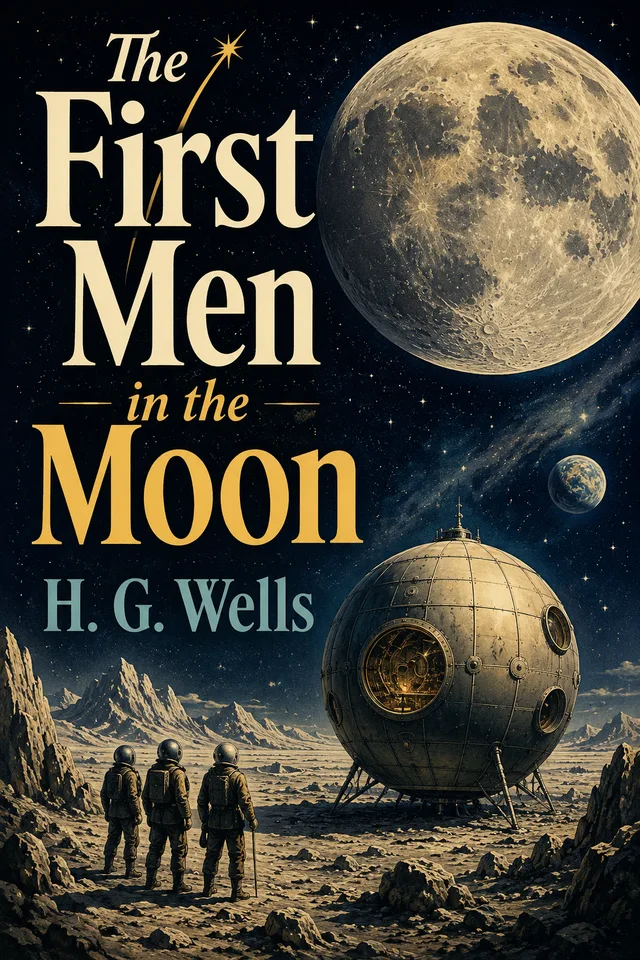
The First Men in the Moon
English BooksWhale Edition by H. G. Wells
H. G. Wells sends invention and imperial curiosity to the Moon, where discovery becomes strange, comic, and unsettling.
- Preview
- A sample from the prepared text
- Formats
- Online reader, EPUB, PDF
- Access
- Library claim
Book introduction
The First Men in the Moon
The First Men in the Moon begins with Cavor's anti-gravity substance and Bedford's opportunism, then carries them into the lunar world of the Selenites. Wells turns a voyage of scientific wonder into a sharp story about exploration, empire, social organization, and the limits of human confidence.
BooksWhale edition
How this edition was prepared
This edition is based on a public domain text and has been prepared for digital reading by BooksWhale.
Public domain basis
Why this edition can be shared
H. G. Wells died in 1946, and The First Men in the Moon was first published in 1901. These dates support the public-domain basis for this English original-language edition.
Read preview
A sample from the prepared text
Preview selected from the prepared reader text.
Preview chapterFull textRead preview
The First Men in the Moon
Preview chapterI. Mr. Bedford Meets Mr. Cavor at LympnePreview
As I sit down to write here amidst the shadows of vine-leaves under the blue sky of southern Italy, it comes to me with a certain quality of astonishment that my participation in these amazing adventures of Mr. Cavor was, after all, the outcome of the purest accident. It might have been any one. I fell into these things at a time when I thought myself removed from the slightest possibility of disturbing experiences. I had gone to Lympne because I had imagined it the most uneventful place in the world. “Here, at any rate,” said I, “I shall find peace and a chance to work!”
And this book is the sequel. So utterly at variance is destiny with all the little plans of men. I may perhaps mention here that very recently I had come an ugly cropper in certain business enterprises. Sitting now surrounded by all the circumstances of wealth, there is a luxury in admitting my extremity. I can admit, even, that to a certain extent my disasters were conceivably of my own making. It may be there are directions in which I have some capacity, but the conduct of business operations is not among these. But in those days I was young, and my youth among other objectionable forms took that of a pride in my capacity for affairs. I am young still in years, but the things that have happened to me have rubbed something of the youth from my mind. Whether they have brought any wisdom to light below it is a more doubtful matter.
It is scarcely necessary to go into the details of the speculations that landed me at Lympne, in Kent. Nowadays even about business transactions there is a strong spice of adventure. I took risks. In these things there is invariably a certain amount of give and take, and it fell to me finally to do the giving reluctantly enough. Even when I had got out of everything, one cantankerous creditor saw fit to be malignant. Perhaps you have met that flaming sense of outraged virtue, or perhaps you have only felt it. He ran me hard. It seemed to me, at last, that there was nothing for it but to write a play, unless I wanted to drudge for my living as a clerk. I have a certain imagination, and luxurious tastes, and I meant to make a vigorous fight for it before that fate overtook me. In addition to my belief in my powers as a business man, I had always in those days had an idea that I was equal to writing a very good play. It is not, I believe, a very uncommon persuasion. I knew there is nothing a man can do outside legitimate business transactions that has such opulent possibilities, and very probably that biased my opinion. I had, indeed, got into the habit of regarding this unwritten drama as a convenient little reserve put by for a rainy day. That rainy day had come, and I set to work.
I soon discovered that writing a play was a longer business than I had supposed; at first I had reckoned ten days for it, and it was to have a _pied-à-terre_ while it was in hand that I came to Lympne. I reckoned myself lucky in getting that little bungalow. I got it on a three years’ agreement. I put in a few sticks of furniture, and while the play was in hand I did my own cooking. My cooking would have shocked Mrs. Bond. And yet, you know, it had flavour. I had a coffee-pot, a sauce-pan for eggs, and one for potatoes, and a frying-pan for sausages and bacon—such was the simple apparatus of my comfort. One cannot always be magnificent, but simplicity is always a possible alternative. For the rest I laid in an eighteen-gallon cask of beer on credit, and a trustful baker came each day. It was not, perhaps, in the style of Sybaris, but I have had worse times. I was a little sorry for the baker, who was a very decent man indeed, but even for him I hoped.
Preview chapterII. The First Making of CavoritePreview
But Cavor’s fears were groundless, so far as the actual making was concerned. On the 14th of October, 1899, this incredible substance was made!
Oddly enough, it was made at last by accident, when Mr. Cavor least expected it. He had fused together a number of metals and certain other things—I wish I knew the particulars now!—and he intended to leave the mixture a week and then allow it to cool slowly. Unless he had miscalculated, the last stage in the combination would occur when the stuff sank to a temperature of 60 degrees Fahrenheit. But it chanced that, unknown to Cavor, dissension had arisen about the furnace tending. Gibbs, who had previously seen to this, had suddenly attempted to shift it to the man who had been a gardener, on the score that coal was soil, being dug, and therefore could not possibly fall within the province of a joiner; the man who had been a jobbing gardener alleged, however, that coal was a metallic or ore-like substance, let alone that he was cook. But Spargus insisted on Gibbs doing the coaling, seeing that he was a joiner and that coal is notoriously fossil wood. Consequently Gibbs ceased to replenish the furnace, and no one else did so, and Cavor was too much immersed in certain interesting problems concerning a Cavorite flying machine (neglecting the resistance of the air and one or two other points) to perceive that anything was wrong. And the premature birth of his invention took place just as he was coming across the field to my bungalow for our afternoon talk and tea.
I remember the occasion with extreme vividness. The water was boiling, and everything was prepared, and the sound of his “zuzzoo” had brought me out upon the verandah. His active little figure was black against the autumnal sunset, and to the right the chimneys of his house just rose above a gloriously tinted group of trees. Remoter rose the Wealden Hills, faint and blue, while to the left the hazy marsh spread out spacious and serene. And then—
The chimneys jerked heavenward, smashing into a string of bricks as they rose, and the roof and a miscellany of furniture followed. Then overtaking them came a huge white flame. The trees about the building swayed and whirled and tore themselves to pieces, that sprang towards the flare. My ears were smitten with a clap of thunder that left me deaf on one side for life, and all about me windows smashed, unheeded.
I took three steps from the verandah towards Cavor’s house, and even as I did so came the wind.
Instantly my coat tails were over my head, and I was progressing in great leaps and bounds, and quite against my will, towards him. In the same moment the discoverer was seized, whirled about, and flew through the screaming air. I saw one of my chimney pots hit the ground within six yards of me, leap a score of feet, and so hurry in great strides towards the focus of the disturbance. Cavor, kicking and flapping, came down again, rolled over and over on the ground for a space, struggled up and was lifted and borne forward at an enormous velocity, vanishing at last among the labouring, lashing trees that writhed about his house.
A mass of smoke and ashes, and a square of bluish shining substance rushed up towards the zenith. A large fragment of fencing came sailing past me, dropped edgeways, hit the ground and fell flat, and then the worst was over. The aerial commotion fell swiftly until it was a mere strong gale, and I became once more aware that I had breath and feet. By leaning back against the wind I managed to stop, and could collect such wits as still remained to me.
In that instant the whole face of the world had changed. The tranquil sunset had vanished, the sky was dark with scurrying clouds, everything was flattened and swaying with the gale. I glanced back to see if my bungalow was still in a general way standing, then staggered forwards towards the trees amongst which Cavor had vanished, and through whose tall and leaf-denuded branches shone the flames of his burning house.
Table of contents
Inside this edition
- 01Full text
- 02I. Mr. Bedford Meets Mr. Cavor at Lympne
- 03II. The First Making of Cavorite
- 04III. The Building of the sphere
- 05IV. Inside the Sphere
- 06V. The Journey to the Moon
- 07VI. The Landing on the Moon
- 08VII. Sunrise on the Moon
- 09VIII. A Lunar Morning
- 10IX. Prospecting Begins
- 11X. Lost Men in the Moon
- 12XI. The Mooncalf Pastures
- 13XII. The Selenite’s Face
- 14XIII. Mr. Cavor Makes Some Suggestions
- 15XIV. Experiments in intercourse
- 16XV. The Giddy Bridge
- 17XVI. Points of View
- 18XVII. The Fight in the Cave of the Moon Butchers
- 19XVIII. In the Sunlight
- 20XIX. Mr. Bedford Alone
- 21XX. Mr. Bedford in Infinite Space
- 22XXI. Mr. Bedford at Littlestone
- 23XXII. The Astonishing Communication of Mr. Julius Wendigee
- 24XXIII. An Abstract of the Six Messages First Received from Mr. Cavor
- 25XXIV. The Natural History of the Selenites
- 26XXV. The Grand Lunar
- 27XXVI. The Last Message Cavor sent to the Earth
Language availability
Other languages
Additional language editions are not published yet. This section will link to other BooksWhale editions when they become available.
Request another language