English Edition
Literature
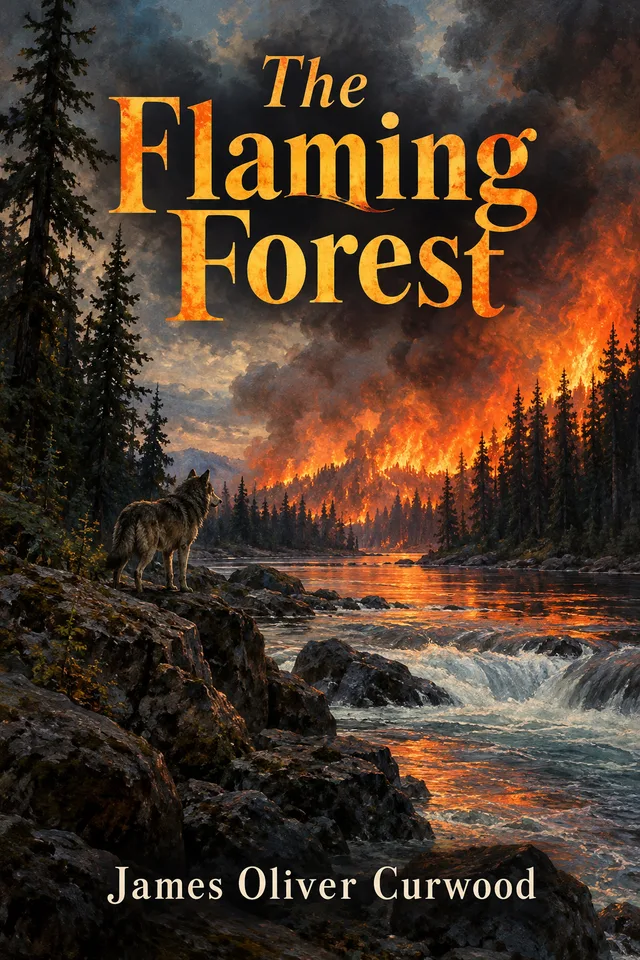
The Flaming Forest
English BooksWhale Edition by James Oliver Curwood
An injured Canadian police officer is drawn into a river journey filled with hidden loyalties, danger, and an approaching forest fire.
- Preview
- A sample from the prepared text
- Formats
- Online reader, EPUB, PDF
- Access
- Library claim
Book introduction
The Flaming Forest
David Carrigan’s mission in the Canadian north takes an unexpected turn when an attack leaves him injured and dependent on strangers. His encounter with Marie-Anne and St. Pierre opens a story of withheld explanations, personal allegiance, and the hazards of river and forest. James Oliver Curwood combines adventure and romance across twenty-six chapters, bringing the human conflicts into the path of a devastating fire.
BooksWhale edition
How this edition was prepared
This edition is based on a public domain text and has been prepared for digital reading by BooksWhale.
Public domain basis
Why this edition can be shared
James Oliver Curwood died in 1927; the work was first published in 1921. This edition uses the public-domain English original from Project Gutenberg, without later notes, illustrations, or publisher material.
Read preview
A sample from the prepared text
Preview selected from the prepared reader text.
Preview chapterIRead preview
An hour ago, under the marvelous canopy of the blue northern sky, David Carrigan, Sergeant in His Most Excellent Majesty's Royal Northwest Mounted Police, had hummed softly to himself, and had thanked God that he was alive. He had blessed McVane, superintendent of "N" Division at Athabasca Landing, for detailing him to the mission on which he was bent. He was glad that he was traveling alone, and in the deep forest, and that for many weeks his adventure would carry him deeper and deeper into his beloved north. Making his noonday tea over a fire at the edge of the river, with the green forest crowding like an inundation on three sides of him, he had come to the conclusion—for the hundredth time, perhaps—that it was a nice thing to be alone in the world, for he was on what his comrades at the Landing called a "bad assignment."
"If anything happens to me," Carrigan had said to McVane, "there isn't anybody in particular to notify. I lost out in the matter of family a long time ago."
He was not a man who talked much about himself, even to the superintendent of "N" Division, yet there were a thousand who loved Dave Carrigan, and many who placed their confidences in him. Superintendent Me Vane had one story which he might have told, but he kept it to himself, instinctively sensing the sacredness of it. Even Carrigan did not know that the one thing which never passed his lips was known to McVane.
Of that, too, he had been thinking an hour ago. It was the thing which, first of all, had driven him into the north. And though it had twisted and disrupted the earth under his feet for a time, it had brought its compensation. For he had come to love the north with a passionate devotion. It was, in a way, his God. It seemed to him that the time had never been when he had lived any other life than this under the open skies. He was thirty-seven now. A bit of a philosopher, as philosophy comes to one in a sun-cleaned and unpolluted air, A good-humored brother of humanity, even when he put manacles on other men's wrists; graying a little over the temples—and a lover of life. Above all else he was that. A lover of life. A worshiper at the shrine of God's Country.
So he sat, that hour ago, deep in the wilderness eighty miles north of Athabasca Landing, congratulating himself on the present conditions of his existence. A hundred and eighty miles farther on was Fort McMurray, and another two hundred beyond that was Chipewyan, and still beyond that the Mackenzie and its fifteen-hundred-mile trail to the northern sea. He was glad there was no end to this world of his. He was glad there were few people in it. But these people he loved. That hour ago he had looked out on the river as two York boats had forged up against the stream, craft like the long, slim galleys of old, brought over through the Churchill and Clearwater countries from Hudson's Bay. There were eight rowers in each boat. They were singing. Their voices rolled between the walls of the forests. Their naked arms and shoulders glistened in the sun. They rowed like Vikings, and to him they were symbols of the freedom of the world. He had watched them until they were gone up-stream, but it was a long time before the chanting of their voices had died away. And then he had risen from beside his tiny fire, and had stretched himself until his muscles cracked. It was good to feel the blood running red and strong in one's veins at the age of thirty-seven. For Carrigan felt the thrill of these days when strong men were coming out of the north—days when the glory of June hung over the land, when out of the deep wilderness threaded by the Three Rivers came romance and courage and red-blooded men and women of an almost forgotten people to laugh and sing and barter for a time with the outpost guardians of a younger and more progressive world. It was north of Fifty-Four, and the waters of a continent flowed toward the Arctic Sea. Yet soon would the strawberries be crushing red underfoot; the forest road was in bloom, scarlet fire-flowers reddened the trail, wild hyacinths and golden-freckled violets played hide-and-seek with the forget-me-nots in the meadows, and the sky was a great splash of velvety blue. It was the north triumphant—at the edge of civilization; the north triumphant, and yet paying its tribute. For at the other end were waiting the royal Upper Ten Thousand and the smart Four Hundred with all the beau monde behind them, coveting and demanding that tribute to their sex—the silken furs of a far country, the life's blood and labor of a land infinitely beyond the pale of drawing-rooms and the whims of fashion.
Preview chapterIIPreview
Huddled behind a rock which was scarcely larger than his body, groveling in the white, soft sand like a turtle making a nest for its eggs, Carrigan told himself this without any reservation. He was, as he kept repeating to himself for the comfort of his soul, in a deuce of a fix. His head was bare—simply because a bullet had taken his hat away. His blond hair was filled with sand. His face was sweating. But his blue eyes were alight with a grim sort of humor, though he knew that unless the other fellow's ammunition ran out he was going to die.
For the twentieth time in as many minutes he looked about him. He was in the center of a flat area of sand. Fifty feet from him the river murmured gently over yellow bars and a carpet of pebbles. Fifty feet on the opposite side of him was the cool, green wall of the forest. The sunshine playing in it seemed like laughter to him now, a whimsical sort of merriment roused by the sheer effrontery of the joke which fate had inflicted upon him.
Between the river and the balsam and spruce was only the rock behind which he was cringing like a rabbit afraid to take to the open. And his rock was a mere up-jutting of the solid floor of shale that was under him. The wash sand that covered it like a carpet was not more than four or five inches deep. He could not dig in. There was not enough of it within reach to scrape up as a protection. And his enemy, a hundred yards or so away, was a determined wretch—and the deadliest shot he had ever known.
Three times Carrigan had made experiments to prove this, for he had in mind a sudden rush to the shelter of the timber. Three times he had raised the crown of his hat slightly above the top of the rock, and three times the marksmanship of the other had perforated it with neatness and dispatch. The third bullet had carried his hat a dozen feet away. Whenever he showed a patch of his clothing, a bullet replied with unerring precision. Twice they had drawn blood. And the humor faded out of Carrigan's eyes.
Not long ago he had exulted in the bigness and glory of this country of his, where strong men met hand to hand and eye to eye. There were the other kind in it, the sort that made his profession of manhunting a thing of reality and danger, but he expected these—forgot them—when the wilderness itself filled his vision. But his present situation was something unlike anything that had ever happened in his previous experience with the outlawed. He had faced dangers. He had fought. There were times when he had almost died. Fanchet, the half-breed who had robbed a dozen wilderness mail sledges, had come nearest to trapping him and putting him out of business. Fanchet was a desperate man and had few scruples. But even Fanchet—before he was caught—would not have cornered a man with such bloodthirsty unfairness as Carrigan found himself cornered now. He no longer had a doubt as to what was in the other's mind. It was not to wound and make merely helpless. It was to kill. It was not difficult to prove this. Careful not to expose a part of his arm or shoulder, he drew a white handkerchief from his pocket, fastened it to the end of his rifle, and held the flag of surrender three feet above the rock. And then, with equal caution, he slowly thrust up a flat piece of shale, which at a distance of a hundred yards might appear as his shoulder or even his head. Scarcely was it four inches above the top of the rock before there came the report of a rifle, and the shale was splintered into a hundred bits.
Preview chapterIIIPreview
For a matter of twenty seconds—even longer it seemed to Carrigan—the life of these two was expressed in a vivid and unforgettable tableau. One half of it David saw—the blue sky, the dazzling sun, the girl in between. The pistol dropped from his limp hand, and the weight of his body tottered on the crook of his under-elbow. Mentally and physically he was on the point of collapse, and yet in those few moments every detail of the picture was painted with a brush of fire in his brain. The girl was bareheaded. Her face was as white as any face he had ever seen, living or dead; her eyes were like pools that had caught the reflection of fire; he saw the sheen of her hair, the poise of her slender body—its shock, stupefaction, horror. He sensed these things even as his brain wobbled dizzily, and the larger part of the picture began to fade out of his vision. But her face remained to the last. It grew clearer, like a cameo framed in an iris—a beautiful, staring, horrified face with shimmering tresses of jet-black hair blowing about it like a veil. He noticed the hair, that was partly undone as if she had been in a struggle of some sort, or had been running fast against the breeze that came up the river.
He fought with himself to hold that picture of her, to utter some word, make some movement. But the power to see and to live died out of him. He sank back with a queer sound in his throat. He did not hear the answering cry from the girl as she flung herself, with a quick little prayer for help, on her knees in the soft, white sand beside him. He felt no movement when she raised his head in her arm and with her bare hand brushed back his sand-littered hair, revealing where the bullet had struck him. He did not know when she ran back to the river.
His first sensation was of a cool and comforting something trickling over his burning temples and his face. It was water. Subconsciously he knew that, and in the same way he began to think. But it was hard to pull his thoughts together. They persisted in hopping about, like a lot of sand-fleas in a dance, and just as he got hold of one and reached for another, the first would slip away from him. He began to get the best of them after a time, and he had an uncontrollable desire to say something. But his eyes and his lips were sealed tight, and to open them, a little army of gnomes came out of the darkness in the back of his head, each of them armed with a lever, and began prying with all their might. After that came the beginning of light and a flash of consciousness.
The girl was working over him. He could feel her and hear her movement. Water was trickling over his face. Then he heard a voice, close over him, saying something in a sobbing monotone which he could not understand.
With a mighty effort he opened his eyes.
"Thank LE BON DIEU, you live, m'sieu," he heard the voice say, as if coming from a long distance away. "You live, you live—"
"Tryin' to," he mumbled thickly, feeling suddenly a sense of great elation. "Tryin'—"
He wanted to curse the gnomes for deserting him, for as soon as they were gone with their levers, his eyes and his lips shut tight again, or at least he thought they did. But he began to sense things in a curious sort of way. Some one was dragging him. He could feel the grind of sand under his body. There were intervals when the dragging operation paused. And then, after a long time, he seemed to hear more than one voice. There were two—sometimes a murmur of them. And odd visions came to him. He seemed to see the girl with shining black hair and dark eyes, and then swiftly she would change into a girl with hair like blazing gold. This was a different girl. She was not like Pretty Eyes, as his twisted mind called the other. This second vision that he saw was like a radiant bit of the sun, her hair all aflame with the fire of it and her face a different sort of face. He was always glad when she went away and Pretty Eyes came back.
Table of contents
Inside this edition
- 01I
- 02II
- 03III
- 04IV
- 05V
- 06VI
- 07VII
- 08VIII
- 09IX
- 10X
- 11XI
- 12XII
- 13XIII
- 14XIV
- 15XV
- 16XVI
- 17XVII
- 18XVIII
- 19XIX
- 20XX
- 21XXI
- 22XXII
- 23XXIII
- 24XXIV
- 25XXV
- 26XXVI
Language availability
Other languages
Additional language editions are not published yet. This section will link to other BooksWhale editions when they become available.
Request another language