English Edition
Literature
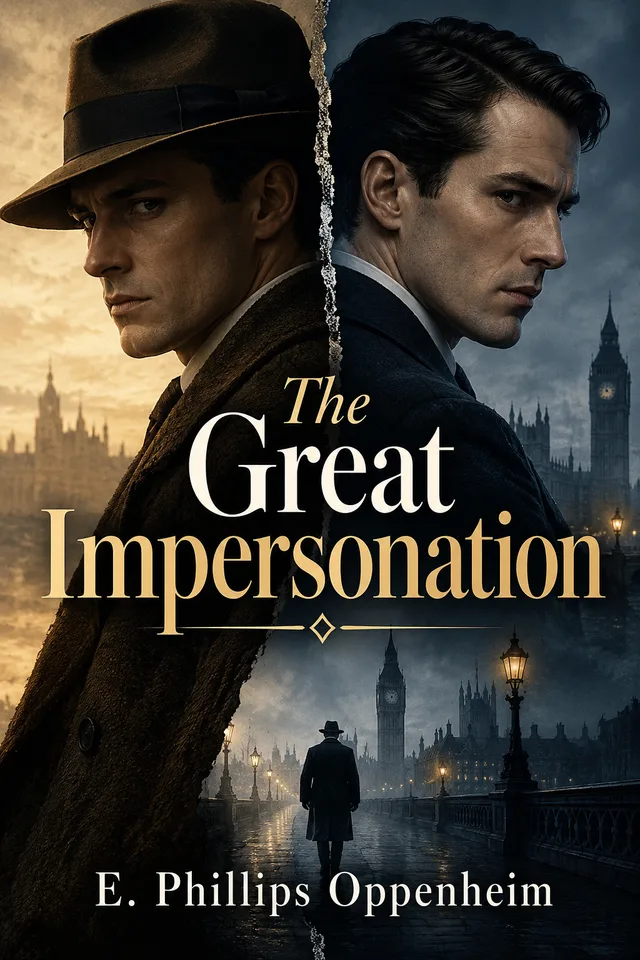
The Great Impersonation
English BooksWhale Edition by E. Phillips Oppenheim
A meeting between lookalikes in Africa leads to a tense struggle over identity, espionage, and trust in prewar English society.
- Preview
- A sample from the prepared text
- Formats
- Online reader, EPUB, PDF
- Access
- Library claim
Book introduction
The Great Impersonation
An Englishman and his German double meet in Africa, setting in motion a dangerous scheme that reaches an English country house. When Everard Dominey returns home, his changed behavior troubles those who knew him before. E. Phillips Oppenheim builds the suspense through uncertain identities, private loyalties, and preparations for war. This English text includes the novel’s twenty-nine chapters.
BooksWhale edition
How this edition was prepared
This edition is based on a public domain text and has been prepared for digital reading by BooksWhale.
Public domain basis
Why this edition can be shared
E. Phillips Oppenheim died in 1946; the work was first published in 1920. This edition uses the public-domain English original from Project Gutenberg, without later notes, illustrations, or publisher material.
Read preview
A sample from the prepared text
Preview selected from the prepared reader text.
Preview chapterCHAPTER IRead preview
The trouble from which great events were to come began when Everard Dominey, who had been fighting his way through the scrub for the last three quarters of an hour towards those thin, spiral wisps of smoke, urged his pony to a last despairing effort and came crashing through the great oleander shrub to pitch forward on his head in the little clearing. It developed the next morning, when he found himself for the first time for many months on the truckle bed, between linen sheets, with a cool, bamboo-twisted roof between him and the relentless sun. He raised himself a little in the bed.
“Where the mischief am I?” he demanded.
A black boy, seated cross-legged in the entrance of the banda, rose to his feet, mumbled something and disappeared. In a few moments the tall, slim figure of a European, in spotless white riding clothes, stooped down and came over to Dominey's side.
“You are better?” he enquired politely.
“Yes, I am,” was the somewhat brusque rejoinder. “Where the mischief am I, and who are you?”
The newcomer's manner stiffened. He was a person of dignified carriage, and his tone conveyed some measure of rebuke.
“You are within half a mile of the Iriwarri River, if you know where that is,” he replied,—“about seventy-two miles southeast of the Darawaga Settlement.”
“The devil! Then I am in German East Africa?”
“Without a doubt.”
“And you are German?”
“I have that honour.”
Dominey whistled softly.
“Awfully sorry to have intruded,” he said. “I left Marlinstein two and a half months ago, with twenty boys and plenty of stores. We were doing a big trek after lions. I took some new Askaris in and they made trouble,—looted the stores one night and there was the devil to pay. I was obliged to shoot one or two, and the rest deserted. They took my compass, damn them, and I'm nearly a hundred miles out of my bearings. You couldn't give me a drink, could you?”
“With pleasure, if the doctor approves,” was the courteous answer. “Here, Jan!”
The boy sprang up, listened to a word or two of brief command in his own language, and disappeared through the hanging grass which led into another hut. The two men exchanged glances of rather more than ordinary interest. Then Dominey laughed.
“I know what you're thinking,” he said. “It gave me quite a start when you came in. We're devilishly alike, aren't we?”
“There is a very strong likeness between us,” the other admitted.
Dominey leaned his head upon his hand and studied his host. The likeness was clear enough, although the advantage was all in favour of the man who stood by the side of the camp bedstead with folded arms. Everard Dominey, for the first twenty-six years of his life, had lived as an ordinary young Englishman of his position,—Eton, Oxford, a few years in the Army, a few years about town, during which he had succeeded in making a still more hopeless muddle of his already encumbered estates: a few months of tragedy, and then a blank. Afterwards ten years—at first in the cities, then in the dark places of Africa—years of which no man knew anything. The Everard Dominey of ten years ago had been, without a doubt, good-looking. The finely shaped features remained, but the eyes had lost their lustre, his figure its elasticity, his mouth its firmness. He had the look of a man run prematurely to seed, wasted by fevers and dissipation. Not so his present companion. His features were as finely shaped, cast in an even stronger though similar mould. His eyes were bright and full of fire, his mouth and chin firm, bespeaking a man of deeds, his tall figure lithe and supple. He had the air of being in perfect health, in perfect mental and physical condition, a man who lived with dignity and some measure of content, notwithstanding the slight gravity of his expression.
Preview chapterCHAPTER IIPreview
Dominey slept till late the following morning, and when he woke at last from a long, dreamless slumber, he was conscious of a curious quietness in the camp. The doctor, who came in to see him, explained it immediately after his morning greeting.
“His Excellency,” he announced, “has received important despatches from home. He has gone to meet an envoy from Dar-es-Salaam. He will be away for three days. He desired that you would remain his guest until his return.”
“Very good of him,” Dominey murmured. “Is there any European news?”
“I do not know,” was the stolid reply. “His Excellency desired me to inform you that if you cared for a short trip along the banks of the river, southward, there are a dozen boys left and some ponies. There are plenty of lion, and rhino may be met with at one or two places which the natives know of.”
Dominey bathed and dressed, sipped his excellent coffee, and lounged about the place in uncertain mood. He unburdened himself to the doctor as they drank tea together late in the afternoon.
“I am not in the least keen on hunting,” he confessed, “and I feel like a horrible sponge, but all the same I have a queer sort of feeling that I'd like to see Von Ragastein again. Your silent chief rather fascinates me, Herr Doctor. He is a man. He has something which I have lost.”
“He is a great man,” the doctor declared enthusiastically. “What he sets his mind to do, he does.”
“I suppose I might have been like that,” Dominey sighed, “if I had had an incentive. Have you noticed the likeness between us, Herr Doctor?”
The latter nodded.
“I noticed it from the first moment of your arrival,” he assented. “You are very much alike yet very different. The resemblance must have been still more remarkable in your youth. Time has dealt with your features according to your deserts.”
“Well, you needn't rub it in,” Dominey protested irritably.
“I am rubbing nothing in,” the doctor replied with unruffled calm. “I speak the truth. If you had been possessed of the same moral stamina as His Excellency, you might have preserved your health and the things that count. You might have been as useful to your country as he is to his.”
“I suppose I am pretty rocky?”
“Your constitution has been abused. You still, however, have much vitality. If you cared to exercise self-control for a few months, you would be a different man.—You must excuse. I have work.”
Dominey spent three restless days. Even the sight of a herd of elephants in the river and that strange, fierce chorus of night sounds, as beasts of prey crept noiselessly around the camp, failed to move him. For the moment his love of sport, his last hold upon the world of real things, seemed dead. What did it matter, the killing of an animal more or less? His mind was fixed uneasily upon the past, searching always for something which he failed to discover. At dawn he watched for that strangely wonderful, transforming birth of the day, and at night he sat outside the banda, waiting till the mountains on the other side of the river had lost shape and faded into the violet darkness. His conversation with Von Ragastein had unsettled him. Without knowing definitely why, he wanted him back again. Memories that had long since ceased to torture were finding their way once more into his brain. On the first day he had striven to rid himself of them in the usual fashion.
“Doctor, you've got some whisky, haven't you?” he asked.
The doctor nodded.
“There is a case somewhere to be found,” he admitted. “His Excellency told me that I was to refuse you nothing, but he advises you to drink only the white wine until his return.”
“He really left that message?”
Preview chapterCHAPTER IIIPreview
Mr. John Lambert Mangan of Lincoln's Inn gazed at the card which a junior clerk had just presented in blank astonishment, an astonishment which became speedily blended with dismay.
“Good God, do you see this, Harrison?” he exclaimed, passing it over to his manager, with whom he had been in consultation. “Dominey—Sir Everard Dominey—back here in England!”
The head clerk glanced at the narrow piece of pasteboard and sighed.
“I'm afraid you will find him rather a troublesome client, sir,” he remarked.
His employer frowned. “Of course I shall,” he answered testily. “There isn't an extra penny to be had out of the estates—you know that, Harrison. The last two quarters' allowance which we sent to Africa came out of the timber. Why the mischief didn't he stay where he was!”
“What shall I tell the gentleman, sir?” the boy enquired.
“Oh, show him in!” Mr. Mangan directed ill-temperedly. “I suppose I shall have to see him sooner or later. I'll finish these affidavits after lunch, Harrison.”
The solicitor composed his features to welcome a client who, however troublesome his affairs had become, still represented a family who had been valued patrons of the firm for several generations. He was prepared to greet a seedy-looking and degenerate individual, looking older than his years. Instead, he found himself extending his hand to one of the best turned out and handsomest men who had ever crossed the threshold of his not very inviting office. For a moment he stared at his visitor, speechless. Then certain points of familiarity—the well-shaped nose, the rather deep-set grey eyes—presented themselves. This surprise enabled him to infuse a little real heartiness into his welcome.
“My dear Sir Everard!” he exclaimed. “This is a most unexpected pleasure—most unexpected! Such a pity, too, that we only posted a draft for your allowance a few days ago. Dear me—you'll forgive my saying so—how well you look!”
Dominey smiled as he accepted an easy chair.
“Africa's a wonderful country, Mangan,” he remarked, with just that faint note of patronage in his tone which took his listener back to the days of his present client's father.
“It—pardon my remarking it—has done wonderful things for you, Sir Everard. Let me see, it must be eleven years since we met.”
Sir Everard tapped the toes of his carefully polished brown shoes with the end of his walking stick.
“I left London,” he murmured reminiscently, “in April, nineteen hundred and two. Yes, eleven years, Mr. Mangan. It seems queer to find myself in London again, as I dare say you can understand.”
“Precisely,” the lawyer murmured. “I was just wondering—I think that last remittance we sent to you could be stopped. I have no doubt you will be glad of a little ready money,” he added, with a confident smile.
“Thanks, I don't think I need any just at present,” was the amazing answer. “We'll talk about financial affairs a little later on.”
Mr. Mangan metaphorically pinched himself. He had known his present client even during his school days, had received a great many visits from him at different times, and could not remember one in which the question of finance had been dismissed in so casual a manner.
“I trust,” he observed chiefly for the sake of saying something, “that you are thinking of settling down here for a time now?”
“I have finished with Africa, if that is what you mean,” was the somewhat grave reply. “As to settling down here, well, that depends a little upon what you have to tell me.”
The lawyer nodded.
“I think,” he said, “that you may make yourself quite easy as regards the matter of Roger Unthank. Nothing has ever been heard of him since the day you left England.”
“His—body has not been found?”
“Nor any trace of it.”
There was a brief silence. The lawyer looked hard at Dominey, and Dominey searchingly back again at the lawyer.
Table of contents
Inside this edition
- 01CHAPTER I
- 02CHAPTER II
- 03CHAPTER III
- 04CHAPTER IV
- 05CHAPTER V
- 06CHAPTER VI
- 07CHAPTER VII
- 08CHAPTER VIII
- 09CHAPTER IX
- 10CHAPTER X
- 11CHAPTER XI
- 12CHAPTER XII
- 13CHAPTER XIII
- 14CHAPTER XIV
- 15CHAPTER XV
- 16CHAPTER XVI
- 17CHAPTER XVII
- 18CHAPTER XVIII
- 19CHAPTER XIX
- 20CHAPTER XX
- 21CHAPTER XXI
- 22CHAPTER XXII
- 23CHAPTER XXIII
- 24CHAPTER XXIV
- 25CHAPTER XXV
- 26CHAPTER XXVI
- 27CHAPTER XXVII
- 28CHAPTER XXVIII
- 29CHAPTER XXIX
Language availability
Other languages
Additional language editions are not published yet. This section will link to other BooksWhale editions when they become available.
Request another language