English Edition
Literature
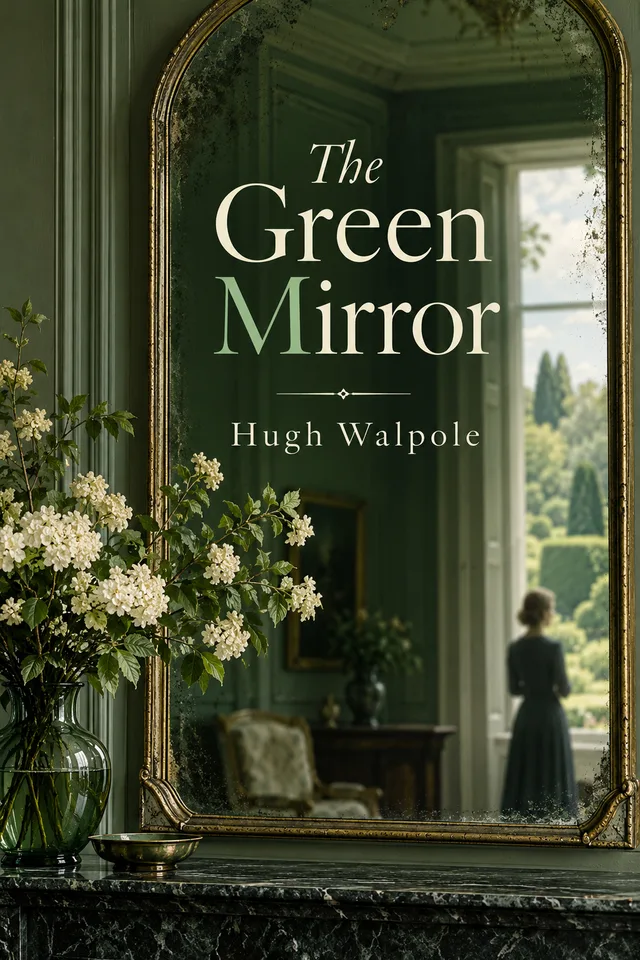
The Green Mirror
English BooksWhale Edition by Hugh Walpole
Katherine Trenchard’s engagement unsettles a close English family whose security depends on loyalty, habit, and resistance to change.
- Preview
- A sample from the prepared text
- Formats
- Online reader, EPUB, PDF
- Access
- Library claim
Book introduction
The Green Mirror
Katherine Trenchard belongs to a family that treats its shared habits as the measure of a good life. Her relationship with Philip challenges that protected world and draws her brother Henry into questions of loyalty and independence. Hugh Walpole follows the household from London to the country, making family affection both a source of comfort and an obstacle to personal freedom.
BooksWhale edition
How this edition was prepared
This edition is based on a public domain text and has been prepared for digital reading by BooksWhale.
Public domain basis
Why this edition can be shared
Hugh Walpole died in 1941. This edition uses the public-domain English original from Project Gutenberg, without later editorial notes or illustrations.
Read preview
A sample from the prepared text
Preview selected from the prepared reader text.
Preview chapterBOOK I THE RAIDRead preview
BOOK I THE RAID
Preview chapterCHAPTER I THE CEREMONYPreview
CHAPTER I THE CEREMONY
Preview chapterIPreview
The fog had swallowed up the house, and the house had submitted. So thick was this fog that the towers of Westminster Abbey, the river, and the fat complacency of the church in the middle of the Square, even the three Plane Trees in front of the old gate and the heavy old-fashioned porch had all vanished together, leaving in their place, the rattle of a cab, the barking of a dog, isolated sounds that ascended, plaintively, from a lost, a submerged world.
The House had, indeed, in its time seen many fogs for it had known its first one in the days of Queen Anne and even then it had yielded, without surprise and without curiosity, to its tyranny. On the brightest of days this was a solemn, unenterprising, unimaginative building, standing four-square to all the winds, its windows planted stolidly, securely, its vigorous propriety well suited to its safe, unagitated surroundings. Its faded red brick had weathered many London storms and would weather many more: that old, quiet Square, with its uneven stones, its church, and its plane-trees, had the Abbey, the Houses of Parliament, the river for its guardians... the skies might fall, the Thames burst into a flaming fire, Rundle Square would not stir from its tranquillity.
The old house—No. 5, Rundle Square—had for its most charming feature its entrance. First came an old iron gate guarded, on either side, by weather-beaten stone pillars. Then a cobbled path, with little green lawns to right and left of it, ran to the door whose stolidity was crowned with an old porch of dim red brick. This was unusual enough for London, but there the gate, the little garden, the Porch had stood for some hundreds of years, and that Progress that had already its throttling fingers about London’s neck, had, as yet, left Rundle Square to its staid propriety.
Westminster abides, like a little Cathedral town, at the heart of London. One is led to it, through Whitehall, through Victoria Street, through Belgravia, over Westminster Bridge with preparatory caution. The thunder of London sinks, as the traveller approaches, dying gradually as though the spirit of the town warned you, with his finger at his lip. To the roar of the traffic there succeeds the solemn striking of Big Ben, the chiming of the Abbey Bells; so narrow and winding are many of the little streets that such traffic as penetrates them proceeds slowly, cautiously, almost sleepily; there are old buildings and grass squares, many clergymen, schoolboys in black gowns and battered top hats, and at the corners one may see policemen, motionless, somnolent, stationed one supposes, to threaten disturbance or agitation.
There is, it seems, no impulse here to pile many more events upon the lap of the day than the poor thing can decently hold. Behind the windows of Westminster life is passing, surely, with easy tranquillity; the very door-bells are, many of them, old and comfortable, unsuited to any frantic ringing; there does not sound, through every hour, the whirring clang of workmen flinging, with eager haste, into the reluctant air, hideous and contemptuous buildings; dust does not rise in blinding clouds from the tortured corpses of old and happy houses.... Those who live here live long.
No. 5, Rundle Square then, had its destiny in pleasant places. Upon a fine summer evening the old red brick with its windows staring complacently upon a comfortable world showed a fine colour. Its very chimneys were square and solid, its eaves and water pipes regular and mathematical. Whatever horrid catastrophe might convulse the rest of London, No. 5 would suffer no hurt; the god of propriety—the strongest of all the gods—had it beneath His care.
Now behind the Fog it waited, as it had waited so often before, with certain assurance, for its release.
Table of contents
Inside this edition
- 01BOOK I THE RAID
- 02CHAPTER I THE CEREMONY
- 03I
- 04II
- 05III
- 06IV
- 07V
- 08VI
- 09CHAPTER II THE WINTER AFTERNOON
- 10CHAPTER III KATHERINE
- 11CHAPTER IV THE FOREST
- 12CHAPTER V THE FINEST THING
- 13CHAPTER VI THE SHOCK
- 14BOOK II THE FEATHER BED
- 15CHAPTER I KATHERINE IN LOVE
- 16CHAPTER II MRS. TRENCHARD
- 17CHAPTER III LIFE AND HENRY
- 18CHAPTER IV GARTH IN ROSELANDS
- 19CHAPTER V THE FEAST
- 20CHAPTER VI SUNDAY
- 21CHAPTER VII ROCHE ST. MARY MOOR
- 22BOOK III KATHERINE AND ANNA
- 23CHAPTER I KATHERINE ALONE
- 24CHAPTER II THE MIRROR
- 25CHAPTER III ANNA AND MRS. TRENCHARD
- 26CHAPTER IV THE WILD NIGHT
- 27CHAPTER V THE TRENCHARDS
- 28CHAPTER VI THE CEREMONY
Language availability
Other languages
Additional language editions are not published yet. This section will link to other BooksWhale editions when they become available.
Request another language