English Edition
Literature
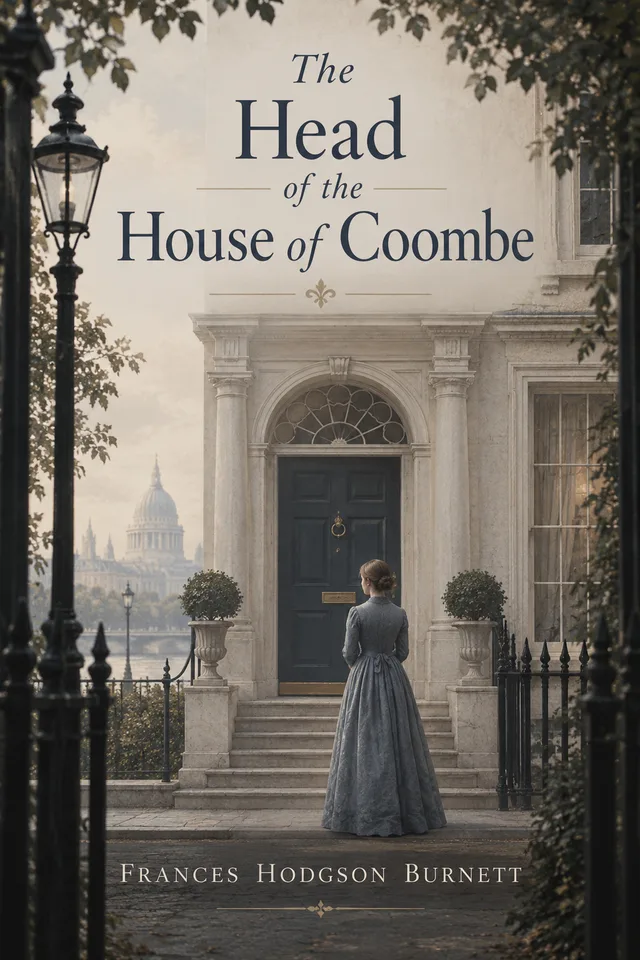
The Head of the House of Coombe
English BooksWhale Edition by Frances Hodgson Burnett
A neglected child grows up amid fashionable London society as Lord Coombe’s guarded interventions complicate appearances, loyalties, and love.
- Preview
- A sample from the prepared text
- Formats
- Online reader, EPUB, PDF
- Access
- Library claim
Book introduction
The Head of the House of Coombe
Frances Hodgson Burnett places Robin, the neglected daughter of the socially ambitious Feather, at the center of a changing London world. The reserved Lord Coombe appears to embody its cold conventions, yet his actions repeatedly challenge easy judgments. Across thirty-two chapters, childhood, status, affection, and responsibility develop against the approach of the First World War. This novel ends in 1914; the later continuation, Robin, is a separate work.
BooksWhale edition
How this edition was prepared
This edition is based on a public domain text and has been prepared for digital reading by BooksWhale.
Public domain basis
Why this edition can be shared
Frances Hodgson Burnett died in 1924. The work was first published in 1922. This edition uses the public-domain English original.
Read preview
A sample from the prepared text
Preview selected from the prepared reader text.
Preview chapterCHAPTER IRead preview
The history of the circumstances about to be related began many years ago—or so it seems in these days. It began, at least, years before the world being rocked to and fro revealed in the pause between each of its heavings some startling suggestion of a new arrangement of its kaleidoscopic particles, and then immediately a re-arrangement, and another and another until all belief in a permanency of design seemed lost, and the inhabitants of the earth waited, helplessly gazing at changing stars and colours in a degree of mental chaos.
Its opening incidents may be dated from a period when people still had reason to believe in permanency and had indeed many of them—sometimes through ingenuousness, sometimes through stupidity of type—acquired a singular confidence in the importance and stability of their possessions, desires, ambitions and forms of conviction.
London at the time, in common with other great capitals, felt itself rather final though priding itself on being much more fluid and adaptable than it had been fifty years previously. In speaking of itself it at least dealt with fixed customs, and conditions and established facts connected with them—which gave rise to brilliant—or dull—witticisms.
One of these, heard not infrequently, was to the effect that—in London—one might live under an umbrella if one lived under it in the right neighbourhood and on the right side of the street, which axiom is the reason that a certain child through the first six years of her life sat on certain days staring out of a window in a small, dingy room on the top floor of a slice of a house on a narrow but highly fashionable London street and looked on at the passing of motors, carriages and people in the dull afternoon grayness.
The room was exalted above its station by being called The Day Nursery and another room equally dingy and uninviting was known as The Night Nursery. The slice of a house was inhabited by the very pretty Mrs. Gareth-Lawless, its inordinate rent being reluctantly paid by her—apparently with the assistance of those “ravens” who are expected to supply the truly deserving. The rent was inordinate only from the standpoint of one regarding it soberly in connection with the character of the house itself which was a gaudy little kennel crowded between two comparatively stately mansions. On one side lived an inordinately rich South African millionaire, and on the other an inordinately exalted person of title, which facts combined to form sufficient grounds for a certain inordinateness of rent.
Mrs. Gareth-Lawless was also, it may be stated, of the fibre which must live on the right side of the street or dissolve into nothingness—since as nearly nothingness as an embodied entity can achieve had Nature seemingly created her at the outset. So light and airy was the fair, slim, physical presentation of her being to the earthly vision, and so almost impalpably diaphanous the texture and form of mind and character to be observed by human perception, that among such friends—and enemies—as so slight a thing could claim she was prettily known as “Feather”. Her real name, “Amabel”, was not half as charming and whimsical in its appropriateness. “Feather” she adored being called and as it was the fashion among the amazing if amusing circle in which she spent her life, to call its acquaintances fantastic pet names selected from among the world of birds, beasts and fishes or inanimate objects—“Feather” she floated through her curious existence. And it so happened that she was the mother of the child who so often stared out of the window of the dingy and comfortless Day Nursery, too much a child to be more than vaguely conscious in a chaotic way that a certain feeling which at times raged within her and made her little body hot and restless was founded on something like actual hate for a special man who had certainly taken no deliberate steps to cause her detestation.
Preview chapterCHAPTER IIPreview
The Head of the House of Coombe was not a title to be found in Burke or Debrett. It was a fine irony of the Head’s own and having been accepted by his acquaintances was not infrequently used by them in their light moments in the same spirit. The peerage recorded him as a Marquis and added several lesser attendant titles.
“When English society was respectable, even to stodginess at times,” was his point of view, “to be born ‘the Head of the House’ was a weighty and awe-inspiring thing. In fearful private denunciatory interviews with one’s parents and governors it was brought up against one as a final argument against immoral conduct such as debt and not going to church. As the Head of the House one was called upon to be an Example. In the country one appeared in one’s pew and announced oneself a ‘miserable sinner’ in loud tones, one had to invite the rector to dinner with regularity and ‘the ladies’ of one’s family gave tea and flannel petticoats and baby clothes to cottagers. Men and women were known as ‘ladies’ and ‘gentlemen’ in those halcyon days. One Represented things—Parties in Parliament—Benevolent Societies, and British Hospitality in the form of astounding long dinners at which one drank healths and made speeches. In roseate youth one danced the schottische and the polka and the round waltz which Lord Byron denounced as indecent. To recall the vigour of his poem gives rise to a smile—when one chances to sup at a cabaret.”
He was considered very amusing when he analyzed his own mental attitude towards his world in general.
“I was born somewhat too late and somewhat too early,” he explained in his light, rather cold and detached way. “I was born and educated at the closing of one era and have to adjust myself to living in another. I was as it were cradled among treasured relics of the ethics of the Georges and Queen Charlotte, and Queen Victoria in her bloom. I was in my bloom in the days when ‘ladies’ were reproved for wearing dresses cut too low at Drawing Rooms. Such training gives curious interest to fashions in which bodices are unconsidered trifles and Greek nymphs who dance with bare feet and beautiful bare legs may be one’s own relations. I trust I do not seem even in the shadowiest way to comment unfavourably. I merely look on at the rapidities of change with unalloyed interest. As the Head of the House of Coombe I am not sure what I am an Example of—or to. Which is why I at times regard myself in that capacity with a slightly ribald lightness.”
The detachment of his question with regard to the newborn infant of the airily irresponsible Feather was in entire harmony with his attitude towards the singular incident of Life as illustrated by the World, the Flesh and the Devil by none of which he was—as far as could be observed—either impressed, disturbed or prejudiced. His own experience had been richly varied and practically unlimited in its opportunities for pleasure, sinful or unsinful indulgence, mitigated or unmitigated wickedness, the gathering of strange knowledge, and the possible ignoring of all dull boundaries. This being the case a superhuman charity alone could have forborne to believe that his opportunities had been neglected in the heyday of his youth. Wealth and lack of limitations in themselves would have been quite enough to cause the Nonconformist Victorian mind to regard a young—or middle-aged—male as likely to represent a fearsome moral example, but these three temptations combined with good looks and a certain mental brilliance were so inevitably the concomitants of elegant iniquity that the results might be taken for granted.
That the various worlds in which he lived in various lands accepted him joyfully as an interesting and desirable of more or less abominably sinful personage, the Head of the House of Coombe—even many years before he became its head—regarded with the detachment which he had, even much earlier, begun to learn. Why should it be in the least matter what people thought of one? Why should it in the least matter what one thought of oneself—and therefore—why should one think at all? He had begun at the outset a brilliantly happy young pagan with this simple theory. After the passing of some years he had not been quite so happy but had remained quite as pagan and retained the theory which had lost its first fine careless rapture and gained a secret bitterness. He had not married and innumerable stories were related to explain the reason why. They were most of them quite false and none of them quite true. When he ceased to be a young man his delinquency was much discussed, more especially when his father died and he took his place as the head of his family. He was old enough, rich enough, important enough for marriage to be almost imperative. But he remained unmarried. In addition he seemed to consider his abstinence entirely an affair of his own.
Preview chapterCHAPTER IIIPreview
Two or three decades earlier the prevailing sentiment would have been that “poor little Mrs. Gareth-Lawless” and her situation were pathetic. Her acquaintances would sympathetically have discussed her helplessness and absolute lack of all resource. So very pretty, so young, the mother of a dear little girl—left with no income! How very sad! What could she do? The elect would have paid her visits and sitting in her darkened drawing-room earnestly besought her to trust to her Maker and suggested “the Scriptures” as suitable reading. Some of them—rare and strange souls even in their time—would have known what they meant and meant what they said in a way they had as yet only the power to express through the medium of a certain shibboleth, the rest would have used the same forms merely because shibboleth is easy and always safe and creditable.
But to Feather’s immediate circle a multiplicity of engagements, fevers of eagerness in the attainment of pleasures and ambitions, anxieties, small and large terrors, and a whirl of days left no time for the regarding of pathetic aspects. The tiny house up whose staircase—tucked against a wall—one had seemed to have the effect of crowding even when one went alone to make a call, suddenly ceased to represent hilarious little parties which were as entertaining as they were up to date and noisy. The most daring things London gossiped about had been said and done and worn there. Novel social ventures had been tried—dancing and songs which seemed almost startling at first—but which were gradually being generally adopted. There had always been a great deal of laughing and talking of nonsense and the bandying of jokes and catch phrases. And Feather fluttering about and saying delicious, silly things at which her hearers shouted with glee. Such a place could not suddenly become pathetic. It seemed almost indecent for Robert Gareth-Lawless to have dragged Death nakedly into their midst—to have died in his bed in one of the little bedrooms, to have been put in his coffin and carried down the stairs scraping the wall, and sent away in a hearse. Nobody could bear to think of it.
Feather could bear it less than anybody else. It seemed incredible that such a trick could have been played her. She shut herself up in her stuffy little bedroom with its shrimp pink frills and draperies and cried lamentably. At first she cried as a child might who was suddenly snatched away in the midst of a party. Then she began to cry because she was frightened. Numbers of cards “with sympathy” had been left at the front door during the first week after the funeral, they had accumulated in a pile on the salver but very few people had really come to see her and while she knew they had the excuse of her recent bereavement she felt that it made the house ghastly. It had never been silent and empty. Things had always been going on and now there was actually not a sound to be heard—no one going up and down stairs—Rob’s room cleared of all his belongings and left orderly and empty—the drawing-room like a gay little tomb without an occupant. How long would it be before it would be full of people again—how long must she wait before she could decently invite anyone?—It was really at this point that fright seized upon her. Her brain was not given to activities of reasoning and followed no thought far. She had not begun to ask herself questions as to ways and means. Rob had been winning at cards and had borrowed some money from a new acquaintance so no immediate abyss had yawned at her feet. But when the thought of future festivities rose before her a sudden check made her involuntarily clutch at her throat. She had no money at all, bills were piled everywhere, perhaps now Robert was dead none of the shops would give her credit. She remembered hearing Rob come into the house swearing only the day before he was taken ill and it had been because he had met on the door-step a collector of the rent which was long over-due and must be paid. She had no money to pay it, none to pay the servants’ wages, none to pay the household bills, none to pay for the monthly hire of the brougham! Would they turn her into the street—would the servants go away—would she be left without even a carriage? What could she do about clothes! She could not wear anything but mourning now and by the time she was out of mourning her old clothes would have gone out of fashion. The morning on which this aspect of things occurred to her, she was so terrified that she began to run up and down the room like a frightened little cat seeing no escape from the trap it is caught in.
Table of contents
Inside this edition
- 01CHAPTER I
- 02CHAPTER II
- 03CHAPTER III
- 04CHAPTER IV
- 05CHAPTER V
- 06CHAPTER VI
- 07CHAPTER VII
- 08CHAPTER VIII
- 09CHAPTER IX
- 10CHAPTER X
- 11CHAPTER XI
- 12CHAPTER XII
- 13CHAPTER XIII
- 14CHAPTER XIV
- 15CHAPTER XV
- 16CHAPTER XVI
- 17CHAPTER XVII
- 18CHAPTER XVIII
- 19CHAPTER XIX
- 20CHAPTER XX
- 21CHAPTER XXI
- 22CHAPTER XXII
- 23CHAPTER XXIII
- 24CHAPTER XXIV
- 25CHAPTER XXV
- 26CHAPTER XXVI
- 27CHAPTER XXVII
- 28CHAPTER XXVIII
- 29CHAPTER XXIX
- 30CHAPTER XXX
- 31CHAPTER XXXI
- 32CHAPTER XXXII
Language availability
Other languages
Additional language editions are not published yet. This section will link to other BooksWhale editions when they become available.
Request another language