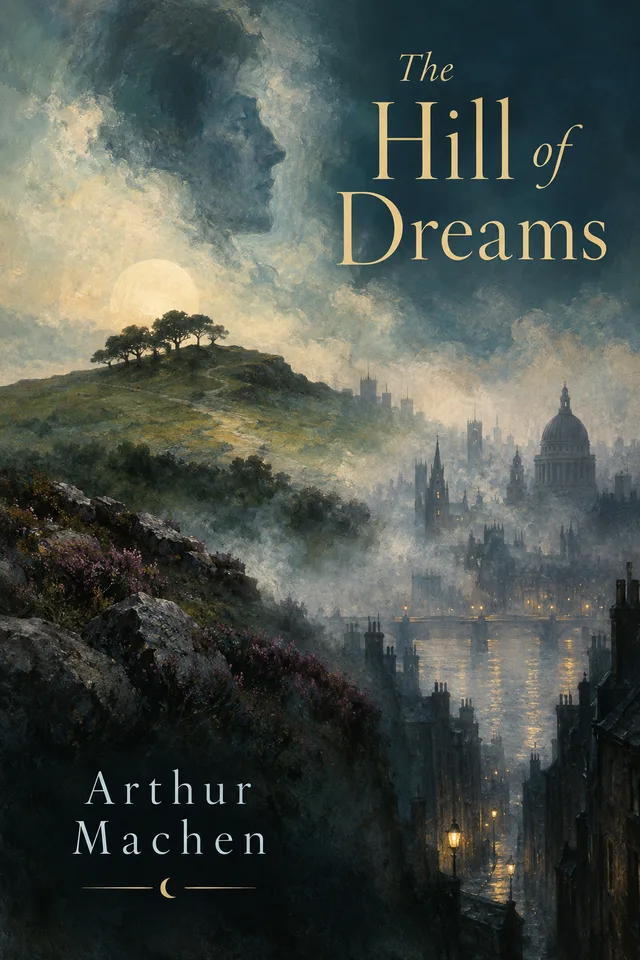
English Edition
Literature
The Hill of Dreams
English BooksWhale Edition by Arthur Machen
A haunting novel of artistic obsession, rural vision, London isolation, and psychological collapse.
- Preview
- A sample from the prepared text
- Formats
- Online reader, EPUB, PDF
- Access
- Library claim
Book introduction
The Hill of Dreams
The Hill of Dreams traces Lucian Taylor from childhood visions in the Welsh countryside to literary ambition and inner disintegration in London. Machen turns artistic longing, memory, landscape, and hallucination into a powerful study of imagination under pressure.
BooksWhale edition
How this edition was prepared
This edition is based on a public domain text and has been prepared for digital reading by BooksWhale.
Public domain basis
Why this edition can be shared
Arthur Machen died in 1947; the work was first published in 1907. These dates support the public-domain basis for this edition.
Read preview
A sample from the prepared text
Preview selected from the prepared reader text.
Preview chapterFull textRead preview
The Hill of Dreams
Arthur Machen
Preview chapterI.Preview
There was a glow in the sky as if great furnace doors were opened.
But all the afternoon his eyes had looked on glamour; he had strayed in fairyland. The holidays were nearly done, and Lucian Taylor had gone out resolved to lose himself, to discover strange hills and prospects that he had never seen before. The air was still, breathless, exhausted after heavy rain, and the clouds looked as if they had been moulded of lead. No breeze blew upon the hill, and down in the well of the valley not a dry leaf stirred, not a bough shook in all the dark January woods.
About a mile from the rectory he had diverged from the main road by an opening that promised mystery and adventure. It was an old neglected lane, little more than a ditch, worn ten feet deep by its winter waters, and shadowed by great untrimmed hedges, densely woven together. On each side were turbid streams, and here and there a torrent of water gushed down the banks, flooding the lane. It was so deep and dark that he could not get a glimpse of the country through which he was passing, but the way went down and down to some unconjectured hollow.
Perhaps he walked two miles between the high walls of the lane before its descent ceased, but he thrilled with the sense of having journeyed very far, all the long way from the known to the unknown. He had come as it were into the bottom of a bowl amongst the hills, and black woods shut out the world. From the road behind him, from the road before him, from the unseen wells beneath the trees, rivulets of waters swelled and streamed down towards the center to the brook that crossed the lane. Amid the dead and wearied silence of the air, beneath leaden and motionless clouds, it was strange to hear such a tumult of gurgling and rushing water, and he stood for a while on the quivering footbridge and watched the rush of dead wood and torn branches and wisps of straw, all hurrying madly past him, to plunge into the heaped spume, the barmy froth that had gathered against a fallen tree.
Then he climbed again, and went up between limestone rocks, higher and higher, till the noise of waters became indistinct, a faint humming of swarming hives in summer. He walked some distance on level ground, till there was a break in the banks and a stile on which he could lean and look out. He found himself, as he had hoped, afar and forlorn; he had strayed into outland and occult territory. From the eminence of the lane, skirting the brow of a hill, he looked down into deep valleys and dingles, and beyond, across the trees, to remoter country, wild bare hills and dark wooded lands meeting the grey still sky. Immediately beneath his feet the ground sloped steep down to the valley, a hillside of close grass patched with dead bracken, and dotted here and there with stunted thorns, and below there were deep oak woods, all still and silent, and lonely as if no one ever passed that way. The grass and bracken and thorns and woods, all were brown and grey beneath the leaden sky, and as Lucian looked he was amazed, as though he were reading a wonderful story, the meaning of which was a little greater than his understanding.
Then, like the hero of a fairy-book, he went on and on, catching now and again glimpses of the amazing country into which he had penetrated, and perceiving rather than seeing that as the day waned everything grew more grey and somber. As he advanced he heard the evening sounds of the farms, the low of the cattle, and the barking of the sheepdogs; a faint thin noise from far away. It was growing late, and as the shadows blackened he walked faster, till once more the lane began to descend, there was a sharp turn, and he found himself, with a good deal of relief, and a little disappointment, on familiar ground. He had nearly described a circle, and knew this end of the lane very well; it was not much more than a mile from home. He walked smartly down the hill; the air was all glimmering and indistinct, transmuting trees and hedges into ghostly shapes, and the walls of the White House Farm flickered on the hillside, as if they were moving towards him. Then a change came.
Preview chapteris?”Preview
“No. I thought it looked different from the common nettles.”
“Yes; it’s a Roman nettle—urtica pilulifera. It’s a rare plant. Burrows says it’s to be found at Caermaen, but I was never able to come across it. I must add it to the flora of the parish.”
Mr. Taylor had begun to compile a flora accompanied by a hortus siccus, but both stayed on high shelves dusty and fragmentary. He put the specimen on his desk, intending to fasten it in the book, but the maid swept it away, dry and withered, in a day or two.
Lucian tossed and cried out in his sleep that night, and the awakening in the morning was, in a measure, a renewal of the awakening in the fort. But the impression was not so strong, and in a plain room it seemed all delirium, a phantasmagoria. He had to go down to Caermaen in the afternoon, for Mrs. Dixon, the vicar’s wife, had “commanded” his presence at tea. Mr. Dixon, though fat and short and clean shaven, ruddy of face, was a safe man, with no extreme views on anything. He “deplored” all extreme party convictions, and thought the great needs of our beloved Church were conciliation, moderation, and above all “amolgamation”—so he pronounced the word. Mrs. Dixon was tall, imposing, splendid, well fitted for the Episcopal order, with gifts that would have shone at the palace. There were daughters, who studied German Literature, and thought Miss Frances Ridley Havergal wrote poetry, but Lucian had no fear of them; he dreaded the boys. Everybody said they were such fine, manly fellows, such gentlemanly boys, with such a good manner, sure to get on in the world.
Lucian had said “Bother!” in a very violent manner when the gracious invitation was conveyed to him, but there was no getting out of it. Miss Deacon did her best to make him look smart; his ties were all so disgraceful that she had to supply the want with a narrow ribbon of a sky-blue tint; and she brushed him so long and so violently that he quite understood why a horse sometimes bites and sometimes kicks the groom. He set out between two and three in a gloomy frame of mind; he knew too well what spending the afternoon with honest manly boys meant. He found the reality more lurid than his anticipation. The boys were in the field, and the first remark he heard when he got in sight of the group was:
“Hullo, Lucian, how much for the tie?” “Fine tie,” another, a stranger,
observed. “You bagged it from the kitten, didn’t you?”
Then they made up a game of cricket, and he was put in first. He was l.b.w. in his second over, so they all said, and had to field for the rest of the afternoon. Arthur Dixon, who was about his own age, forgetting all the laws of hospitality, told him he was a beastly muff when he missed a catch, rather a difficult catch. He missed several catches, and it seemed as if he were always panting after balls, which, as Edward Dixon said, any fool, even a baby, could have stopped. At last the game broke up, solely from Lucian’s lack of skill, as everybody declared. Edward Dixon, who was thirteen, and had a swollen red face and a projecting eye, wanted to fight him for spoiling the game, and the others agreed that he funked the fight in a rather dirty manner. The strange boy, who was called De Carti, and was understood to be faintly related to Lord De Carti of M’Carthytown, said openly that the fellows at his place wouldn’t stand such a sneak for five minutes. So the afternoon passed off very pleasantly indeed, till it was time to go into the vicarage for weak tea, homemade cake, and unripe plums. He got away at last. As he went out at the gate, he heard De Carti’s final observation:
Table of contents
Inside this edition
- 01Full text
- 02I.
- 03is?”
- 04II.
- 05indeed.”
- 06III.
- 07it.
- 08IV.
- 09part of the stirring shadow, of the amber-lighted gloom.
- 10It was as if the mist passed by from the river to the north, as if it still passed by in the silence.
- 11It seemed a hideous insufferable cruelty, that he should so fervently desire that which he could never gain.
- 12It would have been useless to write to the rectory of his only interest, and so he wrote seldom.
Language availability
Other languages
Additional language editions are not published yet. This section will link to other BooksWhale editions when they become available.
Request another language