English Edition
History
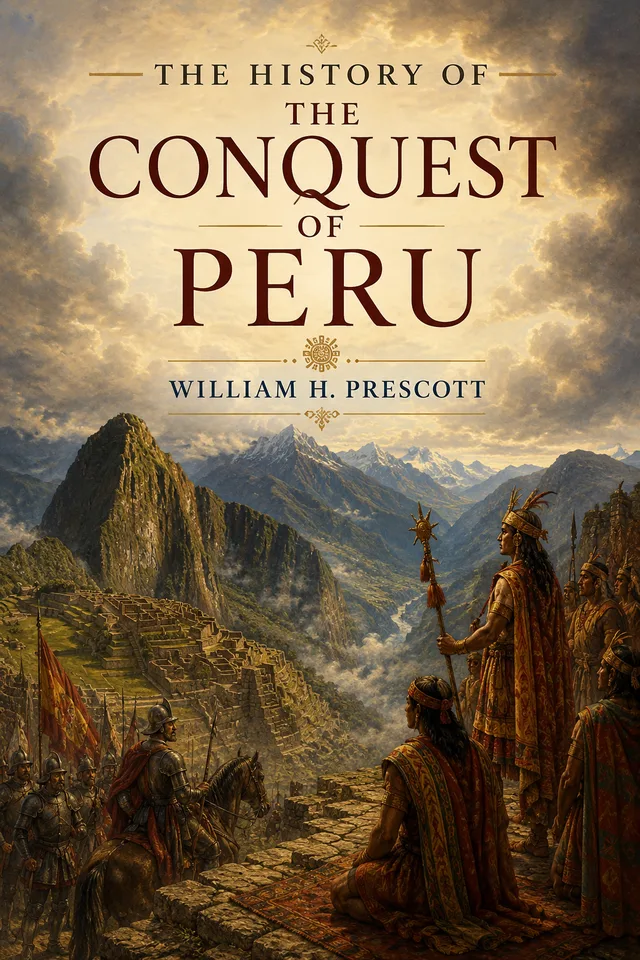
The History of the Conquest of Peru
English BooksWhale Edition by William H. Prescott
A nineteenth-century narrative of Pizarro, the Inca Empire, conquest, conflict, and empire.
- Preview
- A sample from the prepared text
- Formats
- Online reader, EPUB, PDF
- Access
- Library claim
Book introduction
The History of the Conquest of Peru
The History of the Conquest of Peru recounts Francisco Pizarro’s expedition, the fall of Atahualpa, Spanish rivalries, and the upheaval of the Inca world. Prescott’s history is useful for readers researching Peru, colonial conquest, Inca history, and classic historical prose.
BooksWhale edition
How this edition was prepared
This edition is based on a public domain text and has been prepared for digital reading by BooksWhale.
Public domain basis
Why this edition can be shared
Public-domain original text; author died more than 70 years ago or the edition is in the public domain.
Read preview
A sample from the prepared text
Preview selected from the prepared reader text.
Preview chapterFull textRead preview
The History of the Conquest of Peru
The Conquest Of Peru
by
"Congestae cumulantur opes, orbisque rapinas Accipit."
Claudian, In Ruf., lib. i., v. 194.
"So color de religion
Van a buscar plata y oro
Del encubierto tesoro."
Lope De Vega, El Nuevo Mundo, Jorn. 1.
Preview chapterPrefacePreview
The most brilliant passages in the history of Spanish adventure
in the New World are undoubtedly afforded by the conquests of
Mexico and Peru, - the two states which combined with the largest
extent of empire a refined social polity, and considerable
progress in the arts of civilization. Indeed, so prominently do
they stand out on the great canvas of history, that the name of
the one, notwithstanding the contrast they exhibit in their
respective institutions, most naturally suggests that of the
other; and, when I sent to Spain to collect materials for an
account of the Conquest of Mexico, I included in my researches
those relating to the Conquest of Peru.
The larger part of the documents, in both cases, was obtained
from the same great repository, - the archives of the Royal
Academy of History at Madrid; a body specially intrusted with the
preservation of whatever may serve to illustrate the Spanish
colonial annals. The richest portion of its collection is
probably that furnished by the papers of Munoz. This eminent
scholar, the historiographer of the Indies, employed nearly fifty
years of his life in amassing materials for a history of Spanish
discovery and conquest in America. For this, as he acted under
the authority of the government, every facility was afforded him;
and public offices and private depositories, in all the principal
cities of the empire, both at home and throughout the wide extent
of its colonial possessions, were freely opened to his
inspection. The result was a magnificent collection of
manuscripts, many of which he patiently transcribed with his own
hand. But he did not live to reap the fruits of his persevering
industry. The first volume, relative to the voyages of Columbus,
was scarcely finished when he died; and his manuscripts, at least
that portion of them which have reference to Mexico and Peru,
were destined to serve the uses of another, an inhabitant of that
New World to which they related.
Another scholar, to whose literary stores I am largely indebted,
is Don Martin Fernandez de Navarrete, late Director of the Royal
Academy of History. Through the greater part of his long life he
was employed in assembling original documents to illustrate the
colonial annals. Many of these have been incorporated in his
great work, "Coleccion de los Viages y Descubrimientos," which,
although far from being completed after the original plan of its
author, is of inestimable service to the historian. In following
down the track of discovery, Navarrete turned aside from the
conquests of Mexico and Peru, to exhibit the voyages of his
countrymen in the Indian seas. His manuscripts, relating to the
two former countries, he courteously allowed to be copied for me.
Some of them have since appeared in print, under the auspices of
his learned coadjutors, Salva and Baranda, associated with him in
the Academy; but the documents placed in my hands form a most
important contribution to my materials for the present history.
The death of this illustrious man, which occurred some time after
the present work was begun, has left a void in his country not
easy to be filled; for he was zealously devoted to letters, and
few have done more to extend the knowledge of her colonial
history. Far from an exclusive solicitude for his own literary
projects, he was ever ready to extend his sympathy and assistance
to those of others. His reputation as a scholar was enhanced by
the higher qualities which he possessed as a man, - by his
benevolence, his simplicity of manners, and unsullied moral
worth. My own obligations to him are large; for from the
publication of my first historical work, down to the last week of
his life, I have constantly received proofs from him of his
hearty and most efficient interest in the prosecution of my
historical labors; and I now the more willingly pay this
well-merited tribute to his deserts, that it must be exempt from
Preview chapterChapter IPreview
Physical Aspect Of The Country. - Sources Of Peruvian
Civilization. - Empire Of The Incas. - Royal Family. - Nobility.
Of the numerous nations which occupied the great American
continent at the time of its discovery by the Europeans, the two
most advanced in power and refinement were undoubtedly those of
Mexico and Peru. But, though resembling one another in extent of
civilization, they differed widely as to the nature of it; and
the philosophical student of his species may feel a natural
curiosity to trace the different steps by which these two nations
strove to emerge from the state of barbarism, and place
themselves on a higher point in the scale of humanity. - In a
former work I have endeavoured to exhibit the institutions and
character of the ancient Mexicans, and the story of their
conquest by the Spaniards. The present will be devoted to the
Peruvians; and, if their history shall be found to present less
strange anomalies and striking contrasts than that of the Aztecs,
it may interest us quite as much by the pleasing picture it
offers of a well-regulated government and sober habits of
industry under the patriarchal sway of the Incas.
The empire of Peru, at the period of the Spanish invasion,
stretched along the Pacific from about the second degree north to
the thirty-seventh degree of south latitude; a line, also, which
describes the western boundaries of the modern republics of
Ecuador, Peru, Bolivia, and Chili. Its breadth cannot so easily
be determined; for, though bounded everywhere by the great ocean
on the west, towards the east it spread out, in many parts,
considerably beyond the mountains, to the confines of barbarous
states, whose exact position is undetermined, or whose names are
effaced from the map of history. It is certain, however, that its
breadth was altogether disproportioned to its length. *1
The topographical aspect of the country is very remarkable. A
strip of land, rarely exceeding twenty leagues in width, runs
along the coast, and is hemmed in through its whole extent by a
colossal range of mountains, which, advancing from the Straits of
Magellan, reaches its highest elevation - indeed, the highest on
the American continent - about the seventeenth degree south, *2
and, after crossing the line, gradually subsides into hills of
inconsiderable magnitude, as it enters the Isthmus of Panama.
This is the famous Cordillera of the Andes, or "copper
mountains," *3 as termed by the natives, though they might with
more reason have been called "mountains of gold." Arranged
sometimes in a single line, though more frequently in two or
three lines running parallel or obliquely to each other, they
seem to the voyager on the ocean but one continuous chain; while
the huge volcanoes, which to the inhabitants of the table-land
look like solitary and independent masses, appear to him only
like so many peaks of the same vast and magnificent range. So
immense is the scale on which Nature works in these regions, that
it is only when viewed from a great distance, that the spectator
can, in any degree, comprehend the relation of the several parts
to the stupendous whole. Few of the works of Nature, indeed, are
calculated to produce impressions of higher sublimity than the
aspect of this coast, as it is gradually unfolded to the eye of
the mariner sailing on the distant waters of the Pacific; where
mountain is seen to rise above mountain, and Chimborazo, with its
glorious canopy of snow, glittering far above the clouds, crowns
the whole as with a celestial diadem. *4
The face of the country would appear to be peculiarly unfavorable
to the purposes both of agriculture and of internal
communication. The sandy strip along the coast, where rain
rarely falls, is fed only by a few scanty streams, that furnish a
remarkable contrast to the vast volumes of water which roll down
the eastern sides of the Cordilleras into the Atlantic. The
Table of contents
Inside this edition
- 01Full text
- 02Preface
- 03Chapter I
- 04Chapter II
- 05Chapter III
- 06Chapter IV
- 07Chapter V
- 08Book II: Discovery Of Peru
- 09Chapter I
- 10Chapter II
- 11Chapter III
- 12Chapter IV
- 13Preface to his account of Florida, "that Fortune has not smiled
- 14Book III: Conquest Of Peru
- 15Chapter I
- 16Chapter II
- 17Chapter III
- 18Chapter IV
- 19Chapter V
- 20Chapter VI
- 21Chapter VII
- 22Chapter VIII
- 23Chapter IX
- 24Chapter X
- 25Book IV: Civil Wars Of The Conquerors
- 26Chapter I
- 27Chapter II
- 28Chapter III
- 29Chapter IV
- 30Chapter V
- 31Chapter VI
- 32Chapter VI
- 33Chapter VII
- 34Chapter VIII
- 35Chapter IX
- 36Book V: Settlement Of The Country
- 37Chapter I
- 38Chapter II
- 39Chapter III
- 40Chapter III
- 41Chapter IV
- 42Libro y hubieren estado en el Peru, miren el Camino que ba desde
- 43Parte II., Cap. 23.
Language availability
Other languages
Additional language editions are not published yet. This section will link to other BooksWhale editions when they become available.
Request another language