English Edition
Literature
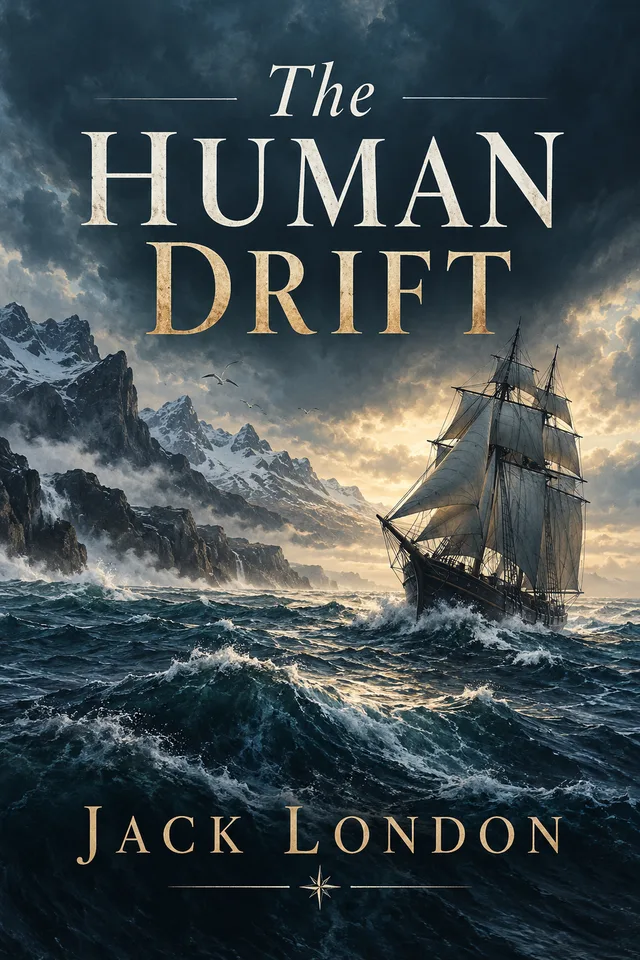
The Human Drift
English BooksWhale Edition by Jack London
Jack London brings migration, seafaring, failed enterprise, and human conflict together in a collection of essays, recollections, and two plays.
- Preview
- A sample from the prepared text
- Formats
- Online reader, EPUB, PDF
- Access
- Library claim
Book introduction
The Human Drift
The title essay considers the movement of populations through history, while other pieces turn to small boats, horses at sea, unsuccessful ventures, and a sailor’s reading. The collection closes with A Wicked Woman and The Birth Mark. These eight works show London moving between social speculation, practical experience, comic reversal, and theatrical dialogue in English.
BooksWhale edition
How this edition was prepared
This edition is based on a public domain text and has been prepared for digital reading by BooksWhale.
Public domain basis
Why this edition can be shared
Jack London died in 1916. This edition uses the English original, first published in 1917, transcribed by Project Gutenberg; later introductions, notes, images and publishing matter are excluded.
Read preview
A sample from the prepared text
Preview selected from the prepared reader text.
Preview chapterFull textRead preview
The Human Drift
Jack London
Preview chapterTHE HUMAN DRIFTPreview
“The Revelations of Devout and Learn’d Who rose before us, and as Prophets Burn’d, Are all but stories, which, awoke from Sleep, They told their comrades, and to Sleep return’d.”
The history of civilisation is a history of wandering, sword in hand, in search of food. In the misty younger world we catch glimpses of phantom races, rising, slaying, finding food, building rude civilisations, decaying, falling under the swords of stronger hands, and passing utterly away. Man, like any other animal, has roved over the earth seeking what he might devour; and not romance and adventure, but the hunger-need, has urged him on his vast adventures. Whether a bankrupt gentleman sailing to colonise Virginia or a lean Cantonese contracting to labour on the sugar plantations of Hawaii, in each case, gentleman and coolie, it is a desperate attempt to get something to eat, to get more to eat than he can get at home.
It has always been so, from the time of the first pre-human anthropoid crossing a mountain-divide in quest of better berry-bushes beyond, down to the latest Slovak, arriving on our shores to-day, to go to work in the coal-mines of Pennsylvania. These migratory movements of peoples have been called drifts, and the word is apposite. Unplanned, blind, automatic, spurred on by the pain of hunger, man has literally drifted his way around the planet. There have been drifts in the past, innumerable and forgotten, and so remote that no records have been left, or composed of such low-typed humans or pre-humans that they made no scratchings on stone or bone and left no monuments to show that they had been.
These early drifts we conjecture and know must have occurred, just as we know that the first upright-walking brutes were descended from some kin of the quadrumana through having developed “a pair of great toes out of two opposable thumbs.” Dominated by fear, and by their very fear accelerating their development, these early ancestors of ours, suffering hunger-pangs very like the ones we experience to-day, drifted on, hunting and being hunted, eating and being eaten, wandering through thousand-year-long odysseys of screaming primordial savagery, until they left their skeletons in glacial gravels, some of them, and their bone-scratchings in cave-men’s lairs.
There have been drifts from east to west and west to east, from north to south and back again, drifts that have criss-crossed one another, and drifts colliding and recoiling and caroming off in new directions. From Central Europe the Aryans have drifted into Asia, and from Central Asia the Turanians have drifted across Europe. Asia has thrown forth great waves of hungry humans from the prehistoric “round-barrow” “broad-heads” who overran Europe and penetrated to Scandinavia and England, down through the hordes of Attila and Tamerlane, to the present immigration of Chinese and Japanese that threatens America. The Phoenicians and the Greeks, with unremembered drifts behind them, colonised the Mediterranean. Rome was engulfed in the torrent of Germanic tribes drifting down from the north before a flood of drifting Asiatics. The Angles, Saxons, and Jutes, after having drifted whence no man knows, poured into Britain, and the English have carried this drift on around the world. Retreating before stronger breeds, hungry and voracious, the Eskimo has drifted to the inhospitable polar regions, the Pigmy to the fever-rotten jungles of Africa. And in this day the drift of the races continues, whether it be of Chinese into the Philippines and the Malay Peninsula, of Europeans to the United States or of Americans to the wheat-lands of Manitoba and the Northwest.
Perhaps most amazing has been the South Sea Drift. Blind, fortuitous, precarious as no other drift has been, nevertheless the islands in that waste of ocean have received drift after drift of the races. Down from the mainland of Asia poured an Aryan drift that built civilisations in Ceylon, Java, and Sumatra. Only the monuments of these Aryans remain. They themselves have perished utterly, though not until after leaving evidences of their drift clear across the great South Pacific to far Easter Island. And on that drift they encountered races who had accomplished the drift before them, and they, the Aryans, passed, in turn, before the drift of other and subsequent races whom we to-day call the Polynesian and the Melanesian.
Preview chapterSMALL-BOAT SAILINGPreview
A sailor is born, not made. And by “sailor” is meant, not the average efficient and hopeless creature who is found to-day in the forecastle of deepwater ships, but the man who will take a fabric compounded of wood and iron and rope and canvas and compel it to obey his will on the surface of the sea. Barring captains and mates of big ships, the small-boat sailor is the real sailor. He knows—he must know—how to make the wind carry his craft from one given point to another given point. He must know about tides and rips and eddies, bar and channel markings, and day and night signals; he must be wise in weather-lore; and he must be sympathetically familiar with the peculiar qualities of his boat which differentiate it from every other boat that was ever built and rigged. He must know how to gentle her about, as one instance of a myriad, and to fill her on the other tack without deadening her way or allowing her to fall off too far.
The deepwater sailor of to-day needs know none of these things. And he doesn’t. He pulls and hauls as he is ordered, swabs decks, washes paint, and chips iron-rust. He knows nothing, and cares less. Put him in a small boat and he is helpless. He will cut an even better figure on the hurricane deck of a horse.
I shall never forget my child-astonishment when I first encountered one of these strange beings. He was a runaway English sailor. I was a lad of twelve, with a decked-over, fourteen-foot, centre-board skiff which I had taught myself to sail. I sat at his feet as at the feet of a god, while he discoursed of strange lands and peoples, deeds of violence, and hair-raising gales at sea. Then, one day, I took him for a sail. With all the trepidation of the veriest little amateur, I hoisted sail and got under way. Here was a man, looking on critically, I was sure, who knew more in one second about boats and the water than I could ever know. After an interval, in which I exceeded myself, he took the tiller and the sheet. I sat on the little thwart amidships, open-mouthed, prepared to learn what real sailing was. My mouth remained open, for I learned what a real sailor was in a small boat. He couldn’t trim the sheet to save himself, he nearly capsized several times in squalls, and, once again, by blunderingly jibing over; he didn’t know what a centre-board was for, nor did he know that in running a boat before the wind one must sit in the middle instead of on the side; and finally, when we came back to the wharf, he ran the skiff in full tilt, shattering her nose and carrying away the mast-step. And yet he was a really truly sailor fresh from the vasty deep.
Which points my moral. A man can sail in the forecastles of big ships all his life and never know what real sailing is. From the time I was twelve, I listened to the lure of the sea. When I was fifteen I was captain and owner of an oyster-pirate sloop. By the time I was sixteen I was sailing in scow-schooners, fishing salmon with the Greeks up the Sacramento River, and serving as sailor on the Fish Patrol. And I was a good sailor, too, though all my cruising had been on San Francisco Bay and the rivers tributary to it. I had never been on the ocean in my life.
Then, the month I was seventeen, I signed before the mast as an able seaman on a three-top-mast schooner bound on a seven-months’ cruise across the Pacific and back again. As my shipmates promptly informed me, I had had my nerve with me to sign on as able seaman. Yet behold, I was an able seaman. I had graduated from the right school. It took no more than minutes to learn the names and uses of the few new ropes. It was simple. I did not do things blindly. As a small-boat sailor I had learned to reason out and know the why of everything. It is true, I had to learn how to steer by compass, which took maybe half a minute; but when it came to steering “full-and-by” and “close-and-by,” I could beat the average of my shipmates, because that was the very way I had always sailed. Inside fifteen minutes I could box the compass around and back again. And there was little else to learn during that seven-months’ cruise, except fancy rope-sailorising, such as the more complicated lanyard knots and the making of various kinds of sennit and rope-mats. The point of all of which is that it is by means of small-boat sailing that the real sailor is best schooled.
Table of contents
Inside this edition
- 01Full text
- 02THE HUMAN DRIFT
- 03SMALL-BOAT SAILING
- 04FOUR HORSES AND A SAILOR
- 05NOTHING THAT EVER CAME TO ANYTHING
- 06THAT DEAD MEN RISE UP NEVER
- 07A CLASSIC OF THE SEA
- 08A WICKED WOMAN
- 09THE BIRTH MARK
Language availability
Other languages
Additional language editions are not published yet. This section will link to other BooksWhale editions when they become available.
Request another language