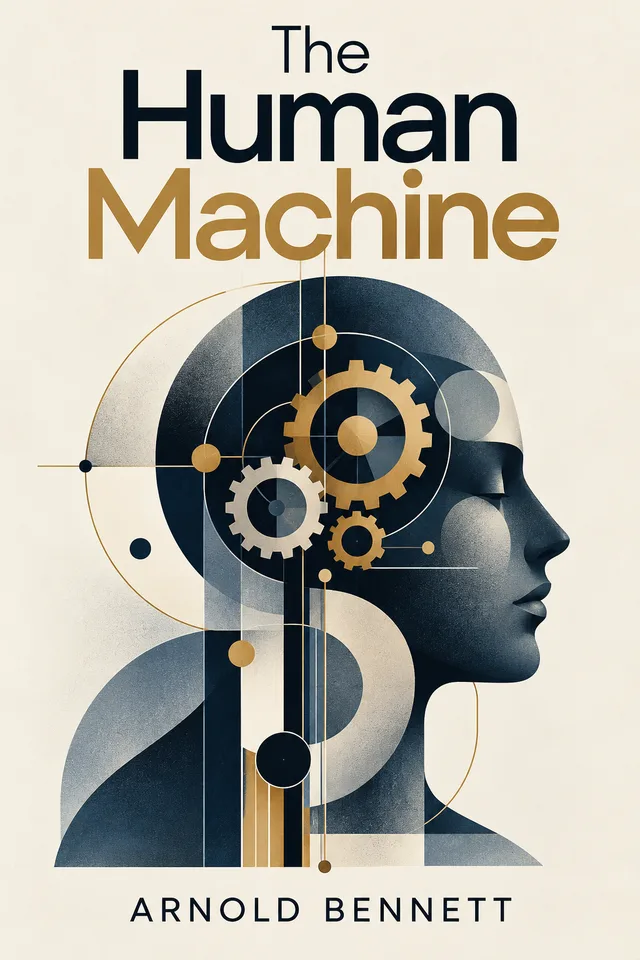
English Edition
Psychology
The Human Machine
English BooksWhale Edition by Arnold Bennett
Arnold Bennett explores attention, habit, emotional friction, and the practical work of directing one’s own mind more deliberately.
- Preview
- A sample from the prepared text
- Formats
- Online reader, EPUB, PDF
- Access
- Library claim
Book introduction
The Human Machine
In sixteen connected essays, Arnold Bennett considers how people can make better use of the mental machinery they already possess. He discusses concentration, habit, irritation, money, success, and the adjustment of a person to everyday surroundings. His approach joins psychological observation to practical exercises in self-direction, presenting the management of daily life as a skill that develops through persistent attention.
BooksWhale edition
How this edition was prepared
This edition is based on a public domain text and has been prepared for digital reading by BooksWhale.
Public domain basis
Why this edition can be shared
Arnold Bennett died in 1931; this work was first published in 1908. This edition uses the public-domain English original from Project Gutenberg, excluding later editorial additions.
Read preview
A sample from the prepared text
Preview selected from the prepared reader text.
Preview chapterI — TAKING ONESELF FOR GRANTEDRead preview
There are men who are capable of loving a machine more deeply than they can love a woman. They are among the happiest men on earth. This is not a sneer meanly shot from cover at women. It is simply a statement of notorious fact. Men who worry themselves to distraction over the perfecting of a machine are indubitably blessed beyond their kind. Most of us have known such men. Yesterday they were constructing motorcars. But to-day aeroplanes are in the air—or, at any rate, they ought to be, according to the inventors. Watch the inventors. Invention is not usually their principal business. They must invent in their spare time. They must invent before breakfast, invent in the Strand between Lyons's and the office, invent after dinner, invent on Sundays. See with what ardour they rush home of a night! See how they seize a half-holiday, like hungry dogs a bone! They don't want golf, bridge, limericks, novels, illustrated magazines, clubs, whisky, starting-prices, hints about neckties, political meetings, yarns, comic songs, anturic salts, nor the smiles that are situate between a gay corsage and a picture hat. They never wonder, at a loss, what they will do next. Their evenings never drag—are always too short. You may, indeed, catch them at twelve o'clock at night on the flat of their backs; but not in bed! No, in a shed, under a machine, holding a candle (whose paths drop fatness) up to the connecting-rod that is strained, or the wheel that is out of centre. They are continually interested, nay, enthralled. They have a machine, and they are perfecting it. They get one part right, and then another goes wrong; and they get that right, and then another goes wrong, and so on. When they are quite sure they have reached perfection, forth issues the machine out of the shed—and in five minutes is smashed up, together with a limb or so of the inventors, just because they had been quite sure too soon. Then the whole business starts again. They do not give up—that particular wreck was, of course, due to a mere oversight; the whole business starts again. For they have glimpsed perfection; they have the gleam of perfection in their souls. Thus their lives run away. 'They will never fly!' you remark, cynically. Well, if they don't? Besides, what about Wright? With all your cynicism, have you never envied them their machine and their passionate interest in it?
You know, perhaps, the moment when, brushing in front of the glass, you detected your first grey hair. You stopped brushing; then you resumed brushing, hastily; you pretended not to be shocked, but you were. Perhaps you know a more disturbing moment than that, the moment when it suddenly occurred to you that you had 'arrived' as far as you ever will arrive; and you had realised as much of your early dream as you ever will realise, and the realisation was utterly unlike the dream; the marriage was excessively prosaic and eternal, not at all what you expected it to be; and your illusions were dissipated; and games and hobbies had an unpleasant core of tedium and futility; and the ideal tobacco-mixture did not exist; and one literary masterpiece resembled another; and all the days that are to come will more or less resemble the present day, until you die; and in an illuminating flash you understood what all those people were driving at when they wrote such unconscionably long letters to the Telegraph as to life being worth living or not worth living; and there was naught to be done but face the grey, monotonous future, and pretend to be cheerful with the worm of ennui gnawing at your heart! In a word, the moment when it occurred to you that yours is 'the common lot.' In that moment have you not wished—do you not continually wish—for an exhaustless machine, a machine that you could never get to the end of? Would you not give your head to be lying on the flat of your back, peering with a candle, dirty, foiled, catching cold—but absorbed in the pursuit of an object? Have you not gloomily regretted that you were born without a mechanical turn, because there is really something about a machine...?
Preview chapterII — AMATEURS IN THE ART OF LIVINGPreview
Considering that we have to spend the whole of our lives in this human machine, considering that it is our sole means of contact and compromise with the rest of the world, we really do devote to it very little attention. When I say 'we,' I mean our inmost spirits, the instinctive part, the mystery within that exists. And when I say 'the human machine' I mean the brain and the body—and chiefly the brain. The expression of the soul by means of the brain and body is what we call the art of 'living.' We certainly do not learn this art at school to any appreciable extent. At school we are taught that it is necessary to fling our arms and legs to and fro for so many hours per diem. We are also shown, practically, that our brains are capable of performing certain useful tricks, and that if we do not compel our brains to perform those tricks we shall suffer. Thus one day we run home and proclaim to our delighted parents that eleven twelves are 132. A feat of the brain! So it goes on until our parents begin to look up to us because we can chatter of cosines or sketch the foreign policy of Louis XIV. Good! But not a word about the principles of the art of living yet! Only a few detached rules from our parents, to be blindly followed when particular crises supervene. And, indeed, it would be absurd to talk to a schoolboy about the expression of his soul. He would probably mutter a monosyllable which is not 'mice.'
Of course, school is merely a preparation for living; unless one goes to a university, in which case it is a preparation for university. One is supposed to turn one's attention to living when these preliminaries are over—say at the age of about twenty. Assuredly one lives then; there is, however, nothing new in that, for one has been living all the time, in a fashion; all the time one has been using the machine without understanding it. But does one, school and college being over, enter upon a study of the machine? Not a bit. The question then becomes, not how to live, but how to obtain and retain a position in which one will be able to live; how to get minute portions of dead animals and plants which one can swallow, in order not to die of hunger; how to acquire and constantly renew a stock of other portions of dead animals and plants in which one can envelop oneself in order not to die of cold; how to procure the exclusive right of entry into certain huts where one may sleep and eat without being rained upon by the clouds of heaven. And so forth. And when one has realised this ambition, there comes the desire to be able to double the operation and do it, not for oneself alone, but for oneself and another. Marriage! But no scientific sustained attention is yet given to the real business of living, of smooth intercourse, of self-expression, of conscious adaptation to environment—in brief, to the study of the machine. At thirty the chances are that a man will understand better the draught of a chimney than his own respiratory apparatus—to name one of the simple, obvious things—and as for understanding the working of his own brain—what an idea! As for the skill to avoid the waste of power involved by friction in the business of living, do we give an hour to it in a month? Do we ever at all examine it save in an amateurish and clumsy fashion? A young lady produces a water-colour drawing. 'Very nice!' we say, and add, to ourselves, 'For an amateur.' But our living is more amateurish than that young lady's drawing; though surely we ought every one of us to be professionals at living!
Preview chapterIII — THE BRAIN AS A GENTLEMAN-AT-LARGEPreview
It is not as if, in this business of daily living, we were seriously hampered by ignorance either as to the results which we ought to obtain, or as to the general means which we must employ in order to obtain them. With all our absorption in the mere preliminaries to living, and all our carelessness about living itself, we arrive pretty soon at a fairly accurate notion of what satisfactory living is, and we perceive with some clearness the methods necessary to success. I have pictured the man who wakes up in the middle of the night and sees the horrid semi-fiasco of his life. But let me picture the man who wakes up refreshed early on a fine summer morning and looks into his mind with the eyes of hope and experience, not experience and despair. That man will pass a delightful half-hour in thinking upon the scheme of the universe as it affects himself. He is quite clear that contentment depends on his own acts, and that no power can prevent him from performing those acts. He plans everything out, and before he gets up he knows precisely what he must and will do in certain foreseen crises and junctures. He sincerely desires to live efficiently—who would wish to make a daily mess of existence?—and he knows the way to realise the desire.
And yet, mark me! That man will not have been an hour on his feet on this difficult earth before the machine has unmistakably gone wrong: the machine which was designed to do this work of living, which is capable of doing it thoroughly well, but which has not been put into order! What is the use of consulting the map of life and tracing the itinerary, and getting the machine out of the shed, and making a start, if half the nuts are loose, or the steering pillar is twisted, or there is no petrol in the tank? (Having asked this question, I will drop the mechanico-vehicular comparison, which is too rough and crude for the delicacy of the subject.) Where has the human machine gone wrong? It has gone wrong in the brain. What, is he 'wrong in the head'? Most assuredly, most strictly. He knows—none better—that when his wife employs a particular tone containing ten grains of asperity, and he replies in a particular tone containing eleven grains, the consequences will be explosive. He knows, on the other hand, that if he replies in a tone containing only one little drop of honey, the consequences may not be unworthy of two reasonable beings. He knows this. His brain is fully instructed. And lo! his brain, while arguing that women are really too absurd (as if that was the point), is sending down orders to the muscles of the throat and mouth which result in at least eleven grains of asperity, and conjugal relations are endangered for the day. He didn't want to do it. His desire was not to do it. He despises himself for doing it. But his brain was not in working order. His brain ran away—'raced'—on its own account, against reason, against desire, against morning resolves—and there he is!
That is just one example, of the simplest and slightest. Examples can be multiplied. The man may be a young man whose immediate future depends on his passing an examination—an examination which he is capable of passing 'on his head,' which nothing can prevent him from passing if only his brain will not be so absurd as to give orders to his legs to walk out of the house towards the tennis court instead of sending them upstairs to the study; if only, having once safely lodged him in the study, his brain will devote itself to the pages of books instead of dwelling on the image of a nice girl—not at all like other girls. Or the man may be an old man who will live in perfect comfort if only his brain will not interminably run round and round in a circle of grievances, apprehensions, and fears which no amount of contemplation can destroy or even ameliorate.
Table of contents
Inside this edition
- 01I — TAKING ONESELF FOR GRANTED
- 02II — AMATEURS IN THE ART OF LIVING
- 03III — THE BRAIN AS A GENTLEMAN-AT-LARGE
- 04IV — THE FIRST PRACTICAL STEP
- 05V — HABIT-FORMING BY CONCENTRATION
- 06VI — LORD OVER THE NODDLE
- 07VII — WHAT 'LIVING' CHIEFLY IS
- 08VIII — THE DAILY FRICTION
- 09IX — 'FIRE!'
- 10X — MISCHIEVOUSLY OVERWORKING IT
- 11XI — AN INTERLUDE
- 12XII — AN INTEREST IN LIFE
- 13XIII — SUCCESS AND FAILURE
- 14XIV — A MAN AND HIS ENVIRONMENT
- 15XV — L.S.D.
- 16XVI — REASON, REASON!
Language availability
Other languages
Additional language editions are not published yet. This section will link to other BooksWhale editions when they become available.
Request another language