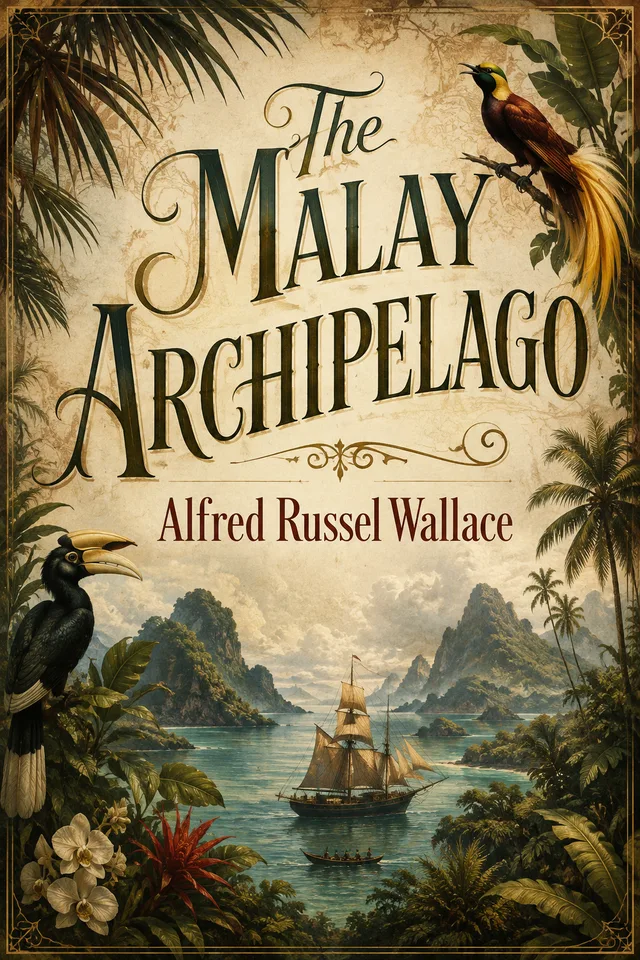
English Edition
Science
The Malay Archipelago
English BooksWhale Edition by Alfred Russel Wallace
A landmark natural-history journey through islands, species, geography, evolution, and exploration.
- Preview
- A sample from the prepared text
- Formats
- Online reader, EPUB, PDF
- Access
- Library claim
Book introduction
The Malay Archipelago
The Malay Archipelago combines travel narrative, zoology, ethnography, geography, and evolutionary observation from Alfred Russel Wallace’s years in Southeast Asia. This edition is for readers of natural history, exploration, biology, and scientific travel writing.
BooksWhale edition
How this edition was prepared
This edition is based on a public domain text and has been prepared for digital reading by BooksWhale.
Public domain basis
Why this edition can be shared
Alfred Russel Wallace died in 1913, and The Malay Archipelago was first published in 1869. These dates support the public-domain basis for the source text used in this English edition.
Read preview
A sample from the prepared text
Preview selected from the prepared reader text.
Preview chapterFull textRead preview
The Malay Archipelago
Alfred Russel Wallace
Preview chapterPREFACE.Preview
My readers will naturally ask why I have delayed writing this book for six years after my return; and I feel bound to give them full satisfaction on this point.
When I reached England in the spring of 1862, I found myself surrounded by a room full of packing cases containing the collections that I had, from time to time, sent home for my private use. These comprised nearly three thousand bird-skins of about one thousand species, at least twenty thousand beetles and butterflies of about seven thousand species, and some quadrupeds and land shells besides. A large proportion of these I had not seen for years, and in my then weakened state of health, the unpacking, sorting, and arranging of such a mass of specimens occupied a long time.
I very soon decided that until I had done something towards naming and describing the most important groups in my collection, and had worked out some of the more interesting problems of variation and geographical distribution (of which I had had glimpses while collecting them), I would not attempt to publish my travels. Indeed, I could have printed my notes and journals at once, leaving all reference to questions of natural history for a future work; but, I felt that this would be as unsatisfactory to myself as it would be disappointing to my friends, and uninstructive to the public.
Since my return, up to this date, I have published eighteen papers in the "Transactions" or "Proceedings of the Linnean Zoological and Entomological Societies", describing or cataloguing portions of my collections, along with twelve others in various scientific periodicals on more general subjects connected with them.
Nearly two thousand of my Coleoptera, and many hundreds of my butterflies, have been already described by various eminent naturalists, British and foreign; but a much larger number remains undescribed. Among those to whom science is most indebted for this laborious work, I must name Mr. F. P. Pascoe, late President of the Entomological Society of London, who had almost completed the classification and description of my large collection of Longicorn beetles (now in his possession), comprising more than a thousand species, of which at least nine hundred were previously undescribed and new to European cabinets.
The remaining orders of insects, comprising probably more than two thousand species, are in the collection of Mr. William Wilson Saunders, who has caused the larger portion of them to be described by good entomologists. The Hymenoptera alone amounted to more than nine hundred species, among which were two hundred and eighty different kinds of ants, of which two hundred were new.
The six years' delay in publishing my travels thus enables me to give what I hope may be an interesting and instructive sketch of the main results yet arrived at by the study of my collections; and as the countries I have to describe are not much visited or written about, and their social and physical conditions are not liable to rapid change, I believe and hope that my readers will gain much more than they will lose by not having read my book six years ago, and by this time perhaps forgotten all about it.
I must now say a few words on the plan of my work.
My journeys to the various islands were regulated by the seasons and the means of conveyance. I visited some islands two or three times at distant intervals, and in some cases had to make the same voyage four times over. A chronological arrangement would have puzzled my readers. They would never have known where they were, and my frequent references to the groups of islands, classed in accordance with the peculiarities of their animal productions and of their human inhabitants, would have been hardly intelligible. I have adopted, therefore, a geographical, zoological, and ethnological arrangement, passing from island to island in what seems the most natural succession, while I transgress the order in which I myself visited them, as little as possible.
Preview chapterCHAPTER I. PHYSICAL GEOGRAPHY.Preview
From a look at a globe or a map of the Eastern hemisphere, we shall perceive between Asia and Australia a number of large and small islands forming a connected group distinct from those great masses of land, and having little connection with either of them. Situated upon the Equator, and bathed by the tepid water of the great tropical oceans, this region enjoys a climate more uniformly hot and moist than almost any other part of the globe, and teems with natural productions which are elsewhere unknown. The richest of fruits and the most precious of spices are Indigenous here. It produces the giant flowers of the Rafflesia, the great green-winged Ornithoptera (princes among the butterfly tribes), the man-like Orangutan, and the gorgeous Birds of Paradise. It is inhabited by a peculiar and interesting race of mankind--the Malay, found nowhere beyond the limits of this insular tract, which has hence been named the Malay Archipelago.
To the ordinary Englishman this is perhaps the least known part of the globe. Our possessions in it are few and scanty; scarcely any of our travellers go to explore it; and in many collections of maps it is almost ignored, being divided between Asia and the Pacific Islands. It thus happens that few persons realize that, as a whole, it is comparable with the primary divisions of the globe, and that some of its separate islands are larger than France or the Austrian Empire. The traveller, however, soon acquires different ideas. He sails for days or even weeks along the shores of one of these great islands, often so great that its inhabitants believe it to be a vast continent. He finds that voyages among these islands are commonly reckoned by weeks and months, and that their several inhabitants are often as little known to each other as are the native races of the northern to those of the southern continent of America. He soon comes to look upon this region as one apart from the rest of the world, with its own races of men and its own aspects of nature; with its own ideas, feelings, customs, and modes of speech, and with a climate, vegetation, and animated life altogether peculiar to itself.
From many points of view these islands form one compact geographical whole, and as such they have always been treated by travellers and men of science; but, a more careful and detailed study of them under various aspects reveals the unexpected fact that they are divisible into two portions nearly equal in extent which differ widely in their natural products, and really form two parts of the primary divisions of the earth. I have been able to prove this in considerable detail by my observations on the natural history of the various parts of the Archipelago; and, as in the description of my travels and residence in the several islands I shall have to refer continually to this view, and adduce facts in support of it, I have thought it advisable to commence with a general sketch of the main features of the Malayan region as will render the facts hereafter brought forward more interesting, and their bearing upon the general question more easily understood. I proceed, therefore, to sketch the limits and extent of the Archipelago, and to point out the more striking features of its geology, physical geography, vegetation, and animal life.
Definition and Boundaries.--For reasons which depend mainly on the distribution of animal life, I consider the Malay Archipelago to include the Malay Peninsula as far as Tenasserim and the Nicobar Islands on the west, the Philippines on the north, and the Solomon Islands, beyond New Guinea, on the east. All the great islands included within these limits are connected together by innumerable smaller ones, so that no one of them seems to be distinctly separated from the rest. With but few exceptions all enjoy an uniform and very similar climate, and are covered with a luxuriant forest vegetation. Whether we study their form and distribution on maps, or actually travel from island to island, our first impression will be that they form a connected whole, all the parts of which are intimately related to each other.
Table of contents
Inside this edition
- 01Full text
- 02PREFACE.
- 03CHAPTER I. PHYSICAL GEOGRAPHY.
- 04CHAPTER II. SINGAPORE.
- 05CHAPTER III. MALACCA AND MOUNT OPHIR.
- 06CHAPTER IV. BORNEO--THE ORANGUTAN.
- 07CHAPTER V. BORNEO--JOURNEY INTO THE INTERIOR.
- 08CHAPTER VI. BORNEO--THE DYAKS.
- 09CHAPTER VII. JAVA.
- 10CHAPTER VIII. SUMATRA.
- 11CHAPTER IX. NATURAL HISTORY OF THE INDO-MALAY ISLANDS.
- 12CHAPTER X. BALI AND LOMBOCK.
- 13CHAPTER XI. LOMBOCK: MANNERS AND CUSTOMS OF THE PEOPLE.
- 14CHAPTER XII. LOMBOCK: HOW THE RAJAH TOOK THE CENSUS.
- 15CHAPTER XIII. TIMOR.
- 16CHAPTER XIV. THE NATURAL HISTORY OF THE TIMOR GROUP.
- 17CHAPTER XV. CELEBES.
- 18CHAPTER XVI. CELEBES.
- 19CHAPTER XVII. CELEBES.
- 20CHAPTER XVIII. NATURAL HISTORY OF CELEBES.
- 21PAPILIONIDAE AND HAWKS, PARROTS, AND
- 22CHAPTER XIX. BANDA.
- 23CHAPTER XX. AMBOYNA.
- 24THE MALAY ARCHIPELAGO
- 25CHAPTER XXI. THE MOLUCCAS--TERNATE.
- 26CHAPTER XXII. GILOLO.
- 27CHAPTER XXIII. TERNATE TO THE KAIOA ISLANDS AND BATCHIAN.
- 28CHAPTER XXIV. BATCHIAN.
- 29CHAPTER XXV. CERAM, GORAM, AND THE MATABELLO ISLANDS.
- 30GORAM
- 31CHAPTER XXVI. BOURU.
- 32CHAPTER XXVII. THE NATURAL HISTORY OF THE MOLUCCAS.
- 33CHAPTER XXVIII. MACASSAR TO THE ARU ISLANDS IN A NATIVE PRAU.
- 34CHAPTER XXIX. THE KE ISLANDS.
- 35CHAPTER XXX. THE ARU ISLANDS--RESIDENCE IN DOBBO
- 36CHAPTER XXXI. THE ARU ISLANDS.--JOURNEY AND RESIDENCE IN THE INTERIOR.
- 37CHAPTER XXXII. THE ARU ISLANDS.--SECOND RESIDENCE AT DOBBO.
- 38CHAPTER XXXIII. THE ARU ISLANDS--PHYSICAL GEOGRAPHY AND ASPECTS OF
- 39CHAPTER XXXIV. NEW GUINEA.--DOREY.
- 40CHAPTER XXXV. VOYAGE FROM CERAM TO WAIGIOU.
- 41CHAPTER XXXVI. WAIGIOU.
- 42CHAPTER XXXVII. VOYAGE FROM WAIGIOU TO TERNATE.
- 43CHAPTER XXXVIII. THE BIRDS OF PARADISE.
- 44CHAPTER XXXIX. THE NATURAL HISTORY OF THE PAPUAN ISLANDS.
- 45CHAPTER XL. THE RACES OF MAN IN THE MALAY ARCHIPELAGO.
Language availability
Other languages
Additional language editions are not published yet. This section will link to other BooksWhale editions when they become available.
Request another language