English Edition
Literature
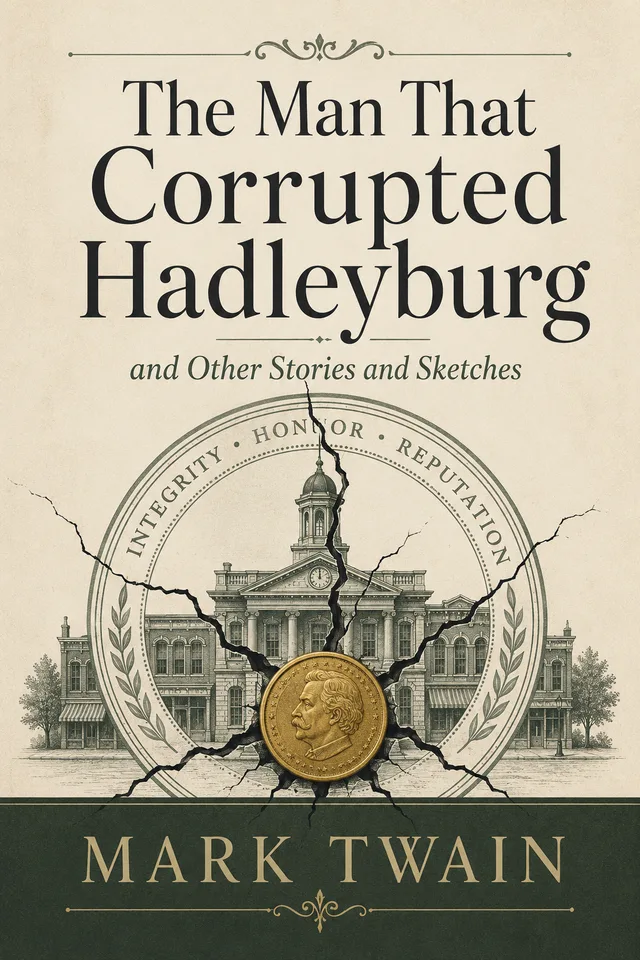
The Man That Corrupted Hadleyburg and Other Stories and Sketches
English BooksWhale Edition by Mark Twain
A Mark Twain story collection led by the famous Hadleyburg satire, with sketches on reputation, fraud, belief, and social comedy.
- Preview
- A sample from the prepared text
- Formats
- Online reader, EPUB, PDF
- Access
- Library claim
Book introduction
The Man That Corrupted Hadleyburg and Other Stories and Sketches
The Man That Corrupted Hadleyburg and Other Stories and Sketches gathers Mark Twain’s late satire with comic and skeptical pieces such as My First Lie, The Esquimaux Maiden’s Romance, Christian Science and the Book of Mrs. Eddy, Is He Living or Is He Dead?, and My Début as a Literary Person. The collection moves from civic hypocrisy and money worship to literary memory, imposture, public opinion, and Twain’s sharp humor.
BooksWhale edition
How this edition was prepared
This edition is based on a public domain text and has been prepared for digital reading by BooksWhale.
Public domain basis
Why this edition can be shared
The Man That Corrupted Hadleyburg and Other Stories and Sketches is public domain: the author died in 1910, and the collection was first published before 1929. This edition uses the original English text.
Read preview
A sample from the prepared text
Preview selected from the prepared reader text.
Preview chapterFull textRead preview
The Man That Corrupted Hadleyburg and Other Stories and Sketches
Preview chapterTHE MAN THAT CORRUPTED HADLEYBURGPreview
It was many years ago. Hadleyburg was the most honest and upright town in all the region round about. It had kept that reputation unsmirched during three generations, and was prouder of it than of any other of its possessions. It was so proud of it, and so anxious to insure its perpetuation, that it began to teach the principles of honest dealing to its babies in the cradle, and made the like teachings the staple of their culture thenceforward through all the years devoted to their education. Also, throughout the formative years temptations were kept out of the way of the young people, so that their honesty could have every chance to harden and solidify, and become a part of their very bone. The neighbouring towns were jealous of this honourable supremacy, and affected to sneer at Hadleyburg's pride in it and call it vanity; but all the same they were obliged to acknowledge that Hadleyburg was in reality an incorruptible town; and if pressed they would also acknowledge that the mere fact that a young man hailed from Hadleyburg was all the recommendation he needed when he went forth from his natal town to seek for responsible employment.
But at last, in the drift of time, Hadleyburg had the ill luck to offend a passing stranger--possibly without knowing it, certainly without caring, for Hadleyburg was sufficient unto itself, and cared not a rap for strangers or their opinions. Still, it would have been well to make an exception in this one's case, for he was a bitter man, and revengeful. All through his wanderings during a whole year he kept his injury in mind, and gave all his leisure moments to trying to invent a compensating satisfaction for it. He contrived many plans, and all of them were good, but none of them was quite sweeping enough: the poorest of them would hurt a great many individuals, but what he wanted was a plan which would comprehend the entire town, and not let so much as one person escape unhurt. At last he had a fortunate idea, and when it fell into his brain it lit up his whole head with an evil joy. He began to form a plan at once, saying to himself “That is the thing to do--I will corrupt the town.”
Six months later he went to Hadleyburg, and arrived in a buggy at the house of the old cashier of the bank about ten at night. He got a sack out of the buggy, shouldered it, and staggered with it through the cottage yard, and knocked at the door. A woman's voice said “Come in,” and he entered, and set his sack behind the stove in the parlour, saying politely to the old lady who sat reading the “Missionary Herald” by the lamp:
“Pray keep your seat, madam, I will not disturb you. There--now it is pretty well concealed; one would hardly know it was there. Can I see your husband a moment, madam?”
No, he was gone to Brixton, and might not return before morning.
“Very well, madam, it is no matter. I merely wanted to leave that sack in his care, to be delivered to the rightful owner when he shall be found. I am a stranger; he does not know me; I am merely passing through the town to-night to discharge a matter which has been long in my mind. My errand is now completed, and I go pleased and a little proud, and you will never see me again. There is a paper attached to the sack which will explain everything. Good-night, madam.”
The old lady was afraid of the mysterious big stranger, and was glad to see him go. But her curiosity was roused, and she went straight to the sack and brought away the paper. It began as follows:
“TO BE PUBLISHED, or, the right man sought out by private inquiry--either will answer. This sack contains gold coin weighing a hundred and sixty pounds four ounces--”
Preview chapter“HOWARD L. STEPHENSON.”Preview
“Oh, Edward, the money is ours, and I am so grateful, OH, so grateful,--kiss me, dear, it's for ever since we kissed--and we needed it so--the money--and now you are free of Pinkerton and his bank, and nobody's slave any more; it seems to me I could fly for joy.”
It was a happy half-hour that the couple spent there on the settee caressing each other; it was the old days come again--days that had begun with their courtship and lasted without a break till the stranger brought the deadly money. By-and-by the wife said:
“Oh, Edward, how lucky it was you did him that grand service, poor Goodson! I never liked him, but I love him now. And it was fine and beautiful of you never to mention it or brag about it.” Then, with a touch of reproach, “But you ought to have told ME, Edward, you ought to have told your wife, you know.”
“Well, I--er--well, Mary, you see--”
“Now stop hemming and hawing, and tell me about it, Edward. I always loved you, and now I'm proud of you. Everybody believes there was only one good generous soul in this village, and now it turns out that you--Edward, why don't you tell me?”
“Well--er--er--Why, Mary, I can't!”
“You CAN'T? WHY can't you?”
“You see, he--well, he--he made me promise I wouldn't.”
The wife looked him over, and said, very slowly:
“Made--you--promise? Edward, what do you tell me that for?”
“Mary, do you think I would lie?”
She was troubled and silent for a moment, then she laid her hand within his and said:
“No... no. We have wandered far enough from our bearings--God spare us that! In all your life you have never uttered a lie. But now--now that the foundations of things seem to be crumbling from under us, we--we--” She lost her voice for a moment, then said, brokenly, “Lead us not into temptation... I think you made the promise, Edward. Let it rest so. Let us keep away from that ground. Now--that is all gone by; let us be happy again; it is no time for clouds.”
Edward found it something of an effort to comply, for his mind kept wandering--trying to remember what the service was that he had done Goodson.
The couple lay awake the most of the night, Mary happy and busy, Edward busy, but not so happy. Mary was planning what she would do with the money. Edward was trying to recall that service. At first his conscience was sore on account of the lie he had told Mary--if it was a lie. After much reflection--suppose it WAS a lie? What then? Was it such a great matter? Aren't we always ACTING lies? Then why not tell them? Look at Mary--look what she had done. While he was hurrying off on his honest errand, what was she doing? Lamenting because the papers hadn't been destroyed and the money kept. Is theft better than lying?
THAT point lost its sting--the lie dropped into the background and left comfort behind it. The next point came to the front: HAD he rendered that service? Well, here was Goodson's own evidence as reported in Stephenson's letter; there could be no better evidence than that--it was even PROOF that he had rendered it. Of course. So that point was settled... No, not quite. He recalled with a wince that this unknown Mr. Stephenson was just a trifle unsure as to whether the performer of it was Richards or some other--and, oh dear, he had put Richards on his honour! He must himself decide whither that money must go--and Mr. Stephenson was not doubting that if he was the wrong man he would go honourably and find the right one. Oh, it was odious to put a man in such a situation--ah, why couldn't Stephenson have left out that doubt? What did he want to intrude that for?
Table of contents
Inside this edition
- 01Full text
- 02THE MAN THAT CORRUPTED HADLEYBURG
- 03“HOWARD L. STEPHENSON.”
- 04MY FIRST LIE, AND HOW I GOT OUT OF IT
- 05THE ESQUIMAUX MAIDEN'S ROMANCE
- 06CHRISTIAN SCIENCE AND THE BOOK OF MRS. EDDY
- 07IS HE LIVING OR IS HE DEAD?
- 08MY DÉBUT AS A LITERARY PERSON
- 09HENRY FERGUSON'S DIARY TO DATE, GIVEN IN FULL:
- 10NOTE SECRETLY PASSED BY HENRY TO HIS BROTHER:
- 11REPLY:
- 12SECOND NOTE:
- 13HENRY FERGUSON'S LOG:
- 14AT THE APPETITE-CURE
- 15CONCERNING THE JEWS
- 16FROM THE 'LONDON TIMES' OF 1904
- 17M.T.
- 18ABOUT PLAY-ACTING
- 19TRAVELLING WITH A REFORMER
- 20DIPLOMATIC PAY AND CLOTHES
- 21LUCK
- 22THE CAPTAIN'S STORY
- 23STIRRING TIMES IN AUSTRIA
- 24I. THE GOVERNMENT IN THE FRYING-PAN.
- 25II. A MEMORABLE SITTING.
- 26III.--CURIOUS PARLIAMENTARY ETIQUETTE.
- 27IV.--THE HISTORIC CLIMAX
- 28PRIVATE HISTORY OF THE 'JUMPING FROG' STORY
- 29THE ATHENIAN AND THE FROG.(1)
- 30FROM 'THE CELEBRATED JUMPING FROG OF CALAVERAS COUNTY'
- 31THE FROG JUMPING OF THE COUNTY OF CALAVERAS
- 32P.S.
- 33M.T.
- 34MY MILITARY CAMPAIGN
- 35MEISTERSCHAFT
- 36IN THREE ACTS (1)
- 37DRAMATIS PERSONÆ:
- 38ACT I. SCENE I.
- 39ACT II. SCENE I.
- 40W. UMSTEIGNEN!
- 41ACT III.
- 42SCENE I.
- 43MY BOYHOOD DREAMS
- 44TO THE ABOVE OLD PEOPLE
- 45IN MEMORIAM
- 46OLIVIA SUSAN CLEMENS
- 47DIED AUGUST 18, 1896; AGED 24
- 48S.L.C.
Language availability
Other languages
Additional language editions are not published yet. This section will link to other BooksWhale editions when they become available.
Request another language