English Edition
Literature
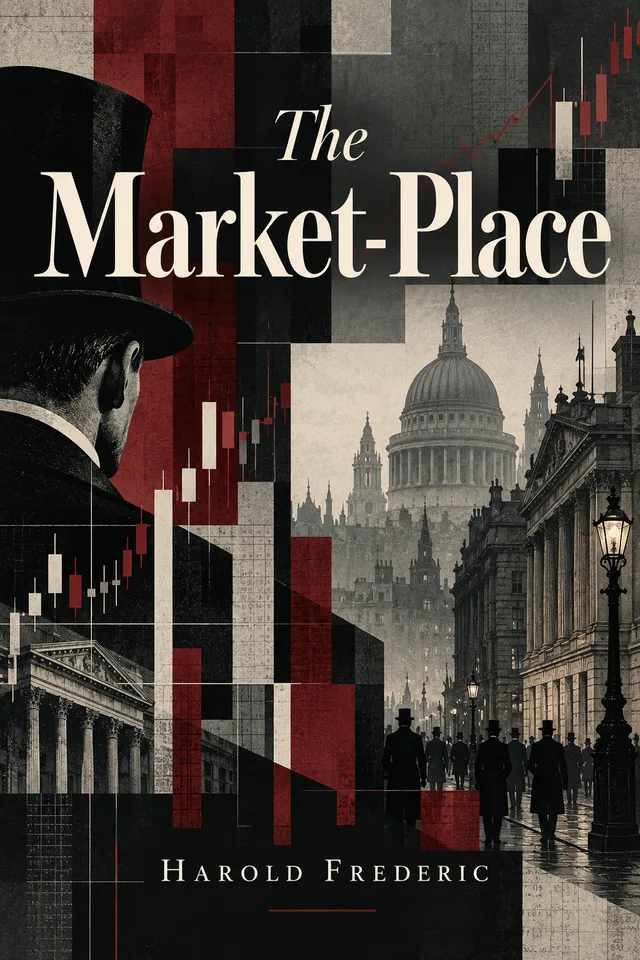
The Market-Place
English BooksWhale Edition by Harold Frederic
A London speculator’s financial schemes turn social ambition and intimate relationships into a sharp study of money and power.
- Preview
- A sample from the prepared text
- Formats
- Online reader, EPUB, PDF
- Access
- Library claim
Book introduction
The Market-Place
Joel Thorpe returns to London determined to make his fortune and engineers a speculative campaign on the stock market. As wealth brings access to fashionable society, his dealings reshape friendships, family obligations, and the possibility of marriage. Harold Frederic joins financial intrigue to an unsentimental portrait of social climbing, examining the habits of calculation that prosperity encourages and the compromises hidden beneath respectability.
BooksWhale edition
How this edition was prepared
This edition is based on a public domain text and has been prepared for digital reading by BooksWhale.
Public domain basis
Why this edition can be shared
Original English work by Harold Frederic, who died in 1898. The source is the public-domain transcription from Project Gutenberg; modern editorial apparatus and illustrations are excluded.
Read preview
A sample from the prepared text
Preview selected from the prepared reader text.
Preview chapterCHAPTER IRead preview
THE battle was over, and the victor remained on the field—sitting alone with the hurly-burly of his thoughts.
His triumph was so sweeping and comprehensive as to be somewhat shapeless to the view. He had a sense of fascinated pain when he tried to define to himself what its limits would probably be. Vistas of unchecked, expanding conquest stretched away in every direction. He held at his mercy everything within sight. Indeed, it rested entirely with him to say whether there should be any such thing as mercy at all—and until he chose to utter the restraining word the rout of the vanquished would go on with multiplying terrors and ruin. He could crush and torture and despoil his enemies until he was tired. The responsibility of having to decide when he would stop grinding their faces might come to weigh upon him later on, but he would not give it room in his mind to-night.
A picture of these faces of his victims shaped itself out of the flames in the grate. They were moulded in a family likeness, these phantom visages: they were all Jewish, all malignant, all distorted with fright. They implored him with eyes in which panic asserted itself above rage and cunning. Only here and there did he recall a name with which to label one of these countenances; very few of them raised a memory of individual rancour. The faces were those of men he had seen, no doubt, but their persecution of him had been impersonal; his great revenge was equally so. As he looked, in truth, there was only one face—a composite mask of what he had done battle with, and overthrown, and would trample implacably under foot. He stared with a conqueror's cold frown at it, and gave an abrupt laugh which started harsh echoes in the stillness of the Board Room. Then he shook off the reverie, and got to his feet. He shivered a little at the sudden touch of a chill.
A bottle of brandy, surrounded by glasses, stood on the table where the two least-considered of his lieutenants, the dummy Directors, had left it. He poured a small quantity and sipped it. During the whole eventful day it had not occurred to him before to drink; the taste of the neat liquor seemed on the instant to calm and refresh his brain. With more deliberation, he took a cigar from the broad, floridly-decorated open box beside the bottle, lit it, and blew a long draught of smoke thoughtfully through his nostrils. Then he put his hands in his pockets, looked again into the fire, and sighed a wondering smile. God in heaven! it was actually true!
This man of forty found himself fluttering with a novel exhilaration, which yet was not novel. Upon reflection, he perceived that he felt as if he were a boy again—a boy excited by pleasure. It surprised as much as it delighted him to experience this frank and direct joy of a child. He caught the inkling of an idea that perhaps his years were an illusion. He had latterly been thinking of himself as middle-aged; the grey hairs thickening at his temples had vaguely depressed him. Now all at once he saw that he was not old at all. The buoyancy of veritable youth bubbled in his veins. He began walking up and down the room, regarding new halcyon visions with a sparkling eye. He was no longer conscious of the hated foe beneath his feet; they trod instead elastic upon the clouds.
The sound of someone moving about in the hallway outside, and of trying a door near by, suddenly caught his attention. He stood still and listened with alertness for a surprised instant, then shrugged his shoulders and began moving again. It must be nearly seven o'clock; although the allotment work had kept the clerks later than usual that day, everybody connected with the offices had certainly gone home. He realized that his nerves had played him a trick in giving that alarmed momentary start—and smiled almost tenderly as he remembered how notable and even glorious a warrant those nerves had for their unsettled state. They would be all right after a night's real rest. He would know how to sleep NOW, thank God!
Preview chapterCHAPTER IIPreview
“LOUISA, the long and short of it is this,” said Thorpe, half an hour later: “you never did believe in me, as a sister should do.”
He was seated alone with this sister, in a small, low, rather dismally-appointed room, half-heartedly lighted by two flickering gasjets. They sat somewhat apart, confronting a fireplace, where only the laid materials for a fire disclosed themselves in the cold grate. Above the mantel hung an enlarged photograph of a scowling old man. Thorpe's gaze recurred automatically at brief intervals to this portrait—which somehow produced the effect upon him of responsibility for the cheerlessness of the room. There were other pictures on the walls of which he was dimly conscious—small, faded, old prints about Dido and AEneas and Agamemnon, which seemed to be coming back to him out of the mists of his childhood.
Vagrant impressions and associations of this childhood strayed with quaint inconsequence across the field of his preoccupied mind. The peculiar odour of the ancient book-shop on the floor below remained like snuff in his nostrils. Somewhere underneath, or in the wainscoting at the side, he could hear the assiduous gnawing of a rat. Was it the same rat, he wondered with a mental grin, that used to keep him awake nights, in one of the rooms next to this, with that same foolish noise, when he was a boy?
“I know you always say that,” replied Louisa, impassively.
She was years older than her brother, but, without a trace of artifice or intention, contrived to look the younger of the two. Her thick hair, drawn simply from her temples into a knot behind, was of that palest brown which assimilates grey. Her face, long, plain, masculine in contour and spirit, conveyed no message as to years. Long and spare of figure, she sat upright in her straight-backed chair, with her large, capable hands on her knees.
“I believed in you as much as you'd let me,” she went on, indifferently, almost wearily. “But I don't see that it mattered to you whether I did or didn't. You went your own way: you did what you wanted to do. What had I to do with it? I don't suppose I even knew what part of the world you were in more than once in two or three years. How should I know whether you were going to succeed, when I didn't even know what it was you were at? Certainly you hadn't succeeded here in London—but elsewhere you might or you might not—how could I tell? And moreover, I don't feel that I know you very well; you've grown into something very different from the boy Joel that left the shop—it must be twenty years ago. I can only know about you and your affairs what you tell me.”
“But my point is,” pursued Thorpe, watching her face with a curiously intent glance, “you never said to yourself: 'I KNOW he's going to succeed. I KNOW he'll be a rich man before he dies.'”
She shook her head dispassionately. Her manner expressed fatigued failure to comprehend why he was making so much of this purposeless point.
“No—I don't remember ever having said that to myself,” she admitted, listlessly. Then a comment upon his words occurred to her, and she spoke with more animation: “You don't seem to understand, Joel, that what was very important to you, didn't occupy me at all. You were always talking about getting rich; you kept the idea before you of sometime, at a stroke, finding yourself a millionaire. That's been the idea of your life. But what do I know about all that? My work has been to keep a roof over my head—to keep the little business from disappearing altogether. It's been hard enough, I can tell you, these last few years, with the big jobbers cutting the hearts out of the small traders. I had the invalid husband to support for between three and four years—a dead weight on me every week—and then the children to look after, to clothe and educate.”
Preview chapterCHAPTER IIIPreview
THORPE took a long, thoughtful pull at the beer his sister brought him.
“Ah, I didn't know I was so thirsty,” he said, when he put the glass down. “Truth is—I've lost track of myself altogether since—since the big thing happened. I seem to be somebody else—a comparative stranger, so to speak. I've got to get acquainted with myself, all over again. You can't imagine what an extraordinary feeling it is—this being hit every few minutes with the recollection that you're worth half a million. It's like being struck over the head. It knocks you down. There are such thousands of things to do—you dance about, all of a flutter. You don't know where to begin.”
“Begin where you left off,” suggested Louisa. “You were going to tell me how—how 'the big thing' happened. You're always coming to it—and never getting any further.”
Nodding comprehension of the rebuke's justification, he plunged forthwith into the tale.
“You remember my telling you at the time how I got my Board together. I'm speaking now of the present Company—after I'd decided to be my own promoter, and have at least some kind of 'a look-in' for my money. There wasn't much money left, by the way; it was considerably under three thousand. But I come to that later. First there was the Board. Here was where that Lord Plowden that I told you about—the man that came over on the ship with me—came in. I went to him. I—God! I was desperate—but I hadn't much of an idea he'd consent. But he did! He listened to me, and I told him how I'd been robbed, and how the Syndicate would have cut my throat if I hadn't pulled away,—and he said, 'Why, yes, I'll go on your Board.' Then I told him more about it, and presently he said he'd get me another man of title—a sky-scraper of a title too—to be my Chairman. That's the Marquis of Chaldon, a tremendous diplomatic swell, you know, Ambassador at Vienna in his time, and Lord Lieutenant and all sorts of things, but willing to gather in his five hundred a year, all the same.”
“Do you mean that YOU pay HIM five hundred pounds a year?” asked the sister.
“Yes, I've got a live Markiss who works for me at ten quid a week, and a few extras. The other Directors get three hundred. This Lord Plowden is one of them—but I'll tell you more about him later on. Then there's Watkin, he's a small accountant Finsbury way; and Davidson, he's a wine-merchant who used to belong to a big firm in Dundee, but gets along the best way he can on a very dicky business here in London, now. And then there's General Kervick, awfully well-connected old chap, they say, but I guess he needs all he can get. He's started wearing his fur-coat already. Well, that's my Board. I couldn't join it, of course, till after allotment—that's because I'm the vendor, as they call it—but that hasn't interfered at all with my running the whole show. The Board doesn't really count, you know. It only does what I want it to do. It's just a form that costs me seventeen hundred a year, that's all.”
“Seventeen hundred a year,” she repeated, mechanically.
“Well, then we got out the prospectus, d'ye see. Or first, there were other things to be done. I saw that a good broker's name counted for a lot on a prospectus. I picked out one that I'd heard was reasonable—it'd been a splendid name if I could have got it—but he calmly said his price was two thousand pounds, all cash down—and I came away. Finally I got a fellow who hadn't done much of anything yet, and so wasn't so stiff about his figure. He agreed to take 500 pounds cash, and 2,000 in shares. It was God's luck that I hit on him, for he turned out, at the pinch, to be the one man in a million for me. But I'll tell you about him later. He's the Broker, mind; you mustn't forget him. Well, then, he and I got a Solicitor—he took 200 pounds cash, but he had to have 2,000 shares—and the firm of Auditors—they were 100 pounds cash and 1,000 shares. Every company has to have these people pasted on to it, by law. Oh yes, and then you must have your Bankers. You don't pay them anything, though, thank God! Well, then, there was the machinery complete, all ready to start. I took a handsome set of offices, and furnished them up to the nines—but that I was able to do pretty well on credit. You see, ready money was getting short.
Table of contents
Inside this edition
- 01CHAPTER I
- 02CHAPTER II
- 03CHAPTER III
- 04CHAPTER IV
- 05CHAPTER V
- 06CHAPTER VI
- 07CHAPTER VII
- 08CHAPTER VIII
- 09CHAPTER IX
- 10CHAPTER X
- 11CHAPTER XI
- 12CHAPTER XII
- 13CHAPTER XIII
- 14CHAPTER XIV
- 15CHAPTER XV
- 16CHAPTER XVI
- 17CHAPTER XVII
- 18CHAPTER XVIII
- 19CHAPTER XIX
- 20CHAPTER XX
- 21CHAPTER XXI
- 22CHAPTER XXII
- 23CHAPTER XXIII
- 24CHAPTER XXIV
- 25CHAPTER XXV
- 26CHAPTER XXVI
- 27CHAPTER XXVII
Language availability
Other languages
Additional language editions are not published yet. This section will link to other BooksWhale editions when they become available.
Request another language