English Edition
Literature
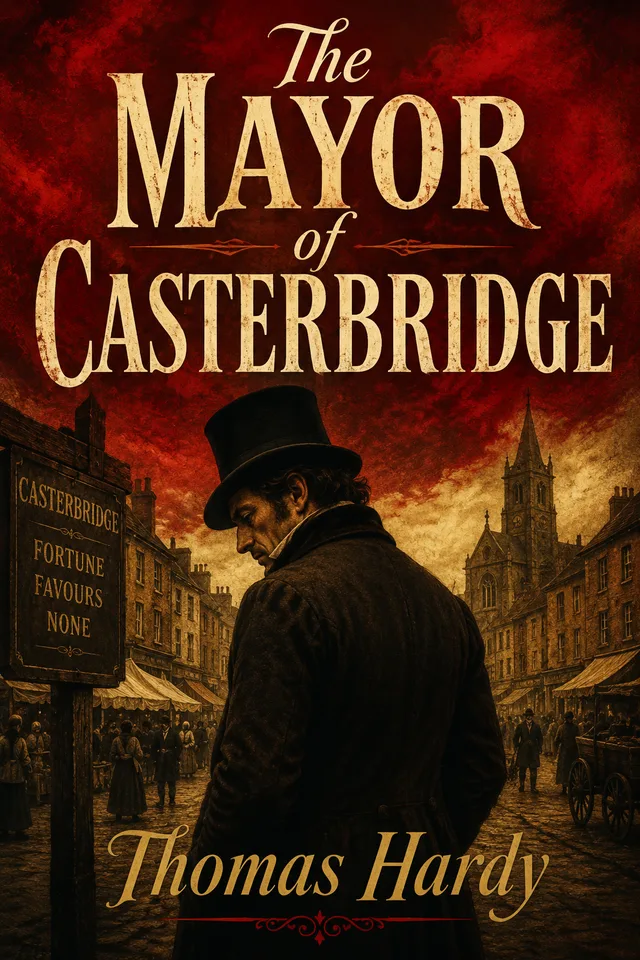
The Mayor of Casterbridge
English BooksWhale Edition by Thomas Hardy
Hardy's Michael Henchard rises by force of will and falls through pride, secrecy, and unforgiving chance.
- Preview
- A sample from the prepared text
- Formats
- Online reader, EPUB, PDF
- Access
- Library claim
Book introduction
The Mayor of Casterbridge
The Mayor of Casterbridge begins with a drunken act of betrayal and follows Michael Henchard through prosperity, rivalry, guilt, and ruin. Thomas Hardy builds a tragic portrait of character and fate in a market town where old decisions return with devastating force.
BooksWhale edition
How this edition was prepared
This edition is based on a public domain text and has been prepared for digital reading by BooksWhale.
Public domain basis
Why this edition can be shared
Thomas Hardy died in 1928, and The Mayor of Casterbridge was first published in 1886. These dates support the public-domain basis for this English original-language edition.
Read preview
A sample from the prepared text
Preview selected from the prepared reader text.
Preview chapterFull textRead preview
The Mayor of Casterbridge
Preview chapterI.Preview
One evening of late summer, before the nineteenth century had reached one-third of its span, a young man and woman, the latter carrying a child, were approaching the large village of Weydon-Priors, in Upper Wessex, on foot. They were plainly but not ill clad, though the thick hoar of dust which had accumulated on their shoes and garments from an obviously long journey lent a disadvantageous shabbiness to their appearance just now.
The man was of fine figure, swarthy, and stern in aspect; and he showed in profile a facial angle so slightly inclined as to be almost perpendicular. He wore a short jacket of brown corduroy, newer than the remainder of his suit, which was a fustian waistcoat with white horn buttons, breeches of the same, tanned leggings, and a straw hat overlaid with black glazed canvas. At his back he carried by a looped strap a rush basket, from which protruded at one end the crutch of a hay-knife, a wimble for hay-bonds being also visible in the aperture. His measured, springless walk was the walk of the skilled countryman as distinct from the desultory shamble of the general labourer; while in the turn and plant of each foot there was, further, a dogged and cynical indifference personal to himself, showing its presence even in the regularly interchanging fustian folds, now in the left leg, now in the right, as he paced along.
What was really peculiar, however, in this couple’s progress, and would have attracted the attention of any casual observer otherwise disposed to overlook them, was the perfect silence they preserved. They walked side by side in such a way as to suggest afar off the low, easy, confidential chat of people full of reciprocity; but on closer view it could be discerned that the man was reading, or pretending to read, a ballad sheet which he kept before his eyes with some difficulty by the hand that was passed through the basket strap. Whether this apparent cause were the real cause, or whether it were an assumed one to escape an intercourse that would have been irksome to him, nobody but himself could have said precisely; but his taciturnity was unbroken, and the woman enjoyed no society whatever from his presence. Virtually she walked the highway alone, save for the child she bore. Sometimes the man’s bent elbow almost touched her shoulder, for she kept as close to his side as was possible without actual contact, but she seemed to have no idea of taking his arm, nor he of offering it; and far from exhibiting surprise at his ignoring silence she appeared to receive it as a natural thing. If any word at all were uttered by the little group, it was an occasional whisper of the woman to the child—a tiny girl in short clothes and blue boots of knitted yarn—and the murmured babble of the child in reply.
The chief—almost the only—attraction of the young woman’s face was its mobility. When she looked down sideways to the girl she became pretty, and even handsome, particularly that in the action her features caught slantwise the rays of the strongly coloured sun, which made transparencies of her eyelids and nostrils and set fire on her lips. When she plodded on in the shade of the hedge, silently thinking, she had the hard, half-apathetic expression of one who deems anything possible at the hands of Time and Chance except, perhaps, fair play. The first phase was the work of Nature, the second probably of civilization.
That the man and woman were husband and wife, and the parents of the girl in arms there could be little doubt. No other than such relationship would have accounted for the atmosphere of stale familiarity which the trio carried along with them like a nimbus as they moved down the road.
The wife mostly kept her eyes fixed ahead, though with little interest—the scene for that matter being one that might have been matched at almost any spot in any county in England at this time of the year; a road neither straight nor crooked, neither level nor hilly, bordered by hedges, trees, and other vegetation, which had entered the blackened-green stage of colour that the doomed leaves pass through on their way to dingy, and yellow, and red. The grassy margin of the bank, and the nearest hedgerow boughs, were powdered by the dust that had been stirred over them by hasty vehicles, the same dust as it lay on the road deadening their footfalls like a carpet; and this, with the aforesaid total absence of conversation, allowed every extraneous sound to be heard.
Preview chapterII.Preview
The morning sun was streaming through the crevices of the canvas when the man awoke. A warm glow pervaded the whole atmosphere of the marquee, and a single big blue fly buzzed musically round and round it. Besides the buzz of the fly there was not a sound. He looked about—at the benches—at the table supported by trestles—at his basket of tools—at the stove where the furmity had been boiled—at the empty basins—at some shed grains of wheat—at the corks which dotted the grassy floor. Among the odds and ends he discerned a little shining object, and picked it up. It was his wife’s ring.
A confused picture of the events of the previous evening seemed to come back to him, and he thrust his hand into his breast-pocket. A rustling revealed the sailor’s bank-notes thrust carelessly in.
This second verification of his dim memories was enough; he knew now they were not dreams. He remained seated, looking on the ground for some time. “I must get out of this as soon as I can,” he said deliberately at last, with the air of one who could not catch his thoughts without pronouncing them. “She’s gone—to be sure she is—gone with that sailor who bought her, and little Elizabeth-Jane. We walked here, and I had the furmity, and rum in it—and sold her. Yes, that’s what’s happened and here am I. Now, what am I to do—am I sober enough to walk, I wonder?” He stood up, found that he was in fairly good condition for progress, unencumbered. Next he shouldered his tool basket, and found he could carry it. Then lifting the tent door he emerged into the open air.
Here the man looked around with gloomy curiosity. The freshness of the September morning inspired and braced him as he stood. He and his family had been weary when they arrived the night before, and they had observed but little of the place; so that he now beheld it as a new thing. It exhibited itself as the top of an open down, bounded on one extreme by a plantation, and approached by a winding road. At the bottom stood the village which lent its name to the upland and the annual fair that was held thereon. The spot stretched downward into valleys, and onward to other uplands, dotted with barrows, and trenched with the remains of prehistoric forts. The whole scene lay under the rays of a newly risen sun, which had not as yet dried a single blade of the heavily dewed grass, whereon the shadows of the yellow and red vans were projected far away, those thrown by the felloe of each wheel being elongated in shape to the orbit of a comet. All the gipsies and showmen who had remained on the ground lay snug within their carts and tents or wrapped in horse-cloths under them, and were silent and still as death, with the exception of an occasional snore that revealed their presence. But the Seven Sleepers had a dog; and dogs of the mysterious breeds that vagrants own, that are as much like cats as dogs and as much like foxes as cats also lay about here. A little one started up under one of the carts, barked as a matter of principle, and quickly lay down again. He was the only positive spectator of the hay-trusser’s exit from the Weydon Fair-field.
This seemed to accord with his desire. He went on in silent thought, unheeding the yellowhammers which flitted about the hedges with straws in their bills, the crowns of the mushrooms, and the tinkling of local sheep-bells, whose wearer had had the good fortune not to be included in the fair. When he reached a lane, a good mile from the scene of the previous evening, the man pitched his basket and leant upon a gate. A difficult problem or two occupied his mind.
Table of contents
Inside this edition
- 01Full text
- 02I.
- 03II.
- 04III.
- 05IV.
- 06V.
- 07VI.
- 08VII.
- 09VIII.
- 10IX.
- 11X.
- 12XI.
- 13XII.
- 14XIII.
- 15XIV.
- 16XV.
- 17XVI.
- 18XVII.
- 19M. HENCHARD.
- 20XVIII.
- 21XIX.
- 22XX.
- 23M. HENCHARD. Mr. Farfrae.
- 24XXI.
- 25XXII.
- 26XXIII.
- 27XXIV.
- 28XXV.
- 29XXVI.
- 30XXVII.
- 31XXVIII.
- 32XXIX.
- 33XXX.
- 34XXXI.
- 35XXXII.
- 36XXXIII.
- 37XXXIV.
- 38XXXV.
- 39XXXVI.
- 40XXXVII.
- 41XXXVIII.
- 42XXXIX.
- 43XL.
- 44XLI.
- 45XLII.
- 46XLIII.
- 47XLIV.
- 48XLV.
Language availability
Other languages
Additional language editions are not published yet. This section will link to other BooksWhale editions when they become available.
Request another language