English Edition
Literature
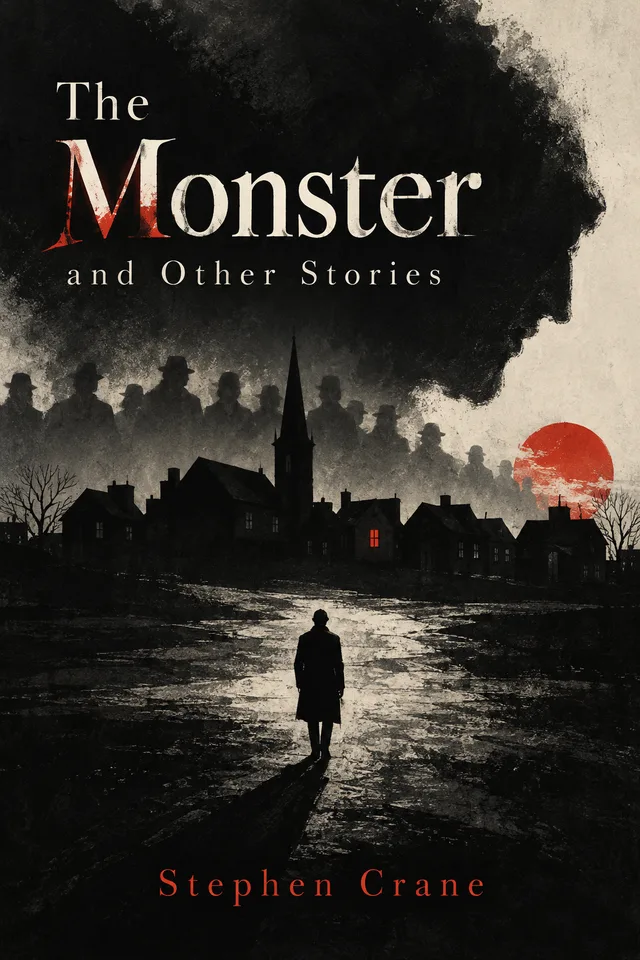
The Monster and Other Stories
English BooksWhale Edition by Stephen Crane
A powerful Crane collection about prejudice, fear, violence, and the moral pressure of small communities.
- Preview
- A sample from the prepared text
- Formats
- Online reader, EPUB, PDF
- Access
- Library claim
Book introduction
The Monster and Other Stories
The Monster and Other Stories brings together Stephen Crane’s compressed realism, social criticism, irony, and psychological force. Centered on injury, race, rumor, and communal judgment, the collection shows why Crane remains essential to American literature and short fiction.
BooksWhale edition
How this edition was prepared
This edition is based on a public domain text and has been prepared for digital reading by BooksWhale.
Public domain basis
Why this edition can be shared
Stephen Crane died in 1900, and The Monster and Other Stories was first published in 1899. These dates support the public-domain basis for this original English collection.
Read preview
A sample from the prepared text
Preview selected from the prepared reader text.
Preview chapterFull textRead preview
The Monster and Other Stories
Stephen Crane
Preview chapterTHE MONSTERPreview
I
Little Jim was, for the time, engine Number 36, and he was making the run between Syracuse and Rochester. He was fourteen minutes behind time, and the throttle was wide open. In consequence, when he swung around the curve at the flower-bed, a wheel of his cart destroyed a peony. Number 36 slowed down at once and looked guiltily at his father, who was mowing the lawn. The doctor had his back to this accident, and he continued to pace slowly to and fro, pushing the mower.
Jim dropped the tongue of the cart. He looked at his father and at the broken flower. Finally he went to the peony and tried to stand it on its pins, resuscitated, but the spine of it was hurt, and it would only hang limply from his hand. Jim could do no reparation. He looked again towards his father.
He went on to the lawn, very slowly, and kicking wretchedly at the turf. Presently his father came along with the whirring machine, while the sweet, new grass blades spun from the knives. In a low voice, Jim said, "Pa!"
The doctor was shaving this lawn as if it were a priest's chin. All during the season he had worked at it in the coolness and peace of the evenings after supper. Even in the shadow of the cherry-trees the grass was strong and healthy. Jim raised his voice a trifle. "Pa!"
The doctor paused, and with the howl of the machine no longer occupying the sense, one could hear the robins in the cherry-trees arranging their affairs. Jim's hands were behind his back, and sometimes his fingers clasped and unclasped. Again he said, "Pa!" The child's fresh and rosy lip was lowered.
The doctor stared down at his son, thrusting his head forward and frowning attentively. "What is it, Jimmie?"
"Pa!" repeated the child at length. Then he raised his finger and pointed at the flowerbed. "There!"
"What?" said the doctor, frowning more. "What is it, Jim?"
After a period of silence, during which the child may have undergone a severe mental tumult, he raised his finger and repeated his former word--"There!" The father had respected this silence with perfect courtesy. Afterwards his glance carefully followed the direction indicated by the child's finger, but he could see nothing which explained to him. "I don't understand what you mean, Jimmie," he said.
It seemed that the importance of the whole thing had taken away the boy's vocabulary, He could only reiterate, "There!"
The doctor mused upon the situation, but he could make nothing of it. At last he said, "Come, show me."
Together they crossed the lawn towards the flower-bed. At some yards from the broken peony Jimmie began to lag. "There!" The word came almost breathlessly.
"Where?" said the doctor.
Jimmie kicked at the grass. "There!" he replied.
The doctor was obliged to go forward alone. After some trouble he found the subject of the incident, the broken flower. Turning then, he saw the child lurking at the rear and scanning his countenance.
The father reflected. After a time he said, "Jimmie, come here." With an infinite modesty of demeanor the child came forward. "Jimmie, how did this happen?"
The child answered, "Now--I was playin' train--and--now--I runned over it."
"You were doing what?"
"I was playin' train."
The father reflected again. "Well, Jimmie," he said, slowly, "I guess you had better not play train any more to-day. Do you think you had better?"
"No, sir," said Jimmie.
During the delivery of the judgment the child had not faced his father, and afterwards he went away, with his head lowered, shuffling his feet.
II
It was apparent from Jimmie's manner that he felt some kind of desire to efface himself. He went down to the stable. Henry Johnson, the negro who cared for the doctor's horses, was sponging the buggy. He grinned fraternally when he saw Jimmie coming. These two were pals. In regard to almost everything in life they seemed to have minds precisely alike. Of course there were points of emphatic divergence. For instance, it was plain from Henry's talk that he was a very handsome negro, and he was known to be a light, a weight, and an eminence in the suburb of the town, where lived the larger number of the negroes, and obviously this glory was over Jimmie's horizon; but he vaguely appreciated it and paid deference to Henry for it mainly because Henry appreciated it and deferred to himself. However, on all points of conduct as related to the doctor, who was the moon, they were in complete but unexpressed understanding. Whenever Jimmie became
Preview chapterTHE BLUE HOTELPreview
I
The Palace Hotel at Fort Romper was painted a light blue, a shade that is on the legs of a kind of heron, causing the bird to declare its position against any background. The Palace Hotel, then, was always screaming and howling in a way that made the dazzling winter landscape of Nebraska seem only a gray swampish hush. It stood alone on the prairie, and when the snow was falling the town two hundred yards away was not visible. But when the traveller alighted at the railway station he was obliged to pass the Palace Hotel before he could come upon the company of low clapboard houses which composed Fort Romper, and it was not to be thought that any traveller could pass the Palace Hotel without looking at it. Pat Scully, the proprietor, had proved himself a master of strategy when he chose his paints. It is true that on clear days, when the great trans-continental expresses, long lines of swaying Pullmans, swept through Fort Romper, passengers were
overcome at the sight, and the cult that knows the brown-reds and the subdivisions of the dark greens of the East expressed shame, pity, horror, in a laugh. But to the citizens of this prairie town and to the people who would naturally stop there, Pat Scully had performed a feat. With this opulence and splendor, these creeds, classes, egotisms, that streamed through Romper on the rails day after day, they had no color in common.
As if the displayed delights of such a blue hotel were not sufficiently enticing, it was Scully's habit to go every morning and evening to meet the leisurely trains that stopped at Romper and work his seductions upon any man that he might see wavering, gripsack in hand.
One morning, when a snow-crusted engine dragged its long string of freight cars and its one passenger coach to the station, Scully performed the marvel of catching three men. One was a shaky and quick-eyed Swede, with a great shining cheap valise; one was a tall bronzed cowboy, who was on his way to a ranch near the Dakota line; one was a little silent man from the East, who didn't look it, and didn't announce it. Scully practically made them prisoners. He was so nimble and merry and kindly that each probably felt it would be the height of brutality to try to escape. They trudged off over the creaking board sidewalks in the wake of the eager little Irishman. He wore a heavy fur cap squeezed tightly down on his head. It caused his two red ears to stick out stiffly, as if they were made of tin.
At last, Scully, elaborately, with boisterous hospitality, conducted them through the portals of the blue hotel. The room which they entered was small. It seemed to be merely a proper temple for an enormous stove, which, in the centre, was humming with godlike violence. At various points on its surface the iron had become luminous and glowed yellow from the heat. Beside the stove Scully's son Johnnie was playing High-Five with an old farmer who had whiskers both gray and sandy. They were quarrelling. Frequently the old farmer turned his face towards a box of sawdust--colored brown from tobacco juice--that was behind the stove, and spat with an air of great impatience and irritation. With a loud flourish of words Scully destroyed the game of cards, and bustled his son up-stairs with part of the baggage of the new guests. He himself conducted them to three basins of the coldest water in the world. The cowboy and the Easterner
burnished themselves fiery-red with this water, until it seemed to be some kind of a metal polish. The Swede, however, merely dipped his fingers gingerly and with trepidation. It was notable that throughout this series of small ceremonies the three travellers were made to feel that Scully was very benevolent. He was conferring great favors upon them. He handed the towel from one to the other with an air of philanthropic impulse.
Table of contents
Inside this edition
- 01Full text
- 02THE MONSTER
- 03THE BLUE HOTEL
- 04HIS NEW MITTENS
Language availability
Other languages
Additional language editions are not published yet. This section will link to other BooksWhale editions when they become available.
Request another language