English Edition
Science
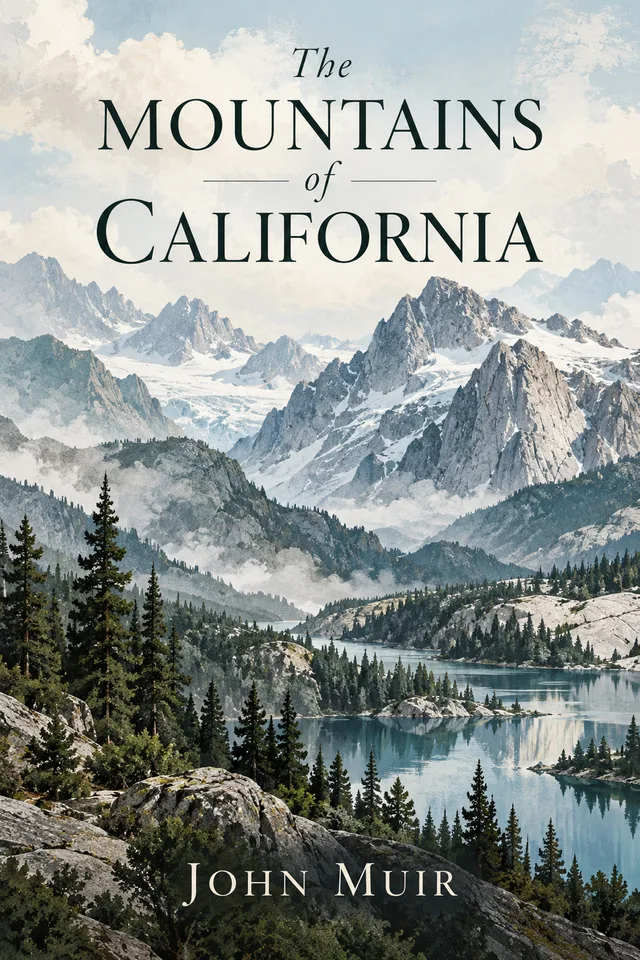
The Mountains of California
English BooksWhale Edition by John Muir
John Muir explores Sierra Nevada glaciers, forests, mountain storms, wildlife, and the changing natural landscapes of California.
- Preview
- A sample from the prepared text
- Formats
- Online reader, EPUB, PDF
- Access
- Library claim
Book introduction
The Mountains of California
John Muir leads the reader through California’s Sierra Nevada, describing glaciers, forests, lakes, meadows and the effects of snow and storms. Chapters on squirrels, birds, wild sheep and bee pastures connect close observation with the larger shape of the mountain landscape. His natural history combines accounts of outdoor travel with an attentive interest in the processes that form and sustain living environments.
BooksWhale edition
How this edition was prepared
This edition is based on a public domain text and has been prepared for digital reading by BooksWhale.
Public domain basis
Why this edition can be shared
John Muir died in 1914. This edition uses the public-domain English original from Project Gutenberg, without later editorial notes or illustrations.
Read preview
A sample from the prepared text
Preview selected from the prepared reader text.
Preview chapterCHAPTER I THE SIERRA NEVADARead preview
Go where you may within the bounds of California, mountains are ever in sight, charming and glorifying every landscape. Yet so simple and massive is the topography of the State in general views, that the main central portion displays only one valley, and two chains of mountains which seem almost perfectly regular in trend and height: the Coast Range on the west side, the Sierra Nevada on the east. These two ranges coming together in curves on the north and south inclose a magnificent basin, with a level floor more than 400 miles long, and from 35 to 60 miles wide. This is the grand Central Valley of California, the waters of which have only one outlet to the sea through the Golden Gate. But with this general simplicity of features there is great complexity of hidden detail. The Coast Range, rising as a grand green barrier against the ocean, from 2000 to 8000 feet high, is composed of innumerable forest-crowned spurs, ridges, and rolling hill-waves which inclose a multitude of smaller valleys; some looking out through long, forest-lined vistas to the sea; others, with but few trees, to the Central Valley; while a thousand others yet smaller are embosomed and concealed in mild, round-browed hills, each, with its own climate, soil, and productions.
Making your way through the mazes of the Coast Range to the summit of any of the inner peaks or passes opposite San Francisco, in the clear springtime, the grandest and most telling of all California landscapes is outspread before you. At your feet lies the great Central Valley glowing golden in the sunshine, extending north and south farther than the eye can reach, one smooth, flowery, lake-like bed of fertile soil. Along its eastern margin rises the mighty Sierra, miles in height, reposing like a smooth, cumulous cloud in the sunny sky, and so gloriously colored, and so luminous, it seems to be not clothed with light, but wholly composed of it, like the wall of some celestial city. Along the top, and extending a good way down, you see a pale, pearl-gray belt of snow; and below it a belt of blue and dark purple, marking the extension of the forests; and along the base of the range a broad belt of rose-purple and yellow, where lie the minor’s gold-fields and the foot-hill gardens. All these colored belts blending smoothly make a wall of light ineffably fine, and as beautiful as a rainbow, yet firm as adamant.
When I first enjoyed this superb view, one glowing April day, from the summit of the Pacheco Pass, the Central Valley, but little trampled or plowed as yet, was one furred, rich sheet of golden compositae, and the luminous wall of the mountains shone in all its glory. Then it seemed to me the Sierra should be called not the Nevada, or Snowy Range, but the Range of Light. And after ten years spent in the heart of it, rejoicing and wondering, bathing in its glorious floods of light, seeing the sunbursts of morning among the icy peaks, the noonday radiance on the trees and rocks and snow, the flush of the alpenglow, and a thousand dashing waterfalls with their marvelous abundance of irised spray, it still seems to me above all others the Range of Light, the most divinely beautiful of all the mountain-chains I have ever seen.
The Sierra is about 500 miles long, 70 miles wide, and from 7000 to nearly 15,000 feet high. In general views no mark of man is visible on it, nor anything to suggest the richness of the life it cherishes, or the depth and grandeur of its sculpture. None of its magnificent forest-crowned ridges rises much above the general level to publish its wealth. No great valley or lake is seen, or river, or group of well-marked features of any kind, standing out in distinct pictures. Even the summit-peaks, so clear and high in the sky, seem comparatively smooth and featureless. Nevertheless, glaciers are still at work in the shadows of the peaks, and thousands of lakes and meadows shine and bloom beneath them, and the whole range is furrowed with cañons to a depth of from 2000 to 5000 feet, in which once flowed majestic glaciers, and in which now flow and sing a band of beautiful rivers.
Preview chapterCHAPTER II THE GLACIERSPreview
Of the small residual glaciers mentioned in the preceding chapter, I have found sixty-five in that portion of the range lying between latitude 36° 30′ and 39°. They occur singly or in small groups on the north sides of the peaks of the High Sierra, sheltered beneath broad frosty shadows, in amphitheaters of their own making, where the snow, shooting down from the surrounding heights in avalanches, is most abundant. Over two thirds of the entire number lie between latitude 37° and 38°, and form the highest fountains of the San Joaquin, Merced, Tuolumne, and Owen’s rivers.
The glaciers of Switzerland, like those of the Sierra, are mere wasting remnants of mighty ice-floods that once filled the great valleys and poured into the sea. So, also, are those of Norway, Asia, and South America. Even the grand continuous mantles of ice that still cover Greenland, Spitsbergen, Nova Zembla, Franz-Joseph-Land, parts of Alaska, and the south polar region are shallowing and shrinking. Every glacier in the world is smaller than it once was. All the world is growing warmer, or the crop of snow-flowers is diminishing. But in contemplating the condition of the glaciers of the world, we must bear in mind while trying to account for the changes going on that the same sunshine that wastes them builds them. Every glacier records the expenditure of an enormous amount of sun-heat in lifting the vapor for the snow of which it is made from the ocean to the mountains, as Tyndall strikingly shows.
The number of glaciers in the Alps, according to the Schlagintweit brothers, is 1100, of which 100 may be regarded as primary, and the total area of ice, snow, and névé is estimated at 1177 square miles, or an average for each glacier of little more than one square mile. On the same authority, the average height above sea-level at which they melt is about 7414 feet. The Grindelwald glacier descends below 4000 feet, and one of the Mont Blanc glaciers reaches nearly as low a point. One of the largest of the Himalaya glaciers on the head waters of the Ganges does not, according to Captain Hodgson, descend below 12,914 feet. The largest of the Sierra glaciers on Mount Shasta descends to within 9500 feet of the level of the sea, which, as far as I have observed, is the lowest point reached by any glacier within the bounds of California, the average height of all being not far from 11,000 feet.
The changes that have taken place in the glacial conditions of the Sierra from the time of greatest extension is well illustrated by the series of glaciers of every size and form extending along the mountains of the coast to Alaska. A general exploration of this instructive region shows that to the north of California, through Oregon and Washington, groups of active glaciers still exist on all the high volcanic cones of the Cascade Range,—Mount Pitt, the Three Sisters, Mounts Jefferson, Hood, St. Helens, Adams, Rainier, Baker, and others,—some of them of considerable size, though none of them approach the sea. Of these mountains Rainier, in Washington, is the highest and iciest. Its dome-like summit, between 14,000 and 15,000 feet high, is capped with ice, and eight glaciers, seven to twelve miles long, radiate from it as a center, and form the sources of the principal streams of the State. The lowest-descending of this fine group flows through beautiful forests to within 3500 feet of the sea-level, and sends forth a river laden with glacier mud and sand. On through British Columbia and southeastern Alaska the broad, sustained mountain-chain, extending along the coast, is generally glacier-bearing. The upper branches of nearly all the main cañons and fiords are occupied by glaciers, which gradually increase in size, and descend lower until the high region between Mount Fairweather and Mount St. Elias is reached, where a considerable number discharge into the waters of the ocean. This is preëminently the ice-land of Alaska and of the entire Pacific Coast.
Preview chapterCHAPTER III THE SNOWPreview
The first snow that whitens the Sierra, usually falls about the end of October or early in November, to a depth of a few inches, after months of the most charming Indian summer weather imaginable. But in a few days, this light covering mostly melts from the slopes exposed to the sun and causes but little apprehension on the part of mountaineers who may be lingering among the high peaks at this time. The first general winter storm that yields snow that is to form a lasting portion of the season’s supply, seldom breaks on the mountains before the end of November. Then, warned by the sky, cautions mountaineers, together with the wild sheep, deer, and most of the birds and bears, make haste to the lowlands or foot-hills; and burrowing marmots, mountain beavers, wood-rats, and such people go into winter quarters, some of them not again to see the light of day until the general awakening and resurrection of the spring in June or July. The first heavy fall is usually from about two to four feet in depth. Then, with intervals of splendid sunshine, storm succeeds storm, heaping snow on snow, until thirty to fifty feet has fallen. But on account of its settling and compacting, and the almost constant waste from melting and evaporation, the average depth actually found at any time seldom exceeds ten feet in the forest region, or fifteen feet along the slopes of the summit peaks.
Even during the coldest weather evaporation never wholly ceases, and the sunshine that abounds between the storms is sufficiently powerful to melt the surface more or less through all the winter months. Waste from melting also goes on to some extent on the bottom from heat stored up in the rocks, and given off slowly to the snow in contact with them, as is shown by the rising of the streams on all the higher regions after the first snowfall, and their steady sustained flow all winter.
The greater portion of the snow deposited around the lofty summits of the range falls in small crisp flakes and broken crystals, or, when accompanied by strong winds and low temperature, the crystals, instead of being locked together in their fall to form tufted flakes, are beaten and broken into meal and fine dust. But down in the forest region the greater portion comes gently to the ground, light and feathery, some of the flakes in mild weather being nearly an inch in diameter, and it is evenly distributed and kept from drifting to any great extent by the shelter afforded by the large trees. Every tree during the progress of gentle storms is loaded with, fairy bloom at the coldest and darkest time of year, bending the branches, and hushing every singing needle. But as soon as the storm is over, and the sun shines, the snow at once begins to shift and settle and fall from the branches in miniature avalanches, and the white forest soon becomes green again. The snow on the ground also settles and thaws every bright day, and freezes at night, until it becomes coarsely granulated, and loses every trace of its rayed crystalline structure, and then a man may walk firmly over its frozen surface as if on ice. The forest region up to an elevation of 7000 feet is usually in great part free from snow in June, but at this time the higher regions are still heavy-laden, and are not touched by spring weather to any considerable extent before the middle or end of July.
One of the most striking effects of the snow on the mountains is the burial of the rivers and small lakes.
As the snow fa’s in the river A moment white, then lost forever,
sang Burns, in illustrating the fleeting character of human pleasure. The first snowflakes that fall into the Sierra rivers vanish thus suddenly; but in great storms, when the temperature is low, the abundance of the snow at length chills the water nearly to the freezing-point, and then, of course, it ceases to melt and consume the snow so suddenly. The falling flakes and crystals form, cloud-like masses of blue sludge, which are swept forward with the current and carried down to warmer climates many miles distant, while some are lodged against logs and rocks and projecting points of the banks, and last for days, piled high above the level of the water, and show white again, instead of being at once “lost forever,” while the rivers themselves are at length lost for months during the snowy period. The snow is first built out from the banks in bossy, over-curling drifts, compacting and cementing until the streams are spanned. They then flow in the dark beneath a continuous covering across the snowy zone, which is about thirty miles wide. All the Sierra rivers and their tributaries in these high regions are thus lost every winter, as if another glacial period had come on. Not a drop of running water is to be seen excepting at a few points where large falls occur, though the rush and rumble of the heavier currents may still be heard. Toward spring, when the weather is warm during the day and frosty at night, repeated thawing and freezing and new layers of snow render the bridging-masses dense and firm, so that one may safely walk across the streams, or even lead a horse across them without danger of falling through. In June the thinnest parts of the winter ceiling, and those most exposed to sunshine, begin to give way, forming dark, rugged-edged, pit-like sinks, at the bottom of which the rushing water may be seen. At the end of June only here and there may the mountaineer find a secure snow-bridge. The most lasting of the winter bridges, thawing from below as well as from above, because of warm currents of air passing through the tunnels, are strikingly arched and sculptured; and by the occasional freezing of the oozing, dripping water of the ceiling they become brightly and picturesquely icy. In some of the reaches, where there is a free margin, we may walk through them. Small skylights appearing here and there, these tunnels are not very dark. The roaring river fills all the arching way with impressively loud reverberating music, which is sweetened at times by the ouzel, a bird that is not afraid to go wherever a stream may go, and to sing wherever a stream sings.
Table of contents
Inside this edition
- 01CHAPTER I THE SIERRA NEVADA
- 02CHAPTER II THE GLACIERS
- 03CHAPTER III THE SNOW
- 04SNOW-BANNERS
- 05CHAPTER IV A NEAR VIEW OF THE HIGH SIERRA
- 06CHAPTER V THE PASSES
- 07CHAPTER VI THE GLACIER LAKES
- 08SHADOW LAKE
- 09ORANGE LAKE
- 10LAKE STARR KING
- 11CHAPTER VII THE GLACIER MEADOWS
- 12HANGING MEADOWS
- 13CHAPTER VIII THE FORESTS
- 14THE NUT PINE (Pinus Sabiniana)
- 15Pinus tuberculata
- 16SUGAR PINE (Pinus Lambertiana)
- 17YELLOW, OR SILVER PINE (Pinus ponderosa)
- 18DOUGLAS SPRUCE (Pseudotsuga Douglasii)
- 19INCENSE CEDAR (Libocedrus decurrens)
- 20WHITE SILVER FIR (Abies concolor)
- 21MAGNIFICENT SILVER FIR, OR RED FIR (Abies magnifica)
- 22BIG TREE (Sequoia gigantea)
- 23TWO-LEAVED, OR TAMARACK, PINE (Pinus contorta, var.Marrayana)
- 24MOUNTAIN PINE (Pinus monticola)
- 25JUNIPER, OR RED CEDAR (Juniperus occidentalis)
- 26HEMLOCK SPRUCE (Tsuga Pattoniana)
- 27DWARF PINE (Pinus albicaulis)
- 28WHITE PINE (Pinus flexilis)
- 29NEEDLE PINE (Pinus aristata)
- 30NUT PINE (Pinus monophylla)
- 31CHAPTER IX THE DOUGLAS SQUIRREL (Sciurus Douglasii)
- 32CHAPTER X A WIND-STORM IN THE FORESTS
- 33CHAPTER XI THE RIVER FLOODS
- 34CHAPTER XII SIERRA THUNDER-STORMS
- 35CHAPTER XIII THE WATER-OUZEL
- 36CHAPTER XIV THE WILD SHEEP (Ovis montana)
- 37CHAPTER XV IN THE SIERRA FOOT-HILLS
- 38CHAPTER XVI THE BEE-PASTURES
Language availability
Other languages
Additional language editions are not published yet. This section will link to other BooksWhale editions when they become available.
Request another language