English Edition
Literature
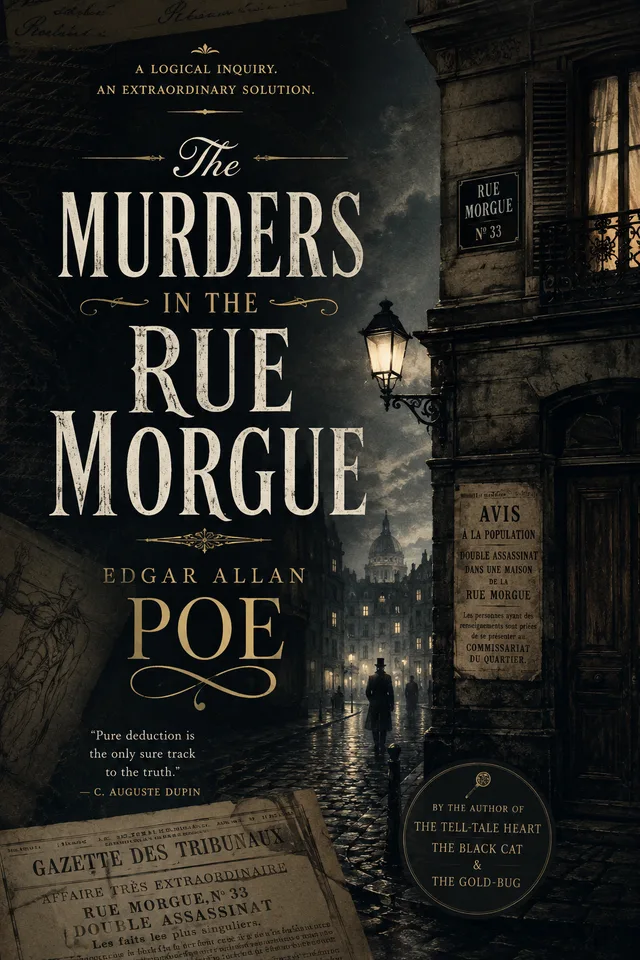
The Murders in the Rue Morgue
English BooksWhale Edition by Edgar Allan Poe
A landmark detective story introducing Dupin's analytic mind and a shocking Paris mystery.
- Preview
- A sample from the prepared text
- Formats
- Online reader, EPUB, PDF
- Access
- Library claim
Book introduction
The Murders in the Rue Morgue
The Murders in the Rue Morgue helped define the modern detective story. Poe's C. Auguste Dupin uses observation, imagination, and logical reconstruction to solve a violent mystery that baffles ordinary investigators.
BooksWhale edition
How this edition was prepared
This edition is based on a public domain text and has been prepared for digital reading by BooksWhale.
Public domain basis
Why this edition can be shared
Edgar Allan Poe died in 1849, and The Murders in the Rue Morgue was first published in 1841. These dates support the public-domain basis for the English source text used in this edition.
Read preview
A sample from the prepared text
Preview selected from the prepared reader text.
Preview chapterFull textRead preview
The Murders in the Rue Morgue
Preview chapterWHY THE LITTLE FRENCHMAN WEARS HIS HAND IN A SLINGPreview
It's on my visiting cards sure enough (and it's them that's all o' pink satin paper) that inny gintleman that plases may behould the intheristhin words, "Sir Pathrick O'Grandison, Barronitt, 39 Southampton Row, Russell Square, Parrish o' Bloomsbury." And shud ye be wantin' to diskiver who is the pink of purliteness quite, and the laider of the hot tun in the houl city o' Lonon—why it's jist mesilf. And fait that same is no wonder at all at all (so be plased to stop curlin your nose), for every inch o' the six wakes that I've been a gintleman, and left aff wid the bogthrothing to take up wid the Barronissy, it's Pathrick that's been living like a houly imperor, and gitting the iddication and the graces. Och! and wouldn't it be a blessed thing for your spirrits if ye cud lay your two peepers jist, upon Sir Pathrick O'Grandison, Barronitt, when he is all riddy drissed for the hopperer, or stipping into the Brisky for the drive into the Hyde Park. But it's the illigant big figgur that I ave, for the rason o' which all the ladies fall in love wid me. Isn't it my own swate silf now that'll missure the six fut, and the three inches more nor that, in me stockins, and that am excadingly will proportioned all over to match? And it is ralelly more than three fut and a bit that there is, inny how, of the little ould furrener Frinchman that lives jist over the way, and that's a oggling and a goggling the houl day, (and bad luck to him,) at the purty widdy Misthress Tracle that's my own nixt-door neighbor, (God bliss her!) and a most particuller frind and acquaintance? You percave the little spalpeen is summat down in the mouth, and wears his lift hand in a sling, and it's for that same thing, by yur lave, that I'm going to give you the good rason.
The truth of the houl matter is jist simple enough; for the very first day that I com'd from Connaught, and showd my swate little silf in the strait to the widdy, who was looking through the windy, it was a gone case althegither with the heart o' the purty Misthress Tracle. I percaved it, ye see, all at once, and no mistake, and that's God's truth. First of all it was up wid the windy in a jiffy, and thin she threw open her two peepers to the itmost, and thin it was a little gould spy-glass that she clapped tight to one o' them and divil may burn me if it didn't spake to me as plain as a peeper cud spake, and says it, through the spy-glass: "Och! the tip o' the mornin' to ye, Sir Pathrick O'Grandison, Barronitt, mavourneen; and it's a nate gintleman that ye are, sure enough, and it's mesilf and me forten jist that'll be at yur sarvice, dear, inny time o' day at all at all for the asking." And it's not mesilf ye wud have to be bate in the purliteness; so I made her a bow that wud ha' broken yur heart altegither to behould, and thin I pulled aff me hat with a flourish, and thin I winked at her hard wid both eyes, as much as to say, "True for you, yer a swate little crature, Mrs. Tracle, me darlint, and I wish I may be drownthed dead in a bog, if it's not mesilf, Sir Pathrick O'Grandison, Barronitt, that'll make a houl bushel o' love to yur leddyship, in the twinkling o' the eye of a Londonderry purraty."
And it was the nixt mornin', sure, jist as I was making up me mind whither it wouldn't be the purlite thing to sind a bit o' writin' to the widdy by way of a love-litter, when up com'd the delivery servant wid an illigant card, and he tould me that the name on it (for I niver could rade the copperplate printin on account of being lift handed) was all about Mounseer, the Count, A Goose, Look—aisy, Maiter-di-dauns, and that the houl of the divilish lingo was the spalpeeny long name of the little ould furrener Frinchman as lived over the way.
Preview chapterTHE BUSINESS MANPreview
Method is the soul of business. —OLD SAYING.
I am a business man. I am a methodical man. Method is the thing, after all. But there are no people I more heartily despise than your eccentric fools who prate about method without understanding it; attending strictly to its letter, and violating its spirit. These fellows are always doing the most out-of-the-way things in what they call an orderly manner. Now here, I conceive, is a positive paradox. True method appertains to the ordinary and the obvious alone, and cannot be applied to the outre. What definite idea can a body attach to such expressions as "methodical Jack o' Dandy," or "a systematical Will o' the Wisp"?
My notions upon this head might not have been so clear as they are, but for a fortunate accident which happened to me when I was a very little boy. A good-hearted old Irish nurse (whom I shall not forget in my will) took me up one day by the heels, when I was making more noise than was necessary, and swinging me round two or knocked my head into a cocked hat against the bedpost. This, I say, decided my fate, and made my fortune. A bump arose at once on my sinciput, and turned out to be as pretty an organ of order as one shall see on a summer's day. Hence that positive appetite for system and regularity which has made me the distinguished man of business that I am.
If there is any thing on earth I hate, it is a genius. Your geniuses are all arrant asses—the greater the genius the greater the ass—and to this rule there is no exception whatever. Especially, you cannot make a man of business out of a genius, any more than money out of a Jew, or the best nutmegs out of pine-knots. The creatures are always going off at a tangent into some fantastic employment, or ridiculous speculation, entirely at variance with the "fitness of things," and having no business whatever to be considered as a business at all. Thus you may tell these characters immediately by the nature of their occupations. If you ever perceive a man setting up as a merchant or a manufacturer, or going into the cotton or tobacco trade, or any of those eccentric pursuits; or getting to be a drygoods dealer, or soap-boiler, or something of that kind; or pretending to be a lawyer, or a blacksmith, or a physician—any thing out of the usual way—you may set him down at once as a genius, and then, according to the rule-of-three, he's an ass.
Now I am not in any respect a genius, but a regular business man. My Day-book and Ledger will evince this in a minute. They are well kept, though I say it myself; and, in my general habits of accuracy and punctuality, I am not to be beat by a clock. Moreover, my occupations have been always made to chime in with the ordinary habitudes of my fellowmen. Not that I feel the least indebted, upon this score, to my exceedingly weak-minded parents, who, beyond doubt, would have made an arrant genius of me at last, if my guardian angel had not come, in good time, to the rescue. In biography the truth is every thing, and in autobiography it is especially so—yet I scarcely hope to be believed when I state, however solemnly, that my poor father put me, when I was about fifteen years of age, into the counting-house of what be termed "a respectable hardware and commission merchant doing a capital bit of business!" A capital bit of fiddlestick! However, the consequence of this folly was, that in two or three days, I had to be sent home to my button-headed family in a high state of fever, and with a most violent and dangerous pain in the sinciput, all around about my organ of order. It was nearly a gone case with me then—just touch-and-go for six weeks—the physicians giving me up and all that sort of thing. But, although I suffered much, I was a thankful boy in the main. I was saved from being a "respectable hardware and commission merchant, doing a capital bit of business," and I felt grateful to the protuberance which had been the means of my salvation, as well as to the kindhearted female who had originally put these means within my reach.
Table of contents
Inside this edition
- 01Full text
- 02WHY THE LITTLE FRENCHMAN WEARS HIS HAND IN A SLING
- 03THE BUSINESS MAN
- 04THE MAN IN THE CROWD
- 05THE MURDERS IN THE RUE MORGUE
- 06A DESCENT INTO THE MAELSTRÖM
- 07THE ISLAND OF THE FAY
- 08THE COLLOQUY OF MONOS AND UNA.
- 09NEVER BET THE DEVIL YOUR HEAD
- 10A Tale With a Moral
- 11ELEONORA
- 12THREE SUNDAYS IN A WEEK
- 13THE OVAL PORTRAIT
- 14THE MASQUE OF THE RED DEATH
- 15THE LANDSCAPE GARDEN
- 16THE MYSTERY OF MARIE ROGÊT
- 17A Sequel to "The Murders in the Rue Morgue"
- 18THE PIT AND THE PENDULUM
- 19THE GOLD-BUG
- 20THE BLACK CAT (1843 Version)
- 21THE BLACK CAT (1845 Version)
- 22DIDDLING CONSIDERED AS ONE OF THE EXACT SCIENCES
Language availability
Other languages
Additional language editions are not published yet. This section will link to other BooksWhale editions when they become available.
Request another language