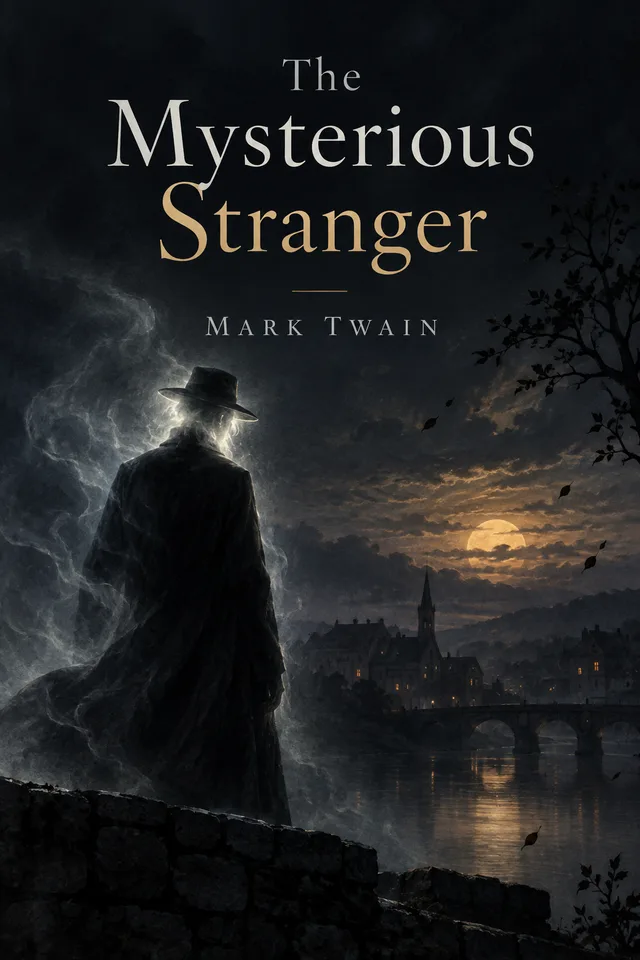
English Edition
Literature
The Mysterious Stranger
English BooksWhale Edition by Mark Twain
A dark late Twain tale where supernatural satire questions morality, belief, cruelty, and human vanity.
- Preview
- A sample from the prepared text
- Formats
- Online reader, EPUB, PDF
- Access
- Library claim
Book introduction
The Mysterious Stranger
The Mysterious Stranger is one of Mark Twain’s strangest and darkest works, blending fantasy, religious skepticism, philosophical satire, and unsettling comedy. This English edition suits readers interested in Twain beyond the river novels, especially his late reflections on illusion, suffering, and human self-importance.
BooksWhale edition
How this edition was prepared
This edition is based on a public domain text and has been prepared for digital reading by BooksWhale.
Public domain basis
Why this edition can be shared
Mark Twain died in 1910, and The Mysterious Stranger was published posthumously in 1916 from his earlier manuscripts. These dates support the public-domain basis for this edition.
Read preview
A sample from the prepared text
Preview selected from the prepared reader text.
Preview chapterFull textRead preview
The Mysterious Stranger
Mark Twain
Preview chapterCHAPTER IPreview
It was in 1590--winter. Austria was far away from the world, and asleep; it was still the Middle Ages in Austria, and promised to remain so forever. Some even set it away back centuries upon centuries and said that by the mental and spiritual clock it was still the Age of Belief in Austria. But they meant it as a compliment, not a slur, and it was so taken, and we were all proud of it. I remember it well, although I was only a boy; and I remember, too, the pleasure it gave me.
Yes, Austria was far from the world, and asleep, and our village was in the middle of that sleep, being in the middle of Austria. It drowsed in peace in the deep privacy of a hilly and woodsy solitude where news from the world hardly ever came to disturb its dreams, and was infinitely content. At its front flowed the tranquil river, its surface painted with cloud-forms and the reflections of drifting arks and stone-boats; behind it rose the woody steeps to the base of the lofty precipice; from the top of the precipice frowned a vast castle, its long stretch of towers and bastions mailed in vines; beyond the river, a league to the left, was a tumbled expanse of forest-clothed hills cloven by winding gorges where the sun never penetrated; and to the right a precipice overlooked the river, and between it and the hills just spoken of lay a far-reaching plain dotted with little homesteads nested among orchards and shade trees.
The whole region for leagues around was the hereditary property of a prince, whose servants kept the castle always in perfect condition for occupancy, but neither he nor his family came there oftener than once in five years. When they came it was as if the lord of the world had arrived, and had brought all the glories of its kingdoms along; and when they went they left a calm behind which was like the deep sleep which follows an orgy.
Eseldorf was a paradise for us boys. We were not overmuch pestered with schooling. Mainly we were trained to be good Christians; to revere the Virgin, the Church, and the saints above everything. Beyond these matters we were not required to know much; and, in fact, not allowed to. Knowledge was not good for the common people, and could make them discontented with the lot which God had appointed for them, and God would not endure discontentment with His plans. We had two priests. One of them, Father Adolf, was a very zealous and strenuous priest, much considered.
There may have been better priests, in some ways, than Father Adolf, but there was never one in our commune who was held in more solemn and awful respect. This was because he had absolutely no fear of the Devil. He was the only Christian I have ever known of whom that could be truly said. People stood in deep dread of him on that account; for they thought that there must be something supernatural about him, else he could not be so bold and so confident. All men speak in bitter disapproval of the Devil, but they do it reverently, not flippantly; but Father Adolf’s way was very different; he called him by every name he could lay his tongue to, and it made every one shudder that heard him; and often he would even speak of him scornfully and scoffingly; then the people crossed themselves and went quickly out of his presence, fearing that something fearful might happen.
Father Adolf had actually met Satan face to face more than once, and defied him. This was known to be so. Father Adolf said it himself. He never made any secret of it, but spoke it right out. And that he was speaking true there was proof in at least one instance, for on that occasion he quarreled with the enemy, and intrepidly threw his bottle at him; and there, upon the wall of his study, was the ruddy splotch where it struck and broke.
Preview chapterCHAPTER IIPreview
Three of us boys were always together, and had been so from the cradle, being fond of one another from the beginning, and this affection deepened as the years went on--Nikolaus Bauman, son of the principal judge of the local court; Seppi Wohlmeyer, son of the keeper of the principal inn, the “Golden Stag,” which had a nice garden, with shade trees reaching down to the riverside, and pleasure boats for hire; and I was the third--Theodor Fischer, son of the church organist, who was also leader of the village musicians, teacher of the violin, composer, tax-collector of the commune, sexton, and in other ways a useful citizen, and respected by all. We knew the hills and the woods as well as the birds knew them; for we were always roaming them when we had leisure--at least, when we were not swimming or boating or fishing, or playing on the ice or sliding down hill.
And we had the run of the castle park, and very few had that. It was because we were pets of the oldest serving-man in the castle--Felix Brandt; and often we went there, nights, to hear him talk about old times and strange things, and to smoke with him (he taught us that) and to drink coffee; for he had served in the wars, and was at the siege of Vienna; and there, when the Turks were defeated and driven away, among the captured things were bags of coffee, and the Turkish prisoners explained the character of it and how to make a pleasant drink out of it, and now he always kept coffee by him, to drink himself and also to astonish the ignorant with. When it stormed he kept us all night; and while it thundered and lightened outside he told us about ghosts and horrors of every kind, and of battles and murders and mutilations, and such things, and made it pleasant and cozy inside; and he told these things from his own experience largely. He had seen many
ghosts in his time, and witches and enchanters, and once he was lost in a fierce storm at midnight in the mountains, and by the glare of the lightning had seen the Wild Huntsman rage on the blast with his specter dogs chasing after him through the driving cloud-rack. Also he had seen an incubus once, and several times he had seen the great bat that sucks the blood from the necks of people while they are asleep, fanning them softly with its wings and so keeping them drowsy till they die.
He encouraged us not to fear supernatural things, such as ghosts, and said they did no harm, but only wandered about because they were lonely and distressed and wanted kindly notice and compassion; and in time we learned not to be afraid, and even went down with him in the night to the haunted chamber in the dungeons of the castle. The ghost appeared only once, and it went by very dim to the sight and floated noiseless through the air, and then disappeared; and we scarcely trembled, he had taught us so well. He said it came up sometimes in the night and woke him by passing its clammy hand over his face, but it did him no hurt; it only wanted sympathy and notice. But the strangest thing was that he had seen angels--actual angels out of heaven--and had talked with them. They had no wings, and wore clothes, and talked and looked and acted just like any natural person, and you would never know them for angels
except for the wonderful things they did which a mortal could not do, and the way they suddenly disappeared while you were talking with them, which was also a thing which no mortal could do. And he said they were pleasant and cheerful, not gloomy and melancholy, like ghosts.
Table of contents
Inside this edition
- 01Full text
- 02CHAPTER I
- 03CHAPTER II
- 04CHAPTER III
- 05CHAPTER IV
- 06CHAPTER V
- 07CHAPTER VI
- 08CHAPTER VII
- 09CHAPTER VIII
- 10CHAPTER IX
- 11CHAPTER X
- 12CHAPTER XI
Language availability
Other languages
Additional language editions are not published yet. This section will link to other BooksWhale editions when they become available.
Request another language