English Edition
Literature
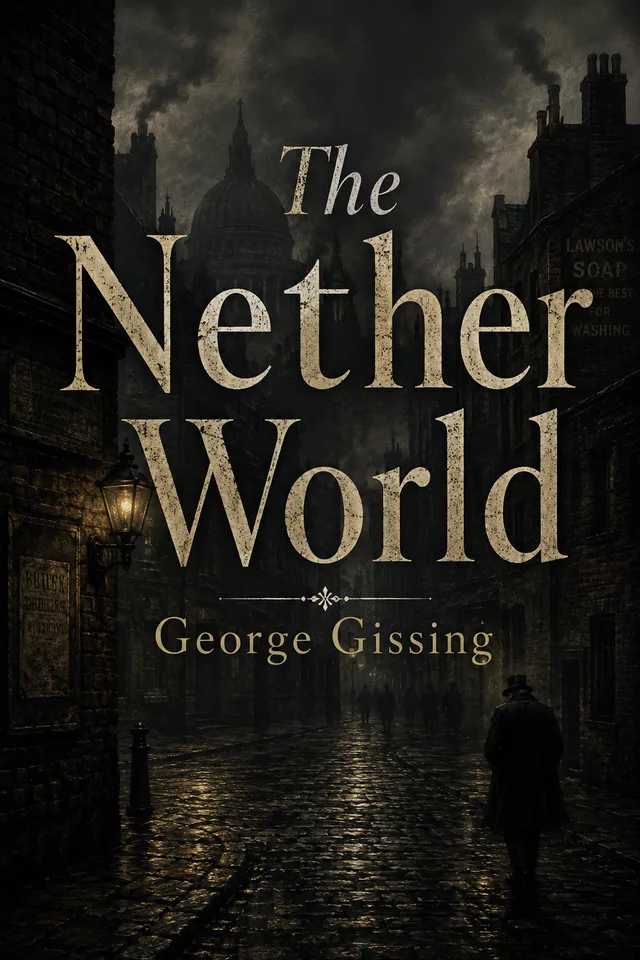
The Nether World
English BooksWhale Edition by George Gissing
A grim London novel of poverty, inheritance, family pressure, and moral injury among the working poor.
- Preview
- A sample from the prepared text
- Formats
- Online reader, EPUB, PDF
- Access
- Library claim
Book introduction
The Nether World
The Nether World enters the streets and rooms of Clerkenwell, where Sidney Kirkwood, Jane Snowdon, Clara Hewett, and Michael Snowdon are caught between poverty, hope, resentment, and impossible moral demands. Gissing creates one of his darkest studies of urban class life, charity, ambition, and social damage.
BooksWhale edition
How this edition was prepared
This edition is based on a public domain text and has been prepared for digital reading by BooksWhale.
Public domain basis
Why this edition can be shared
George Gissing died in 1903, and The Nether World was first published in 1889. These dates support the public-domain basis for the original English text used in this edition.
Read preview
A sample from the prepared text
Preview selected from the prepared reader text.
Preview chapterFull textRead preview
The Nether World
George Gissing
Preview chapterCHAPTER IPreview
A THRALL OF THRALLS
In the troubled twilight of a March evening ten years ago, an old man, whose equipment and bearing suggested that he was fresh from travel, walked slowly across Clerkenwell Green, and by the graveyard of St. James’s Church stood for a moment looking about him. His age could not be far from seventy, but, despite the stoop of his shoulders, he gave little sign of failing under the burden of years; his sober step indicated gravity of character rather than bodily feebleness, and his grasp of a stout stick was not such as bespeaks need of support. His attire was neither that of a man of leisure, nor of the kind usually worn by English mechanics. Instead of coat and waistcoat, he wore a garment something like a fisherman’s guernsey, and over this a coarse short cloak, picturesque in appearance as it was buffeted by the wind. His trousers were of moleskin; his boots reached almost to his knees; for head-covering he had the cheapest kind of undyed felt, its form exactly that of the old petasus. To say that his aspect was Venerable would serve to present him in a measure, yet would not be wholly accurate, for there was too much of past struggle and present anxiety in his countenance to permit full expression of the natural dignity of the features. It was a fine face and might have been distinctly noble, but circumstances had marred the purpose of Nature; you perceived that his cares had too often been of the kind which are created by ignoble necessities, such as leave to most men of his standing a bare humanity of visage. He had long thin white hair; his beard was short and merely grizzled. In his left hand he carried a bundle, which probably contained clothing.
The burial-ground by which he had paused was as little restful to the eye as are most of those discoverable in the byways of London. The small trees that grew about it shivered in their leaflessness; the rank grass was wan under the failing day; most of the stones leaned this way or that, emblems of neglect (they were very white at the top, and darkened downwards till the damp soil made them black), and certain cats and dogs were prowling or sporting among the graves. At this corner the east wind blew with malice such as it never puts forth save where there are poorly clad people to be pierced; it swept before it thin clouds of unsavoury dust, mingled with the light refuse of the streets. Above the shapeless houses night was signalling a murky approach; the sky—if sky it could be called—gave threatening of sleet, perchance of snow. And on every side was the rumble of traffic, the voiceful evidence of toil and of poverty; hawkers were crying their goods; the inevitable organ was clanging before a public-house hard by; the crumpet-man was hastening along, with monotonous ringing of his bell and hoarse rhythmic wail.
The old man had fixed his eyes half absently on the inscription of a gravestone near him; a lean cat springing out between the iron railings seemed to recall his attention, and with a slight sigh he went forward along the narrow street which is called St. James’s Walk. In a few minutes he had reached the end of it, and found himself facing a high grey-brick wall, wherein, at this point, was an arched gateway closed with black doors. He looked at the gateway, then fixed his gaze on something that stood just above—something which the dusk half concealed, and by so doing made more impressive. It was the sculptured counterfeit of a human face, that of a man distraught with agony. The eyes stared wildly from their sockets, the hair struggled in maniac disorder, the forehead was wrung with torture, the cheeks sunken, the throat fearsomely wasted, and from the wide lips there seemed to be issuing a horrible cry. Above this hideous effigy was carved the legend: ‘MIDDLESEX HOUSE OF DETENTION.’
Preview chapterCHAPTER IIPreview
A FRIEND IN REQUEST
It was the hour of the unyoking of men. In the highways and byways of Clerkenwell there was a thronging of released toilers, of young and old, of male and female. Forth they streamed from factories and workrooms, anxious to make the most of the few hours during which they might live for themselves. Great numbers were still bent over their labour, and would be for hours to come, but the majority had leave to wend stable-wards. Along the main thoroughfares the wheel-track was clangorous; every omnibus that clattered by was heavily laden with passengers; tarpaulins gleamed over the knees of those who sat outside. This way and that the lights were blurred into a misty radiance; overhead was mere blackness, whence descended the lashing rain. There was a ceaseless scattering of mud; there were blocks in the traffic, attended with rough jest or angry curse; there was jostling on the crowded pavement. Public-houses began to brighten up, to bestir themselves for the evening’s business. Streets that had been hives of activity since early morning were being abandoned to silence and darkness and the sweeping wind.
At noon to-day there was sunlight on the Surrey hills; the fields and lanes were fragrant with the first breath of spring, and from the shelter of budding copses many a primrose looked tremblingly up to the vision of blue sky. But of these things Clerkenwell takes no count; here it had been a day like any other, consisting of so many hours, each representing a fraction of the weekly wage. Go where you may in Clerkenwell, on every hand are multiform evidences of toil, intolerable as a nightmare. It is not as in those parts of London where the main thoroughfares consist of shops and warehouses and workrooms, whilst the streets that are hidden away on either hand are devoted in the main to dwellings Here every alley is thronged with small industries; all but every door and window exhibits the advertisement of a craft that is carried on within. Here you may see how men have multiplied toil for toil’s sake, have wrought to devise work superfluous, have worn their lives away in imagining new forms of weariness. The energy, the ingenuity daily put forth in these grimy burrows task the brain’s power of wondering. But that those who sit here through the livelong day, through every season, through all the years of the life that is granted them, who strain their eyesight, who overtax their muscles, who nurse disease in their frames, who put resolutely from them the thought of what existence _might_ be—that these do it all without prospect or hope of reward save the permission to eat and sleep and bring into the world other creatures to strive with them for bread, surely that thought is yet more marvellous.
Workers in metal, workers in glass and in enamel, workers in weed, workers in every substance on earth, or from the waters under the earth, that can be made commercially valuable. In Clerkenwell the demand is not so much for rude strength as for the cunning fingers and the contriving brain. The inscriptions on the house-fronts would make you believe that you were in a region of gold and silver and precious stones. In the recesses of dim byways, where sunshine and free air are forgotten things, where families herd together in dear-rented garrets and cellars, craftsmen are for ever handling jewellery, shaping bright ornaments for the necks and arms of such as are born to the joy of life. Wealth inestimable is ever flowing through these workshops, and the hands that have been stained with gold-dust may, as likely as not, some day extend themselves in petition for a crust. In this house, as the announcement tells you, business is carried on by a trader in diamonds, and next door is a den full of children who wait for their day’s one meal until their mother has come home with her chance earnings. A strange enough region wherein to wander and muse. Inextinguishable laughter were perchance the fittest result of such musing; yet somehow the heart grows heavy, somehow the blood is troubled in its course, and the pulses begin to throb hotly.
Table of contents
Inside this edition
- 01Full text
- 02CHAPTER I
- 03CHAPTER II
- 04CHAPTER III
- 05CHAPTER IV
- 06CHAPTER V
- 07CHAPTER VI
- 08CHAPTER VII
- 09CHAPTER VIII
- 10CHAPTER IX
- 11CHAPTER X
- 12CHAPTER XI
- 13CHAPTER XII
- 14CHAPTER XIII
- 15CHAPTER XIV
- 16CHAPTER XV
- 17CHAPTER XVI
- 18CHAPTER XVII
- 19CHAPTER XVIII
- 20CHAPTER XIX
- 21CHAPTER XX
- 22CHAPTER XXI
- 23CHAPTER XXII
- 24CHAPTER XXIII
- 25CHAPTER XXIV
- 26CHAPTER XXV
- 27CHAPTER XXVI
- 28CHAPTER XXVII
- 29CHAPTER XXVIII
- 30CHAPTER XXIX
- 31CHAPTER XXX
- 32CHAPTER XXXI
- 33CHAPTER XXXII
- 34CHAPTER XXXIII
- 35CHAPTER XXXIV
- 36CHAPTER XXXV
- 37CHAPTER XXXVI
- 38CHAPTER XXXVII
- 39CHAPTER XXXVIII
- 40CHAPTER XXXIX
- 41CHAPTER XL
Language availability
Other languages
Additional language editions are not published yet. This section will link to other BooksWhale editions when they become available.
Request another language