English Edition
Literature
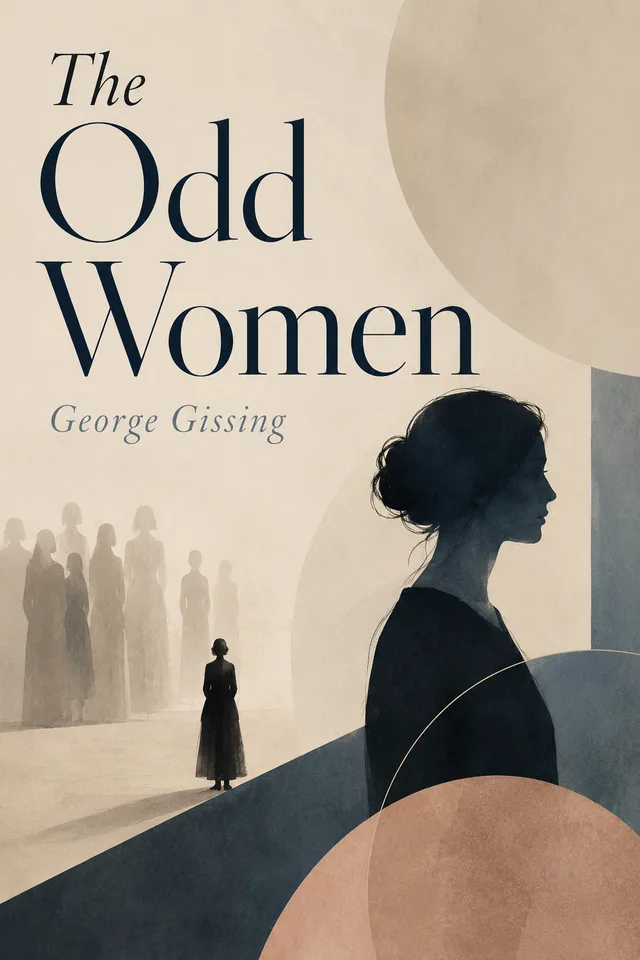
The Odd Women
English BooksWhale Edition by George Gissing
Unmarried women, work, marriage, and independence collide in a searching Victorian social novel.
- Preview
- A sample from the prepared text
- Formats
- Online reader, EPUB, PDF
- Access
- Library claim
Book introduction
The Odd Women
The Odd Women follows the Madden sisters, Rhoda Nunn, Mary Barfoot, and Everard Barfoot in a society where there are more women than marriage prospects. Gissing examines paid work, education, loneliness, gender expectations, sexual double standards, and the risks of female independence in late Victorian England.
BooksWhale edition
How this edition was prepared
This edition is based on a public domain text and has been prepared for digital reading by BooksWhale.
Public domain basis
Why this edition can be shared
George Gissing died in 1903, and The Odd Women was first published in 1893. These dates support the public-domain basis for the original English text used in this edition.
Read preview
A sample from the prepared text
Preview selected from the prepared reader text.
Preview chapterFull textRead preview
The Odd Women
George Gissing
Preview chapterCHAPTER IPreview
THE FOLD AND THE SHEPHERD
“So to-morrow, Alice,” said Dr. Madden, as he walked with his eldest daughter on the coast-downs by Clevedon, “I shall take steps for insuring my life for a thousand pounds.”
It was the outcome of a long and intimate conversation. Alice Madden, aged nineteen, a plain, shy, gentle-mannered girl, short of stature, and in movement something less than graceful, wore a pleased look as she glanced at her father’s face and then turned her eyes across the blue channel to the Welsh hills. She was flattered by the confidence reposed in her, for Dr. Madden, reticent by nature, had never been known to speak in the domestic circle about his pecuniary affairs. He seemed to be the kind of man who would inspire his children with affection: grave but benign, amiably diffident, with a hint of lurking mirthfulness about his eyes and lips. And to-day he was in the best of humours; professional prospects, as he had just explained to Alice, were more encouraging than hitherto; for twenty years he had practised medicine at Clevedon, but with such trifling emolument that the needs of his large family left him scarce a margin over expenditure; now, at the age of forty-nine—it was 1872—he looked forward with a larger hope. Might he not reasonably count on ten or fifteen more years of activity? Clevedon was growing in repute as a seaside resort; new houses were rising; assuredly his practice would continue to extend.
“I don’t think girls ought to be troubled about this kind of thing,” he added apologetically. “Let men grapple with the world; for, as the old hymn says, “’tis their nature to.” I should grieve indeed if I thought my girls would ever have to distress themselves about money matters. But I find I have got into the habit, Alice, of talking to you very much as I should talk with your dear mother if she were with us.”
Mrs. Madden, having given birth to six daughters, had fulfilled her function in this wonderful world; for two years she had been resting in the old churchyard that looks upon the Severn sea. Father and daughter sighed as they recalled her memory. A sweet, calm, unpretending woman; admirable in the domesticities; in speech and thought distinguished by a native refinement, which in the most fastidious eyes would have established her claim to the title of lady. She had known but little repose, and secret anxieties told upon her countenance long before the final collapse of health.
“And yet,” pursued the doctor—doctor only by courtesy—when he had stooped to pluck and examine a flower, “I made a point of never discussing these matters with her. As no doubt you guess, life has been rather an uphill journey with us. But the home must be guarded against sordid cares to the last possible moment; nothing upsets me more than the sight of those poor homes where wife and children are obliged to talk from morning to night of how the sorry earnings shall be laid out. No, no; women, old or young, should never have to think about money.”
The magnificent summer sunshine, and the western breeze that tasted of ocean, heightened his natural cheeriness. Dr. Madden fell into a familiar strain of prescience.
“There will come a day, Alice, when neither man nor woman is troubled with such sordid care. Not yet awhile; no, no; but the day will come. Human beings are not destined to struggle for ever like beasts of prey. Give them time; let civilization grow. You know what our poet says: “There the common sense of most shall hold a fretful realm in awe—””
He quoted the couplet with a subdued fervour which characterized the man and explained his worldly lot. Elkanah Madden should never have entered the medical profession; mere humanitarianism had prompted the choice in his dreamy youth; he became an empiric, nothing more. “Our poet,” said the doctor; Clevedon was chiefly interesting to him for its literary associations. Tennyson he worshipped; he never passed Coleridge’s cottage without bowing in spirit. From the contact of coarse actualities his nature shrank.
Preview chapterCHAPTER IIPreview
ADRIFT
Just before Christmas of 1887, a lady past her twenties, and with a look of discouraged weariness on her thin face, knocked at a house-door in a little street by Lavender Hill. A card in the window gave notice that a bedroom was here to let. When the door opened, and a clean, grave, elderly woman presented herself, the visitor, regarding her anxiously, made known that she was in search of a lodging.
“It may be for a few weeks only, or it may be for a longer period,” she said in a low, tired voice, with an accent of good breeding. “I have a difficulty in finding precisely what I want. One room would be sufficient, and I ask for very little attendance.”
She had but one room to let, replied the other. It might be inspected.
They went upstairs. The room was at the back of the house, small, but neatly furnished. Its appearance seemed to gratify the visitor, for she smiled timidly.
“What rent should you ask?”
“That would depend, mum, on what attendance was required.”
“Yes—of course. I think—will you permit me to sit down? I am really very tired. Thank you. I require very little attendance indeed. My ways are very simple. I should make the bed myself, and—and, do the other little things that are necessary from day to day. Perhaps I might ask you to sweep the room out—once a week or so.”
The landlady grew meditative. Possibly she had had experience of lodgers who were anxious to give as little trouble as possible. She glanced furtively at the stranger.
“And what,” was her question at length, “would you be thinking of paying?”
“Perhaps I had better explain my position. For several years I have been companion to a lady in Hampshire. Her death has thrown me on my own resources—I hope only for a short time. I have come to London because a younger sister of mine is employed here in a house of business; she recommended me to seek for lodgings in this part; I might as well be near her whilst I am endeavouring to find another post; perhaps I may be fortunate enough to find one in London. Quietness and economy are necessary to me. A house like yours would suit me very well—very well indeed. Could we not agree upon terms within my—within my power?”
Again the landlady pondered.
“Would you be willing to pay five and sixpence?”
“Yes, I would pay five and sixpence—if you are quite sure that you could let me live in my own way with satisfaction to yourself. I—in fact, I am a vegetarian, and as the meals I take are so very simple, I feel that I might just as well prepare them myself. Would you object to my doing so in this room? A kettle and a saucepan are really all—absolutely all—that I should need to use. As I shall be much at home, it will be of course necessary for me to have a fire.”
In the course of half an hour an agreement had been devised which seemed fairly satisfactory to both parties.
“I’m not one of the graspin’ ones,” remarked the landlady. “I think I may say that of myself. If I make five or six shillings a week out of my spare room, I don’t grumble. But the party as takes it must do their duty on _their_ side. You haven’t told me your name yet, mum.”
“Miss Madden. My luggage is at the railway station; it shall be brought here this evening. And, as I am quite unknown to you, I shall be glad to pay my rent in advance.”
“Well, I don’t ask for that; but it’s just as you like.”
“Then I will pay you five and sixpence at once. Be so kind as to let me have a receipt.”
Table of contents
Inside this edition
- 01Full text
- 02CHAPTER I
- 03CHAPTER II
- 04CHAPTER III
- 05CHAPTER IV
- 06CHAPTER V
- 07CHAPTER VI
- 08CHAPTER VII
- 09CHAPTER VIII
- 10CHAPTER IX
- 11CHAPTER X
- 12CHAPTER XI
- 13CHAPTER XII
- 14CHAPTER XIII
- 15CHAPTER XIV
- 16CHAPTER XV
- 17CHAPTER XVI
- 18CHAPTER XVII
- 19CHAPTER XVIII
- 20CHAPTER XIX
- 21CHAPTER XX
- 22CHAPTER XXI
- 23CHAPTER XXII
- 24CHAPTER XXIII
- 25CHAPTER XXIV
- 26CHAPTER XXV
- 27CHAPTER XXVI
- 28CHAPTER XXVII
- 29CHAPTER XXVIII
- 30CHAPTER XXIX
- 31CHAPTER XXX
- 32CHAPTER XXXI
Language availability
Other languages
Additional language editions are not published yet. This section will link to other BooksWhale editions when they become available.
Request another language