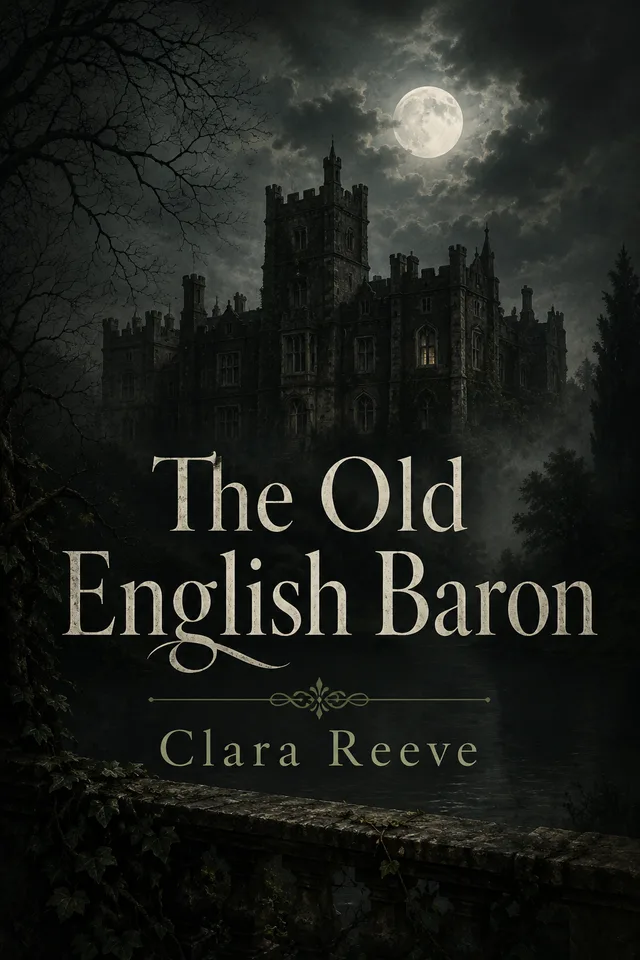
English Edition
Literature
The Old English Baron
English BooksWhale Edition by Clara Reeve
An influential early Gothic romance of inheritance, hidden crime, family honor, and supernatural justice.
- Preview
- A sample from the prepared text
- Formats
- Online reader, EPUB, PDF
- Access
- Library claim
Book introduction
The Old English Baron
The Old English Baron helped shape the Gothic novel after The Castle of Otranto. Clara Reeve blends medieval setting, ancestral mystery, moral testing, disputed inheritance, and restrained supernatural elements into a readable landmark of eighteenth-century fiction.
BooksWhale edition
How this edition was prepared
This edition is based on a public domain text and has been prepared for digital reading by BooksWhale.
Public domain basis
Why this edition can be shared
Clara Reeve died in 1807, and The Old English Baron was first published in 1778. These dates support the public-domain basis for the original English text used in this edition.
Read preview
A sample from the prepared text
Preview selected from the prepared reader text.
Preview chapterFull textRead preview
The Old English Baron
Clara Reeve
By Clara Reeve
Preview chapterPREFACEPreview
As this Story is of a species which, though not new, is out of the common track, it has been thought necessary to point out some circumstances to the reader, which will elucidate the design, and, it is hoped, will induce him to form a favourable, as well as a right judgment of the work before him.
This Story is the literary offspring of The Castle of Otranto, written upon the same plan, with a design to unite the most attractive and interesting circumstances of the ancient Romance and modern Novel, at the same time it assumes a character and manner of its own, that differs from both; it is distinguished by the appellation of a Gothic Story, being a picture of Gothic times and manners. Fictitious stories have been the delight of all times and all countries, by oral tradition in barbarous, by writing in more civilized ones; and although some persons of wit and learning have condemned them indiscriminately, I would venture to affirm, that even those who so much affect to despise them under one form, will receive and embrace them under another.
Thus, for instance, a man shall admire and almost adore the Epic poems of the Ancients, and yet despise and execrate the ancient Romances, which are only Epics in prose.
History represents human nature as it is in real life, alas, too often a melancholy retrospect! Romance displays only the amiable side of the picture; it shews the pleasing features, and throws a veil over the blemishes: Mankind are naturally pleased with what gratifies their vanity; and vanity, like all other passions of the human heart, may be rendered subservient to good and useful purposes.
I confess that it may be abused, and become an instrument to corrupt the manners and morals of mankind; so may poetry, so may plays, so may every kind of composition; but that will prove nothing more than the old saying lately revived by the philosophers the most in fashion, “that every earthly thing has two handles.”
The business of Romance is, first, to excite the attention; and secondly, to direct it to some useful, or at least innocent, end: Happy the writer who attains both these points, like Richardson! and not unfortunate, or undeserving praise, he who gains only the latter, and furnishes out an entertainment for the reader!
Having, in some degree, opened my design, I beg leave to conduct my reader back again, till he comes within view of The Castle of Otranto; a work which, as already has been observed, is an attempt to unite the various merits and graces of the ancient Romance and modern Novel. To attain this end, there is required a sufficient degree of the marvellous, to excite the attention; enough of the manners of real life, to give an air of probability to the work; and enough of the pathetic, to engage the heart in its behalf.
The book we have mentioned is excellent in the two last points, but has a redundancy in the first; the opening excites the attention very strongly; the conduct of the story is artful and judicious; the characters are admirably drawn and supported; the diction polished and elegant; yet, with all these brilliant advantages, it palls upon the mind (though it does not upon the ear); and the reason is obvious, the machinery is so violent, that it destroys the effect it is intended to excite. Had the story been kept within the utmost verge of probability, the effect had been preserved, without losing the least circumstance that excites or detains the attention.
For instance; we can conceive, and allow of, the appearance of a ghost; we can even dispense with an enchanted sword and helmet; but then they must keep within certain limits of credibility: A sword so large as to require an hundred men to lift it; a helmet that by its own weight forces a passage through a court-yard into an arched vault, big enough for a man to go through; a picture that walks out of its frame; a skeleton ghost in a hermit’s cowl:--When your expectation is wound up to the highest pitch, these circumstances take it down with a witness, destroy the work of imagination, and, instead of attention, excite laughter. I was both surprised and vexed to find the enchantment dissolved, which I wished might continue to the end of the book; and several of its readers have confessed the same disappointment to me: The beauties are so numerous, that we cannot bear the defects, but want it to be perfect in all respects.
Table of contents
Inside this edition
- 01Full text
- 02PREFACE
Language availability
Other languages
Additional language editions are not published yet. This section will link to other BooksWhale editions when they become available.
Request another language