English Edition
Literature
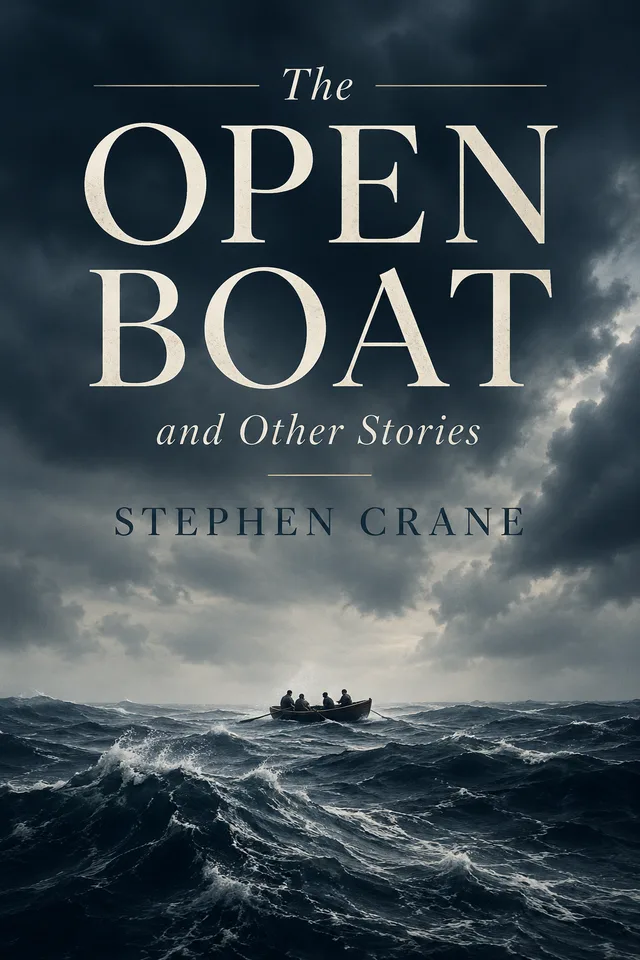
The Open Boat and Other Stories
English BooksWhale Edition by Stephen Crane
Naturalist short fiction of shipwreck, war, fear, chance, urban hardship, and human endurance.
- Preview
- A sample from the prepared text
- Formats
- Online reader, EPUB, PDF
- Access
- Library claim
Book introduction
The Open Boat and Other Stories
The Open Boat and Other Stories gathers Stephen Crane’s tense, compressed fiction around people pushed to the edge by sea, war, poverty, accident, and social pressure. The title story’s shipwreck ordeal and Crane’s unsentimental style make the collection essential for readers of American naturalism and modern short fiction.
BooksWhale edition
How this edition was prepared
This edition is based on a public domain text and has been prepared for digital reading by BooksWhale.
Public domain basis
Why this edition can be shared
Stephen Crane died in 1900, and the stories in this collection were published in the 1890s. These dates support the public-domain basis for this English original edition.
Read preview
A sample from the prepared text
Preview selected from the prepared reader text.
Preview chapterFull textRead preview
The Open Boat and Other Stories
Stephen Crane
Preview chapterIPreview
None of them knew the colour of the sky. Their eyes glanced level, and
were fastened upon the waves that swept toward them. These waves were
of the hue of slate, save for the tops, which were of foaming white,
and all of the men knew the colours of the sea. The horizon narrowed
and widened, and dipped and rose, and at all times its edge was jagged
with waves that seemed thrust up in points like rocks.
Many a man ought to have a bath-tub larger than the boat which here
rode upon the sea. These waves were most wrongfully and barbarously
abrupt and tall, and each froth-top was a problem in small boat
navigation.
The cook squatted in the bottom and looked with both eyes at the six
inches of gunwale which separated him from the ocean. His sleeves were
rolled over his fat forearms, and the two flaps of his unbuttoned vest
dangled as he bent to bail out the boat. Often he said: "Gawd! That was
a narrow clip." As he remarked it he invariably gazed eastward over the
broken sea.
The oiler, steering with one of the two oars in the boat, sometimes
raised himself suddenly to keep clear of water that swirled in over the
stern. It was a thin little oar and it seemed often ready to snap.
The correspondent, pulling at the other oar, watched the waves and
wondered why he was there.
The injured captain, lying in the bow, was at this time buried in that
profound dejection and indifference which comes, temporarily at least,
to even the bravest and most enduring when, willy nilly, the firm
fails, the army loses, the ship goes down. The mind of the master of a
vessel is rooted deep in the timbers of her, though he commanded for a
day or a decade, and this captain had on him the stern impression of
a scene in the greys of dawn of seven turned faces, and later a stump
of a top-mast with a white ball on it that slashed to and fro at the
waves, went low and lower, and down. Thereafter there was something
strange in his voice. Although steady, it was deep with mourning, and
of a quality beyond oration or tears.
"Keep 'er a little more south, Billie," said he.
"'A little more south,' sir," said the oiler in the stern.
A seat in this boat was not unlike a seat upon a bucking broncho, and,
by the same token, a broncho is not much smaller. The craft pranced
and reared, and plunged like an animal. As each wave came, and she
rose for it, she seemed like a horse making at a fence outrageously
high. The manner of her scramble over these walls of water is a mystic
thing, and, moreover, at the top of them were ordinarily these problems
in white water, the foam racing down from the summit of each wave,
requiring a new leap, and a leap from the air. Then, after scornfully
bumping a crest, she would slide, and race, and splash down a long
incline, and arrive bobbing and nodding in front of the next menace.
A singular disadvantage of the sea lies in the fact that after
successfully surmounting one wave you discover that there is another
behind it just as important and just as nervously anxious to do
something effective in the way of swamping boats. In a ten-foot dingey
one can get an idea of the resources of the sea in the line of waves
that is not probable to the average experience which is never at sea in
a dingey. As each slaty wall of water approached, it shut all else from
the view of the men in the boat, and it was not difficult to imagine
that this particular wave was the final outburst of the ocean, the last
effort of the grim water. There was a terrible grace in the move of the
Preview chapterIIPreview
As the boat bounced from the top of each wave, the wind tore through
the hair of the hatless men, and as the craft plopped her stern down
again the spray slashed past them. The crest of each of these waves was
a hill, from the top of which the men surveyed, for a moment, a broad
tumultuous expanse, shining and wind-riven. It was probably splendid.
It was probably glorious, this play of the free sea, wild with lights
of emerald and white and amber.
"Bully good thing it's an on-shore wind," said the cook. "If not, where
would we be? Wouldn't have a show."
"That's right," said the correspondent.
The busy oiler nodded his assent.
Then the captain, in the bow, chuckled in a way that expressed humour,
contempt, tragedy, all in one. "Do you think we've got much of a show
now, boys?" said he.
Whereupon the three were silent, save for a trifle of hemming and
hawing. To express any particular optimism at this time they felt to be
childish and stupid, but they all doubtless possessed this sense of the
situation in their mind. A young man thinks doggedly at such times. On
the other hand, the ethics of their condition was decidedly against any
open suggestion of hopelessness. So they were silent.
"Oh, well," said the captain, soothing his children, "we'll get ashore
all right."
But there was that in his tone which made them think, so the oiler
quoth: "Yes! If this wind holds!"
The cook was bailing: "Yes! If we don't catch hell in the surf."
Canton flannel gulls flew near and far. Sometimes they sat down on the
sea, near patches of brown sea-weed that rolled over the waves with a
movement like carpets on a line in a gale. The birds sat comfortably in
groups, and they were envied by some in the dingey, for the wrath of
the sea was no more to them than it was to a covey of prairie chickens
a thousand miles inland. Often they came very close and stared at the
men with black bead-like eyes. At these times they were uncanny and
sinister in their unblinking scrutiny, and the men hooted angrily at
them, telling them to be gone. One came, and evidently decided to
alight on the top of the captain's head. The bird flew parallel to
the boat and did not circle, but made short sidelong jumps in the
air in chicken-fashion. His black eyes were wistfully fixed upon the
captain's head. "Ugly brute," said the oiler to the bird. "You look as
if you were made with a jack-knife." The cook and the correspondent
swore darkly at the creature. The captain naturally wished to knock
it away with the end of the heavy painter; but he did not dare do it,
because anything resembling an emphatic gesture would have capsized
this freighted boat, and so with his open hand, the captain gently and
carefully waved the gull away. After it had been discouraged from the
pursuit the captain breathed easier on account of his hair, and others
breathed easier because the bird struck their minds at this time as
being somehow grewsome and ominous.
In the meantime the oiler and the correspondent rowed. And also they
rowed.
They sat together in the same seat, and each rowed an oar. Then the
oiler took both oars; then the correspondent took both oars; then the
oiler; then the correspondent. They rowed and they rowed. The very
ticklish part of the business was when the time came for the reclining
one in the stern to take his turn at the oars. By the very last star
of truth, it is easier to steal eggs from under a hen than it was to
change seats in the dingey. First the man in the stern slid his hand
along the thwart and moved with care, as if he were of Sèvres. Then the
Table of contents
Inside this edition
- 01Full text
- 02I
- 03II
- 04III
- 05IV
- 06V
- 07VI
- 08VII
- 09A MAN AND SOME OTHERS
- 10I
- 11II
- 12III
- 13IV
- 14V
- 15VI
- 16THE BRIDE COMES TO YELLOW SKY
- 17I
- 18II
- 19III
- 20IV
- 21THE WISE MEN
- 22THE FIVE WHITE MICE
- 23FLANAGAN AND HIS SHORT FILIBUSTERING ADVENTURE
- 24I
- 25II
- 26III
- 27IV
- 28HORSES
- 29DEATH AND THE CHILD
- 30I
- 31II
- 32III
- 33IV
- 34V
- 35VI
- 36VII
- 37Part II
- 38AN EXPERIMENT IN MISERY
- 39THE MEN IN THE STORM
- 40THE DUEL THAT WAS NOT FOUGHT
- 41AN OMINOUS BABY
- 42A GREAT MISTAKE
- 43AN ELOQUENCE OF GRIEF
- 44THE AUCTION
- 45THE PACE OF YOUTH
- 46I
- 47II
- 48A DETAIL
Language availability
Other languages
Additional language editions are not published yet. This section will link to other BooksWhale editions when they become available.
Request another language