English Edition
Literature
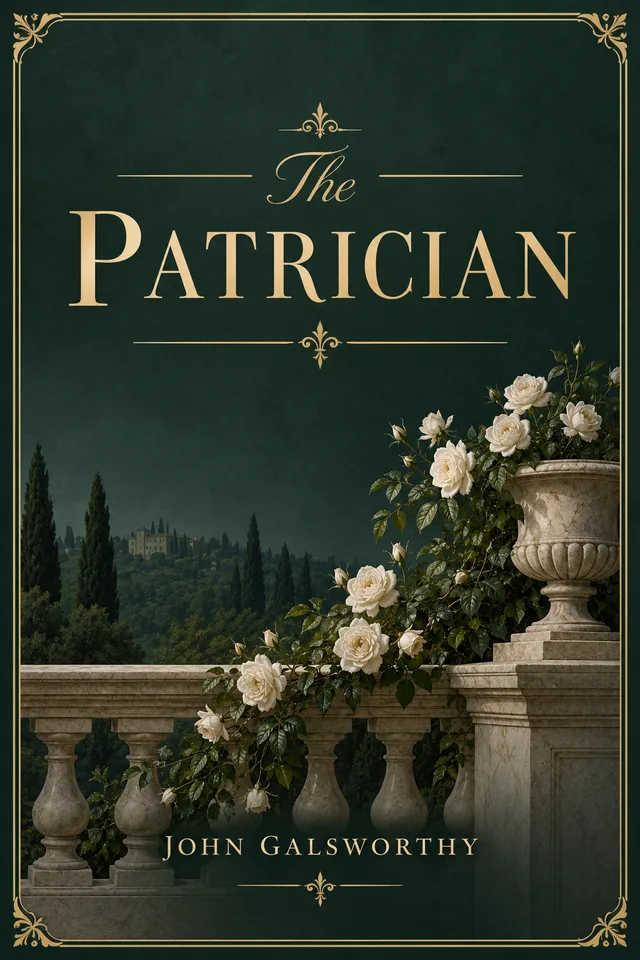
The Patrician
English BooksWhale Edition by John Galsworthy
An aristocratic family faces conflicting loyalties as public duty, intimate relationships, and inherited privilege come under strain.
- Preview
- A sample from the prepared text
- Formats
- Online reader, EPUB, PDF
- Access
- Library claim
Book introduction
The Patrician
John Galsworthy examines a British aristocratic family at the meeting point of political authority and personal feeling. Miltoun and Barbara move through a world shaped by family expectations, public reputation, and assumptions about social leadership. Their relationships expose the costs of maintaining inherited forms of power. The novel combines social observation with an inquiry into conscience, class, and the limits of individual freedom.
BooksWhale edition
How this edition was prepared
This edition is based on a public domain text and has been prepared for digital reading by BooksWhale.
Public domain basis
Why this edition can be shared
John Galsworthy died in 1933; this work was first published in 1911. This edition uses the public-domain English original from Project Gutenberg, excluding later editorial additions.
Read preview
A sample from the prepared text
Preview selected from the prepared reader text.
Preview chapterPART I — CHAPTER IRead preview
Light, entering the vast room—a room so high that its carved ceiling refused itself to exact scrutiny—travelled, with the wistful, cold curiosity of the dawn, over a fantastic storehouse of Time. Light, unaccompanied by the prejudice of human eyes, made strange revelation of incongruities, as though illuminating the dispassionate march of history.
For in this dining hall—one of the finest in England—the Caradoc family had for centuries assembled the trophies and records of their existence. Round about this dining hall they had built and pulled down and restored, until the rest of Monkland Court presented some aspect of homogeneity. Here alone they had left virgin the work of the old quasi-monastic builders, and within it unconsciously deposited their souls. For there were here, meeting the eyes of light, all those rather touching evidences of man's desire to persist for ever, those shells of his former bodies, the fetishes and queer proofs of his faiths, together with the remorseless demonstration of their treatment at the hands of Time.
The annalist might here have found all his needed confirmations; the analyst from this material formed the due equation of high birth; the philosopher traced the course of aristocracy, from its primeval rise in crude strength or subtlety, through centuries of power, to picturesque decadence, and the beginnings of its last stand. Even the artist might here, perchance, have seized on the dry ineffable pervading spirit, as one visiting an old cathedral seems to scent out the constriction of its heart.
From the legendary sword of that Welsh chieftain who by an act of high, rewarded treachery had passed into the favour of the conquering William, and received, with the widow of a Norman, many lands in Devonshire, to the Cup purchased for Geoffrey Caradoc; present Earl of Valleys, by subscription of his Devonshire tenants on the occasion of his marriage with the Lady Gertrude Semmering—no insignia were absent, save the family portraits in the gallery of Valleys House in London. There was even an ancient duplicate of that yellow tattered scroll royally, reconfirming lands and title to John, the most distinguished of all the Caradocs, who had unfortunately neglected to be born in wedlock, by one of those humorous omissions to be found in the genealogies of most old families. Yes, it was there, almost cynically hung in a corner; for this incident, though no doubt a burning question in the fifteenth century, was now but staple for an ironical little tale, in view of the fact that descendants of John's 'own' brother Edmund were undoubtedly to be found among the cottagers of a parish not far distant.
Light, glancing from the suits of armour to the tiger skins beneath them, brought from India but a year ago by Bertie Caradoc, the younger son, seemed recording, how those, who had once been foremost by virtue of that simple law of Nature which crowns the adventuring and strong, now being almost washed aside out of the main stream of national life, were compelled to devise adventure, lest they should lose belief in their own strength.
The unsparing light of that first half-hour of summer morning recorded many other changes, wandering from austere tapestries to the velvety carpets, and dragging from the contrast sure proof of a common sense which denied to the present Earl and Countess the asceticisms of the past. And then it seemed to lose interest in this critical journey, as though longing to clothe all in witchery. For the sun had risen, and through the Eastern windows came pouring its level and mysterious joy. And with it, passing in at an open lattice, came a wild bee to settle among the flowers on the table athwart the Eastern end, used when there was only a small party in the house. The hours fled on silent, till the sun was high, and the first visitors came—three maids, rosy, not silent, bringing brushes. They passed, and were followed by two footmen—scouts of the breakfast brigade, who stood for a moment professionally doing nothing, then soberly commenced to set the table. Then came a little girl of six, to see if there were anything exciting—little Ann Shropton, child of Sir William Shropton by his marriage with Lady Agatha, and eldest daughter of the house, the only one of the four young Caradocs as yet wedded. She came on tiptoe, thinking to surprise whatever was there. She had a broad little face, and wide frank hazel eyes over a little nose that came out straight and sudden. Encircled by a loose belt placed far below the waist of her holland frock, as if to symbolize freedom, she seemed to think everything in life good fun. And soon she found the exciting thing.
Preview chapterCHAPTER IIPreview
At Ravensham House on the borders of Richmond Park, suburban seat of the Casterley family, ever since it became usual to have a residence within easy driving distance of Westminster—in a large conservatory adjoining the hall, Lady Casterley stood in front of some Japanese lilies. She was a slender, short old woman, with an ivory-coloured face, a thin nose, and keen eyes half-veiled by delicate wrinkled lids. Very still, in her grey dress, and with grey hair, she gave the impression of a little figure carved out of fine, worn steel. Her firm, spidery hand held a letter written in free somewhat sprawling style:
MONKLAND COURT, “DEVON. “MY DEAR, MOTHER,
“Geoffrey is motoring up to-morrow. He'll look in on you on the way if he can. This new war scare has taken him up. I shan't be in Town myself till Miltoun's election is over. The fact is, I daren't leave him down here alone. He sees his 'Anonyma' every day. That Mr. Courtier, who wrote the book against War—rather cool for a man who's been a soldier of fortune, don't you think?—is staying at the inn, working for the Radical. He knows her, too—and, one can only hope, for Miltoun's sake, too well—an attractive person, with red moustaches, rather nice and mad. Bertie has just come down; I must get him to have a talk with Miltoun, and see if he cant find out how the land lies. One can trust Bertie—he's really very astute. I must say, that she's quite a sweet-looking woman; but absolutely nothing's known of her here except that she divorced her husband. How does one find out about people? Miltoun's being so extraordinarily strait-laced makes it all the more awkward. The earnestness of this rising generation is most remarkable. I don't remember taking such a serious view of life in my youth.”
Lady Casterley lowered the coronetted sheet of paper. The ghost of a grimace haunted her face—she had not forgotten her daughter's youth. Raising the letter again, she read on:
“I'm sure Geoffrey and I feel years younger than either Miltoun or Agatha, though we did produce them. One doesn't feel it with Bertie or Babs, luckily. The war scare is having an excellent effect on Miltoun's candidature. Claud Harbinger is with us, too, working for Miltoun; but, as a matter of fact, I think he's after Babs. It's rather melancholy, when you think that Babs isn't quite twenty—still, one can't expect anything else, I suppose, with her looks; and Claud is rather a fine specimen. They talk of him a lot now; he's quite coming to the fore among the young Tories.”
Lady Casterley again lowered the letter, and stood listening. A prolonged, muffled sound as of distant cheering and groans had penetrated the great conservatory, vibrating among the pale petals of the lilies and setting free their scent in short waves of perfume. She passed into the hall; where, stood an old man with sallow face and long white whiskers.
“What was that noise, Clifton?”
“A posse of Socialists, my lady, on their way to Putney to hold a demonstration; the people are hooting them. They've got blocked just outside the gates.”
“Are they making speeches?”
“They are talking some kind of rant, my lady.”
“I'll go and hear them. Give me my black stick.”
Above the velvet-dark, flat-toughed cedar trees, which rose like pagodas of ebony on either side of the drive, the sky hung lowering in one great purple cloud, endowed with sinister life by a single white beam striking up into it from the horizon. Beneath this canopy of cloud a small phalanx of dusty, dishevelled-looking men and women were drawn up in the road, guarding, and encouraging with cheers, a tall, black-coated orator. Before and behind this phalanx, a little mob of men and boys kept up an accompaniment of groans and jeering.
Preview chapterCHAPTER IIIPreview
In a very high, white-panelled room, with but little furniture, Lord Valleys greeted his mother-in-law respectfully.
“Motored up in nine hours, Ma'am—not bad going.”
“I am glad you came. When is Miltoun's election?”
“On the twenty-ninth.”
“Pity! He should be away from Monkland, with that—anonymous woman living there.”
“Ah! yes; you've heard of her!”
Lady Casterley replied sharply:
“You're too easy-going, Geoffrey.”
Lord Valleys smiled.
“These war scares,” he said, “are getting a bore. Can't quite make out what the feeling of the country is about them.”
Lady Casterley rose:
“It has none. When war comes, the feeling will be all right. It always is. Give me your arm. Are you hungry?”...
When Lord Valleys spoke of war, he spoke as one who, since he arrived at years of discretion, had lived within the circle of those who direct the destinies of States. It was for him—as for the lilies in the great glass house—impossible to see with the eyes, or feel with the feelings of a flower of the garden outside. Soaked in the best prejudices and manners of his class, he lived a life no more shut off from the general than was to be expected. Indeed, in some sort, as a man of facts and common sense, he was fairly in touch with the opinion of the average citizen. He was quite genuine when he said that he believed he knew what the people wanted better than those who prated on the subject; and no doubt he was right, for temperamentally he was nearer to them than their own leaders, though he would not perhaps have liked to be told so. His man-of-the-world, political shrewdness had been superimposed by life on a nature whose prime strength was its practicality and lack of imagination. It was his business to be efficient, but not strenuous, or desirous of pushing ideas to their logical conclusions; to be neither narrow nor puritanical, so long as the shell of 'good form' was preserved intact; to be a liberal landlord up to the point of not seriously damaging his interests; to be well-disposed towards the arts until those arts revealed that which he had not before perceived; it was his business to have light hands, steady eyes, iron nerves, and those excellent manners that have no mannerisms. It was his nature to be easy-going as a husband; indulgent as a father; careful and straightforward as a politician; and as a man, addicted to pleasure, to work, and to fresh air. He admired, and was fond of his wife, and had never regretted his marriage. He had never perhaps regretted anything, unless it were that he had not yet won the Derby, or quite succeeded in getting his special strain of blue-ticked pointers to breed absolutely true to type. His mother-in-law he respected, as one might respect a principle.
There was indeed in the personality of that little old lady the tremendous force of accumulated decision—the inherited assurance of one whose prestige had never been questioned; who, from long immunity, and a certain clear-cut matter-of-factness, bred by the habit of command, had indeed lost the power of perceiving that her prestige ever could be questioned. Her knowledge of her own mind was no ordinary piece of learning, had not, in fact, been learned at all, but sprang full-fledged from an active dominating temperament. Fortified by the necessity, common to her class, of knowing thoroughly the more patent side of public affairs; armoured by the tradition of a culture demanded by leadership; inspired by ideas, but always the same ideas; owning no master, but in servitude to her own custom of leading, she had a mind, formidable as the two-edged swords wielded by her ancestors the Fitz-Harolds, at Agincourt or Poitiers—a mind which had ever instinctively rejected that inner knowledge of herself or of the selves of others; produced by those foolish practices of introspection, contemplation, and understanding, so deleterious to authority. If Lord Valleys was the body of the aristocratic machine, Lady Casterley was the steel spring inside it. All her life studiously unaffected and simple in attire; of plain and frugal habit; an early riser; working at something or other from morning till night, and as little worn-out at seventy-eight as most women of fifty, she had only one weak spot—and that was her strength—blindness as to the nature and size of her place in the scheme of things. She was a type, a force.
Table of contents
Inside this edition
- 01PART I — CHAPTER I
- 02CHAPTER II
- 03CHAPTER III
- 04CHAPTER IV
- 05CHAPTER V
- 06CHAPTER VI
- 07CHAPTER VII
- 08CHAPTER VIII
- 09CHAPTER IX
- 10CHAPTER X
- 11CHAPTER XI
- 12CHAPTER XII
- 13CHAPTER XIII
- 14CHAPTER XIV
- 15CHAPTER XV
- 16CHAPTER XVI
- 17CHAPTER XVII
- 18CHAPTER XVIII
- 19CHAPTER XIX
- 20CHAPTER XX
- 21CHAPTER XXI
- 22CHAPTER XXII
- 23PART II — CHAPTER I
- 24CHAPTER II
- 25CHAPTER III
- 26CHAPTER IV
- 27CHAPTER V
- 28CHAPTER VI
- 29CHAPTER VII
- 30CHAPTER VIII
- 31CHAPTER IX
- 32CHAPTER X
- 33CHAPTER XI
- 34CHAPTER XII
- 35CHAPTER XIII
- 36CHAPTER XIV
- 37CHAPTER XV
- 38CHAPTER XVI — When Miltoun at last came it was past nine o'clock.
- 39CHAPTER XVII
- 40CHAPTER XVIII
- 41CHAPTER XIX
- 42CHAPTER XX
- 43CHAPTER XXI
- 44CHAPTER XXII
- 45CHAPTER XXIII
- 46CHAPTER XXIV
- 47CHAPTER XXV
- 48CHAPTER XXVI
- 49CHAPTER XXVII
- 50CHAPTER XXVIII
- 51CHAPTER XXIX
- 52CHAPTER XXX
Language availability
Other languages
Additional language editions are not published yet. This section will link to other BooksWhale editions when they become available.
Request another language