English Edition
History
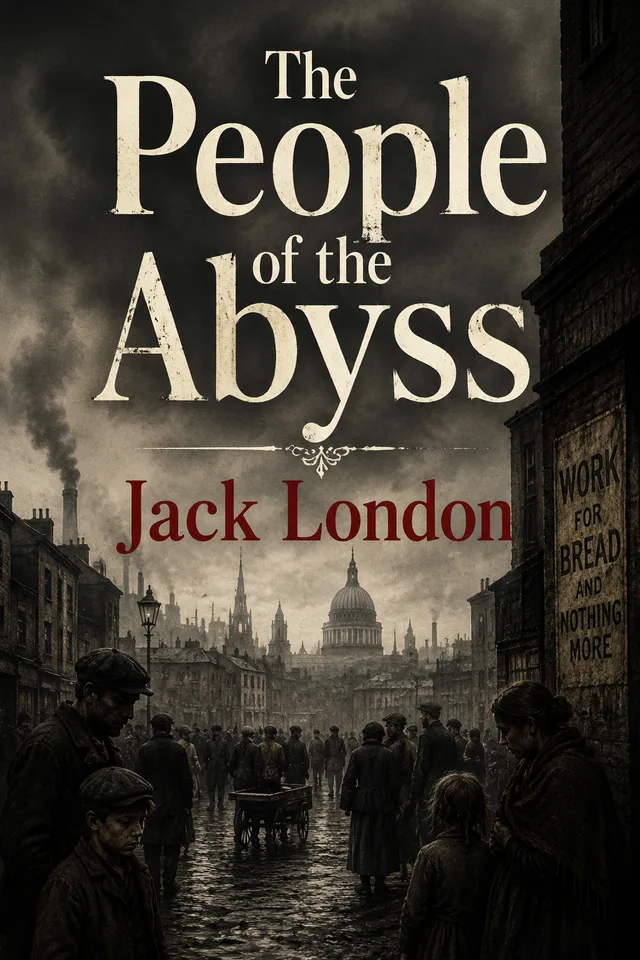
The People of the Abyss
English BooksWhale Edition by Jack London
London’s firsthand account of poverty, labor, housing, and survival in London’s East End.
- Preview
- A sample from the prepared text
- Formats
- Online reader, EPUB, PDF
- Access
- Library claim
Book introduction
The People of the Abyss
Jack London’s “The People of the Abyss” records his investigation of East End poverty, overcrowded lodging houses, unemployment, hunger, and social neglect. Part reportage and part social critique, it remains a vivid document of urban inequality.
BooksWhale edition
How this edition was prepared
This edition is based on a public domain text and has been prepared for digital reading by BooksWhale.
Public domain basis
Why this edition can be shared
The People of the Abyss is a public-domain work: the author died in 1916, and the text was first published in 1903. This edition uses the original English text.
Read preview
A sample from the prepared text
Preview selected from the prepared reader text.
Preview chapterFull textRead preview
The People of the Abyss
by Jack London
PREFACE I. THE DESCENT II. JOHNNY UPRIGHT III. MY LODGING AND SOME OTHERS IV. A MAN AND THE ABYSS V. THOSE ON THE EDGE VI. FRYING-PAN ALLEY AND A GLIMPSE OF INFERNO VII. A WINNER OF THE VICTORIA CROSS VIII. THE CARTER AND THE CARPENTER IX. THE SPIKE X. CARRYING THE BANNER XI. THE PEG XII. CORONATION DAY XIII. DAN CULLEN, DOCKER XIV. HOPS AND HOPPERS XV. THE SEA WIFE XVI. PROPERTY VERSUS PERSON XVII. INEFFICIENCY XVIII. WAGES XIX. THE GHETTO XX. COFFEE-HOUSES AND DOSS-HOUSES XXI. THE PRECARIOUSNESS OF LIFE XXII. SUICIDE XXIII. THE CHILDREN XXIV. A VISION OF THE NIGHT XXV. THE HUNGER WAIL XXVI. DRINK, TEMPERANCE, AND THRIFT XXVII. THE MANAGEMENT
The chief priests and rulers cry:—
“O Lord and Master, not ours the guilt, We build but as our fathers built; Behold thine images how they stand Sovereign and sole through all our land.
“Our task is hard—with sword and flame, To hold thine earth forever the same, And with sharp crooks of steel to keep, Still as thou leftest them, thy sheep.”
Then Christ sought out an artisan, A low-browed, stunted, haggard man, And a motherless girl whose fingers thin Crushed from her faintly want and sin.
These set he in the midst of them, And as they drew back their garment hem For fear of defilement, “Lo, here,” said he, “The images ye have made of me.”
Preview chapterJAMES RUSSELL LOWELL.Preview
JAMES RUSSELL LOWELL.
Preview chapterPREFACEPreview
The experiences related in this volume fell to me in the summer of 1902. I went down into the under-world of London with an attitude of mind which I may best liken to that of the explorer. I was open to be convinced by the evidence of my eyes, rather than by the teachings of those who had not seen, or by the words of those who had seen and gone before. Further, I took with me certain simple criteria with which to measure the life of the under-world. That which made for more life, for physical and spiritual health, was good; that which made for less life, which hurt, and dwarfed, and distorted life, was bad.
It will be readily apparent to the reader that I saw much that was bad. Yet it must not be forgotten that the time of which I write was considered “good times” in England. The starvation and lack of shelter I encountered constituted a chronic condition of misery which is never wiped out, even in the periods of greatest prosperity.
Following the summer in question came a hard winter. Great numbers of the unemployed formed into processions, as many as a dozen at a time, and daily marched through the streets of London crying for bread. Mr. Justin McCarthy, writing in the month of January 1903, to the New York _Independent_, briefly epitomises the situation as follows:—
“The workhouses have no space left in which to pack the starving crowds who are craving every day and night at their doors for food and shelter. All the charitable institutions have exhausted their means in trying to raise supplies of food for the famishing residents of the garrets and cellars of London lanes and alleys. The quarters of the Salvation Army in various parts of London are nightly besieged by hosts of the unemployed and the hungry for whom neither shelter nor the means of sustenance can be provided.”
It has been urged that the criticism I have passed on things as they are in England is too pessimistic. I must say, in extenuation, that of optimists I am the most optimistic. But I measure manhood less by political aggregations than by individuals. Society grows, while political machines rack to pieces and become “scrap.” For the English, so far as manhood and womanhood and health and happiness go, I see a broad and smiling future. But for a great deal of the political machinery, which at present mismanages for them, I see nothing else than the scrap heap.
Table of contents
Inside this edition
- 01Full text
- 02JAMES RUSSELL LOWELL.
- 03PREFACE
- 04JACK LONDON.
- 05PIEDMONT, CALIFORNIA.
- 06SELF-NEGLECT
- 07SWINBURNE.
- 08CHALLENGE
- 09LONGFELLOW
Language availability
Other languages
Additional language editions are not published yet. This section will link to other BooksWhale editions when they become available.
Request another language