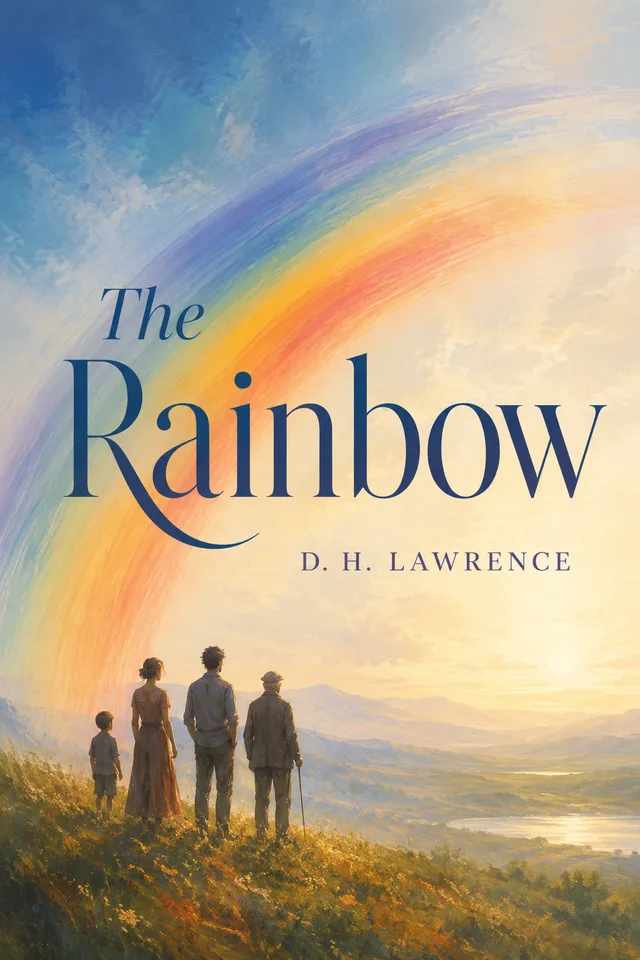
English Edition
Literature
The Rainbow
English BooksWhale Edition by D. H. Lawrence
Three generations of the Brangwen family search for love, faith, sexuality, and modern freedom.
- Preview
- A sample from the prepared text
- Formats
- Online reader, EPUB, PDF
- Access
- Library claim
Book introduction
The Rainbow
The Rainbow traces the Brangwen family from rural Nottinghamshire into a changing modern England, following Tom, Anna, Ursula, and their shifting ideas of marriage, body, religion, education, and selfhood. Lawrence makes family history a study of desire, spiritual hunger, class movement, and the struggle to live freely.
BooksWhale edition
How this edition was prepared
This edition is based on a public domain text and has been prepared for digital reading by BooksWhale.
Public domain basis
Why this edition can be shared
D. H. Lawrence died in 1930, and The Rainbow was first published in 1915. These dates support the public-domain basis for the original English text used in this edition.
Read preview
A sample from the prepared text
Preview selected from the prepared reader text.
Preview chapterFull textRead preview
The Rainbow
D. H. Lawrence
Preview chapterChapter I. HOW TOM BRANGWEN MARRIED A POLISH LADYPreview
Chapter I. HOW TOM BRANGWEN MARRIED A POLISH LADY
Preview chapterIPreview
The Brangwens had lived for generations on the Marsh Farm, in the meadows where the Erewash twisted sluggishly through alder trees, separating Derbyshire from Nottinghamshire. Two miles away, a church-tower stood on a hill, the houses of the little country town climbing assiduously up to it. Whenever one of the Brangwens in the fields lifted his head from his work, he saw the church-tower at Ilkeston in the empty sky. So that as he turned again to the horizontal land, he was aware of something standing above him and beyond him in the distance.
There was a look in the eyes of the Brangwens as if they were expecting something unknown, about which they were eager. They had that air of readiness for what would come to them, a kind of surety, an expectancy, the look of an inheritor.
They were fresh, blond, slow-speaking people, revealing themselves plainly, but slowly, so that one could watch the change in their eyes from laughter to anger, blue, lit-up laughter, to a hard blue-staring anger; through all the irresolute stages of the sky when the weather is changing.
Living on rich land, on their own land, near to a growing town, they had forgotten what it was to be in straitened circumstances. They had never become rich, because there were always children, and the patrimony was divided every time. But always, at the Marsh, there was ample.
So the Brangwens came and went without fear of necessity, working hard because of the life that was in them, not for want of the money. Neither were they thriftless. They were aware of the last halfpenny, and instinct made them not waste the peeling of their apple, for it would help to feed the cattle. But heaven and earth was teeming around them, and how should this cease? They felt the rush of the sap in spring, they knew the wave which cannot halt, but every year throws forward the seed to begetting, and, falling back, leaves the young-born on the earth. They knew the intercourse between heaven and earth, sunshine drawn into the breast and bowels, the rain sucked up in the daytime, nakedness that comes under the wind in autumn, showing the birds’ nests no longer worth hiding. Their life and interrelations were such; feeling the pulse and body of the soil, that opened to their furrow for the grain, and became smooth and supple after their ploughing, and clung to their feet with a weight that pulled like desire, lying hard and unresponsive when the crops were to be shorn away. The young corn waved and was silken, and the lustre slid along the limbs of the men who saw it. They took the udder of the cows, the cows yielded milk and pulse against the hands of the men, the pulse of the blood of the teats of the cows beat into the pulse of the hands of the men. They mounted their horses, and held life between the grip of their knees, they harnessed their horses at the wagon, and, with hand on the bridle-rings, drew the heaving of the horses after their will.
In autumn the partridges whirred up, birds in flocks blew like spray across the fallow, rooks appeared on the grey, watery heavens, and flew cawing into the winter. Then the men sat by the fire in the house where the women moved about with surety, and the limbs and the body of the men were impregnated with the day, cattle and earth and vegetation and the sky, the men sat by the fire and their brains were inert, as their blood flowed heavy with the accumulation from the living day.
The women were different. On them too was the drowse of blood-intimacy, calves sucking and hens running together in droves, and young geese palpitating in the hand while the food was pushed down their throttle. But the women looked out from the heated, blind intercourse of farm-life, to the spoken world beyond. They were aware of the lips and the mind of the world speaking and giving utterance, they heard the sound in the distance, and they strained to listen.
Table of contents
Inside this edition
- 01Full text
- 02Chapter I. HOW TOM BRANGWEN MARRIED A POLISH LADY
- 03I
- 04II
- 05Chapter II. THEY LIVE AT THE MARSH
- 06Chapter III. CHILDHOOD OF ANNA LENSKY
- 07Chapter IV. GIRLHOOD OF ANNA BRANGWEN
- 08Chapter V. WEDDING AT THE MARSH
- 09Chapter VI. ANNA VICTRIX
- 10Chapter VII. THE CATHEDRAL
- 11Chapter VIII. THE CHILD
- 12Chapter IX. THE MARSH AND THE FLOOD
- 13Chapter X. THE WIDENING CIRCLE
- 14Chapter XI. FIRST LOVE
- 15Chapter XII. SHAME
- 16Chapter XIII. THE MAN’S WORLD
- 17Chapter XIV. THE WIDENING CIRCLE
- 18Chapter XV. THE BITTERNESS OF ECSTASY
- 19Chapter XVI. THE RAINBOW
Language availability
Other languages
Additional language editions are not published yet. This section will link to other BooksWhale editions when they become available.
Request another language