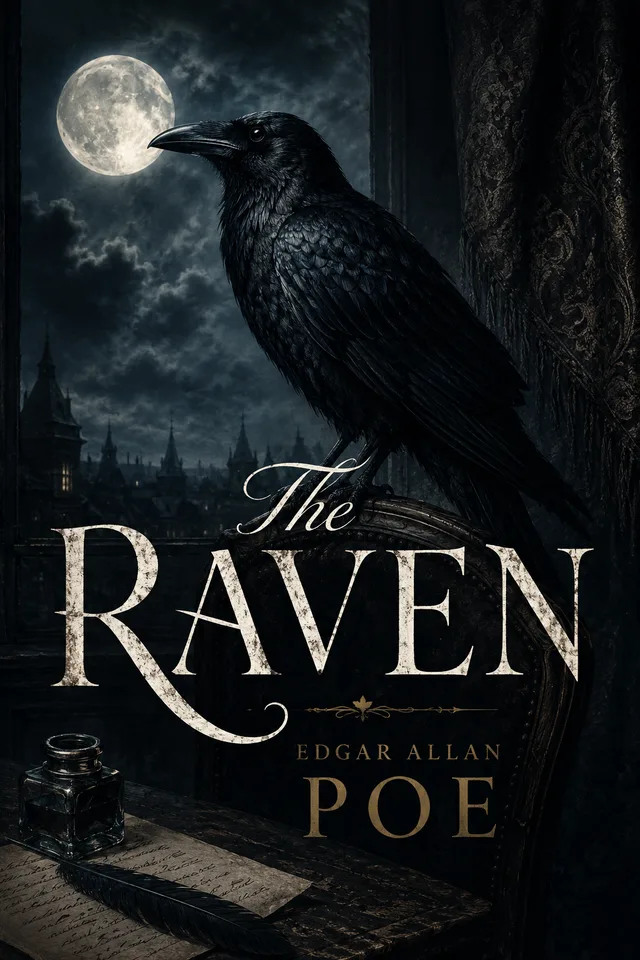
English Edition
Literature
The Raven
English BooksWhale Edition by Edgar Allan Poe
Poe's haunting poem of grief, memory, midnight visitation, and the word that will not leave.
- Preview
- A sample from the prepared text
- Formats
- Online reader, EPUB, PDF
- Access
- Library claim
Book introduction
The Raven
The Raven is Edgar Allan Poe's best-known poem, shaped by musical repetition, mourning, and supernatural suggestion. Its atmosphere of loss and obsession has made it one of the most famous works in American literature.
BooksWhale edition
How this edition was prepared
This edition is based on a public domain text and has been prepared for digital reading by BooksWhale.
Public domain basis
Why this edition can be shared
Edgar Allan Poe died in 1849, and The Raven was first published in 1845. These dates support the public-domain basis for the English source text used in this edition.
Read preview
A sample from the prepared text
Preview selected from the prepared reader text.
Preview chapterFull textRead preview
The Raven
Preview chapterO, TEMPORA! O, MORES!Preview
O, Times! O, Manners! It is my opinion
That you are changing sadly your dominion —
I mean the reign of manners hath long ceased,
For men have none at all, or bad at least;
And as for times, altho' 'tis said by many
The "good old times" were far the worst of any,
Of which sound doctrine l believe each tittle,
Yet still I think these worse than them a little.
I've been a thinking — isn't that the phrase? —
I like your Yankee words and Yankee ways —
I've been a thinking, whether it were best
To take things seriously, or all in jest;
Whether, with grim Heraclitus of yore,
To weep, as he did, till his eyes were sore,
Or rather laugh with him, that queer philosopher,
Democritus of Thrace, who used to toss over
The page of life and grin at the dog-ears,
As though he'd say, "Why, who the devil cares?"
This is a question which, oh heaven, withdraw
The luckless query from a member's claw!
Instead of two sides, Job [Bob] has nearly eight,
Each fit to furnish forth four hours debate.
What shall be done? I'll lay it on the table,
And take the matter up when I'm more able,
And, in the meantime, to prevent all bother,
I'll neither laugh with one, nor cry with t'other,
Nor deal in flatt'ry or aspersions foul,
But, taking one by each hand, merely growl.
Ah, growl, say you, my friend, and pray at what?
Why, really, sir, I almost had forgot —
But, damn it, sir, I deem it a disgrace
That things should stare us boldly in the face,
And daily strut the street with bows and scrapes,
Who would be men by imitating apes.
I beg your pardon, reader, for the oath
The monkeys make me swear, though something loth;
I'm apt to be discursive in my style,
But pray be patient; yet a little while
Will change me, and as politicians do,
I'll mend my manners and my measures too.
Of all the cities — and I've seen no few;
For I have travelled, friend, as well as you —
I don't remember one, upon my soul,
But take it generally upon the whole,
(As members say they like their logick [logic] taken,
Because divided, it may chance be shaken)
So pat, agreeable and vastly proper
As this for a neat, frisky counter-hopper;
Here he may revel to his heart's content,
Flounce like a fish in his own element,
Toss back his fine curls from their forehead fair,
And hop o'er counters with a Vester's air,
Complete at night what he began A.M.,
And having cheated ladies, dance with them;
For, at a ball, what fair one can escape
The pretty little hand that sold her tape,
Or who so cold, so callous to refuse
The youth who cut the ribbon for her shoes!
One of these fish, par excellence the beau —
God help me! — it has been my lot to know,
At least by sight, for I'm a timid man,
And always keep from laughing, if I can;
But speak to him, he'll make you such grimace,
Lord! to be grave exceeds the power of face.
The hearts of all the ladies are with him,
Their bright eyes on his Tom and Jerry brim
And dove-tailed coat, obtained at cost; while then
Those eyes won't turn on anything like men.
His very voice is musical delight,
His form, once seen, becomes a part of sight;
In short, his shirt collar, his look, his tone is
The "beau ideal" fancied for Adonis.
Philosophers have often held dispute
As to the seat of thought in man and brute;
For that the power of thought attends the latter
My friend, the beau, hath made a settled matter,
And spite of all dogmas, current in all ages,
One settled fact is better than ten sages.
For he does think, though I am oft in doubt
Preview chapterTAMERLANEPreview
KIND solace in a dying hour!
Such, father, is not (now) my theme—
I will not madly deem that power
Of Earth may shrive me of the sin
Unearthly pride hath revell'd in—
I have no time to dote or dream:
You call it hope—that fire of fire!
It is but agony of desire:
If I can hope—Oh God! I can—
Its fount is holier—more divine—
I would not call thee fool, old man,
But such is not a gift of thine.
Know thou the secret of a spirit
Bow'd from its wild pride into shame.
O! yearning heart! I did inherit
Thy withering portion with the fame,
The searing glory which hath shone
Amid the jewels of my throne,
Halo of Hell! and with a pain
Not Hell shall make me fear again—
O! craving heart, for the lost flowers
And sunshine of my summer hours!
Th' undying voice of that dead time,
With its interminable chime,
Rings, in the spirit of a spell,
Upon thy emptiness—a knell.
I have not always been as now:
The fever'd diadem on my brow
I claim'd and won usurpingly—
Hath not the same fierce heirdom given
Rome to the Caesar—this to me?
The heritage of a kingly mind,
And a proud spirit which hath striven
Triumphantly with human kind.
On mountain soil I first drew life:
The mists of the Taglay have shed
Nightly their dews upon my head,
And, I believe, the winged strife
And tumult of the headlong air
Have nestled in my very hair.
So late from Heaven—that dew—it fell
(Mid dreams of an unholy night)
Upon me—with the touch of Hell,
While the red flashing of the light
From clouds that hung, like banners, o'er,
Appeared to my half-closing eye
The pageantry of monarchy,
And the deep trumpet-thunder's roar
Came hurriedly upon me, telling
Of human battle, where my voice,
My own voice, silly child!—was swelling
(O! how my spirit would rejoice,
And leap within me at the cry)
The battle-cry of Victory!
The rain came down upon my head
Unshelter'd—and the heavy wind
Was giantlike—so thou, my mind!—
It was but man, I thought, who shed
Laurels upon me: and the rush—
The torrent of the chilly air
Gurgled within my ear the crush
Of empires—with the captive's prayer—
The hum of suiters—and the tone
Of flattery 'round a sovereign's throne.
My passions, from that hapless hour,
Usurp'd a tyranny which men
Have deem'd, since I have reach'd to power;
My innate nature—be it so:
But, father, there liv'd one who, then,
Then—in my boyhood—when their fire
Burn'd with a still intenser glow,
(For passion must, with youth, expire)
E'en then who knew this iron heart
In woman's weakness had a part.
I have no words—alas!—to tell
The loveliness of loving well!
Nor would I now attempt to trace
The more than beauty of a face
Whose lineaments, upon my mind,
Are—shadows on th' unstable wind:
Thus I remember having dwelt
Some page of early lore upon,
With loitering eye, till I have felt
The letters—with their meaning—melt
To fantasies—with none.
O, she was worthy of all love!
Love—as in infancy was mine—
'Twas such as angel minds above
Might envy; her young heart the shrine
On which my ev'ry hope and thought
Were incense—then a goodly gift,
For they were childish—and upright—
Pure—as her young example taught:
Why did I leave it, and, adrift,
Trust to the fire within, for light?
We grew in age—and love—together,
Roaming the forest, and the wild;
My breast her shield in wintry weather—
And, when the friendly sunshine smil'd,
And she would mark the opening skies,
I saw no Heaven—but in her eyes.
Young Love's first lesson is—the heart:
For 'mid that sunshine, and those smiles,
Table of contents
Inside this edition
- 01Full text
- 02O, TEMPORA! O, MORES!
- 03TAMERLANE
- 04STANZAS
- 05TO MARGARET
- 06ALONE
- 07TO ISAAC LEA
- 08AN ACROSTIC
- 09ELIZABETH
- 10LENORE
- 11A PAEAN
- 12THE CITY IN THE SEA
- 13FANNY
- 14SERENADE
- 15TO F——S S. O——D
- 16TO ELIZABETH
- 17MAY QUEEN ODE
- 18SPIRITUAL SONG
- 19LATIN HYMN
- 20LINES ON JOE LOCKE
- 21A CAMPAIGN SONG
- 22DREAM LAND
- 23IMPROMPTU. TO KATE CAROL
- 24EULALIE
- 25EPIGRAM FOR WALL STREET
- 26THE RAVEN
- 27THE DIVINE RIGHT OF KINGS
- 28THE BELOVED PHYSICIAN
- 29DEEP IN EARTH
- 30ULALUME
- 31LINES ON ALE
- 32A DREAM WITHIN A DREAM
- 33TO MY MOTHER
- 34TO ISADORE
- 35THE VILLAGE STREET
- 36THE FOREST REVERIE
Language availability
Other languages
Additional language editions are not published yet. This section will link to other BooksWhale editions when they become available.
Request another language