English Edition
Literature
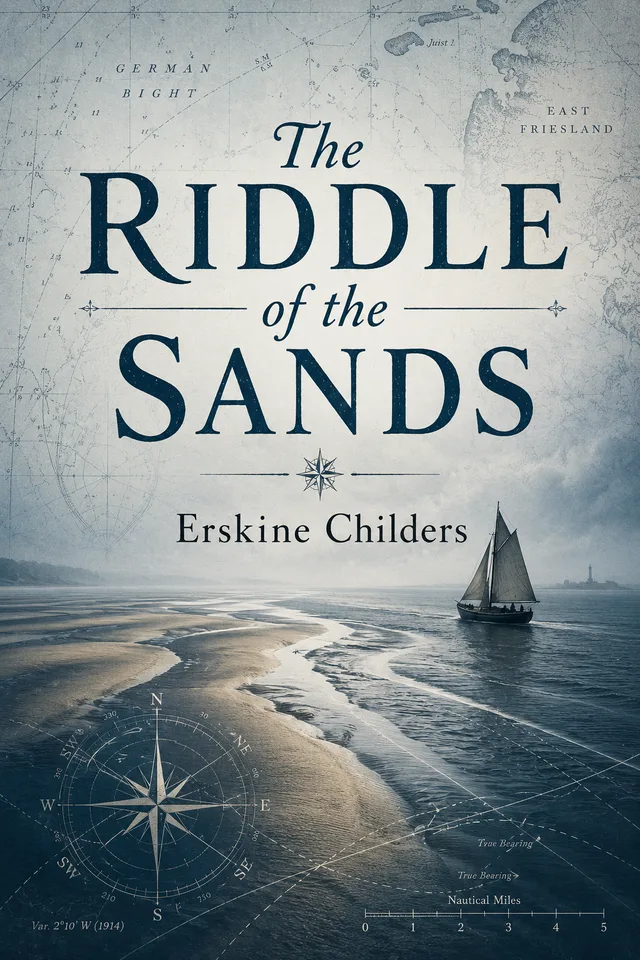
The Riddle of the Sands
English BooksWhale Edition by Erskine Childers
A sailing holiday in the Frisian Islands turns into a tense discovery of invasion plans and espionage.
- Preview
- A sample from the prepared text
- Formats
- Online reader, EPUB, PDF
- Access
- Library claim
Book introduction
The Riddle of the Sands
The Riddle of the Sands sends Carruthers and Davies into channels, tides, charts, and fog along the German coast, where amateur sailing becomes strategic intelligence. Childers helped define the modern spy novel by grounding suspense in maps, seamanship, naval anxiety, and prewar geopolitics.
BooksWhale edition
How this edition was prepared
This edition is based on a public domain text and has been prepared for digital reading by BooksWhale.
Public domain basis
Why this edition can be shared
Erskine Childers died in 1922, and The Riddle of the Sands was first published in 1903. These dates support the public-domain basis for the original English text used in this edition.
Read preview
A sample from the prepared text
Preview selected from the prepared reader text.
Preview chapterFull textRead preview
The Riddle of the Sands
Preview chapterPrefacePreview
A word about the origin and authorship of this book.
In October last (1902), my friend “Carruthers” visited me in my chambers, and, under a provisional pledge of secrecy, told me frankly the whole of the adventure described in these pages. Till then I had only known as much as the rest of his friends, namely, that he had recently undergone experiences during a yachting cruise with a certain Mr “Davies” which had left a deep mark on his character and habits.
At the end of his narrative—which, from its bearing on studies and speculations of my own, as well as from its intrinsic interest and racy delivery, made a very deep impression on me—he added that the important facts discovered in the course of the cruise had, without a moment’s delay, been communicated to the proper authorities, who, after some dignified incredulity, due in part, perhaps, to the pitiful inadequacy of their own secret service, had, he believed, made use of them, to avert a great national danger. I say “he believed”, for though it was beyond question that the danger was averted for the time, it was doubtful whether they had stirred a foot to combat it, the secret discovered being of such a nature that mere suspicion of it on this side was likely to destroy its efficacy.
There, however that may be, the matter rested for a while, as, for personal reasons which will be manifest to the reader, he and Mr “Davies” expressly wished it to rest.
But events were driving them to reconsider their decision. These seemed to show that the information wrung with such peril and labour from the German Government, and transmitted so promptly to our own, had had none but the most transitory influence on our policy. Forced to the conclusion that the national security was really being neglected, the two friends now had a mind to make their story public; and it was about this that “Carruthers” wished for my advice. The great drawback was that an Englishman, bearing an honoured name, was disgracefully implicated, and that unless infinite delicacy were used, innocent persons, and, especially, a young lady, would suffer pain and indignity, if his identity were known. Indeed, troublesome rumours, containing a grain of truth and a mass of falsehood, were already afloat.
After weighing both sides of the question, I gave my vote emphatically for publication. The personal drawbacks could, I thought, with tact be neutralised; while, from the public point of view, nothing but good could come from submitting the case to the common sense of the country at large. Publication, therefore, was agreed upon, and the next point was the form it should take. “Carruthers”, with the concurrence of Mr “Davies”, was for a bald exposition of the essential facts, stripped of their warm human envelope. I was strongly against this course, first, because it would aggravate instead of allaying the rumours that were current; secondly, because in such a form the narrative would not carry conviction, and would thus defeat its own end. The persons and the events were indissolubly connected; to evade, abridge, suppress, would be to convey to the reader the idea of a concocted hoax. Indeed, I took bolder ground still, urging that the story should be made as explicit and circumstantial as possible, frankly and honestly for the purpose of entertaining and so of attracting a wide circle of readers. Even anonymity was undesirable. Nevertheless, certain precautions were imperatively needed.
To cut the matter short, they asked for my assistance and received it at once. It was arranged that I should edit the book; that “Carruthers” should give me his diary and recount to me in fuller detail and from his own point of view all the phases of the “quest”, as they used to call it; that Mr “Davies” should meet me with his charts and maps and do the same; and that the whole story should be written, as from the mouth of the former, with its humours and errors, its light and its dark side, just as it happened; with the following few limitations. The year it belongs to is disguised; the names of persons are throughout fictitious; and, at my instance certain slight liberties have been taken to conceal the identity of the English characters.
Preview chapterCHAPTER I.Preview
The Letter
I have read of men who, when forced by their calling to live for long periods in utter solitude—save for a few black faces—have made it a rule to dress regularly for dinner in order to maintain their self-respect and prevent a relapse into barbarism. It was in some such spirit, with an added touch of self-consciousness, that, at seven o’clock in the evening of September 23 in a recent year, I was making my evening toilet in my chambers in Pall Mall. I thought the date and the place justified the parallel; to my advantage even; for the obscure Burmese administrator might well be a man of blunted sensibilities and coarse fibre, and at least he is alone with nature, while I—well, a young man of condition and fashion, who knows the right people, belongs to the right clubs, has a safe, possibly a brilliant, future in the Foreign Office—may be excused for a sense of complacent martyrdom, when, with his keen appreciation of the social calendar, he is doomed to the outer solitude of London in September. I say “martyrdom”, but in fact the case was infinitely worse. For to feel oneself a martyr, as everybody knows, is a pleasurable thing, and the true tragedy of my position was that I had passed that stage. I had enjoyed what sweets it had to offer in ever dwindling degree since the middle of August, when ties were still fresh and sympathy abundant. I had been conscious that I was missed at Morven Lodge party. Lady Ashleigh herself had said so in the kindest possible manner, when she wrote to acknowledge the letter in which I explained, with an effectively austere reserve of language, that circumstances compelled me to remain at my office. “We know how busy you must be just now”, she wrote, “and I do hope you won’t overwork; we shall _all_ miss you very much.” Friend after friend “got away” to sport and fresh air, with promises to write and chaffing condolences, and as each deserted the sinking ship, I took a grim delight in my misery, positively almost enjoying the first week or two after my world had been finally dissipated to the four bracing winds of heaven. I began to take a spurious interest in the remaining five millions, and wrote several clever letters in a vein of cheap satire, indirectly suggesting the pathos of my position, but indicating that I was broad-minded enough to find intellectual entertainment in the scenes, persons, and habits of London in the dead season. I even did rational things at the instigation of others. For, though I should have liked total isolation best, I, of course, found that there was a sediment of unfortunates like myself, who, unlike me, viewed the situation in a most prosaic light. There were river excursions, and so on, after office-hours; but I dislike the river at any time for its noisy vulgarity, and most of all at this season. So I dropped out of the fresh air brigade and declined H——’s offer to share a riverside cottage and run up to town in the mornings. I did spend one or two week-ends with the Catesbys in Kent; but I was not inconsolable when they let their house and went abroad, for I found that such partial compensations did not suit me. Neither did the taste for satirical observation last. A passing thirst, which I dare say many have shared, for adventures of the fascinating kind described in the _New Arabian Nights_ led me on a few evenings into some shady haunts in Soho and farther eastward; but was finally quenched one sultry Saturday night after an hour’s immersion in the reeking atmosphere of a low music-hall in Ratcliffe Highway, where I sat next a portly female who suffered from the heat, and at frequent intervals refreshed herself and an infant from a bottle of tepid stout.
Table of contents
Inside this edition
- 01Full text
- 02Preface
- 03CHAPTER I.
- 04CHAPTER II.
- 05CHAPTER III.
- 06CHAPTER IV
- 07CHAPTER V.
- 08CHAPTER VI.
- 09CHAPTER VII.
- 10CHAPTER VIII.
- 11part of the world, but he has a house on Norderney Island; and he, and
- 12CHAPTER IX.
- 13part of a stupid idea of decoying you there and gaining time. However,
- 14CHAPTER X.
- 15CHAPTER XI.
- 16CHAPTER XII.
- 17CHAPTER XIII.
- 18CHAPTER XIV.
- 19CHAPTER XV.
- 20CHAPTER XVI.
- 21CHAPTER XVII.
- 22CHAPTER XVIII.
- 23CHAPTER XIX.
- 24CHAPTER XX.
- 25CHAPTER XXI.
- 26CHAPTER XXII.
- 27CHAPTER XXIII.
- 28CHAPTER XXIV.
- 29CHAPTER XXV.
- 30CHAPTER XXVI.
- 31CHAPTER XXVII.
- 32CHAPTER XXVIII.
- 33Epilogue
- 34Postscript (March 1903)
Language availability
Other languages
Additional language editions are not published yet. This section will link to other BooksWhale editions when they become available.
Request another language