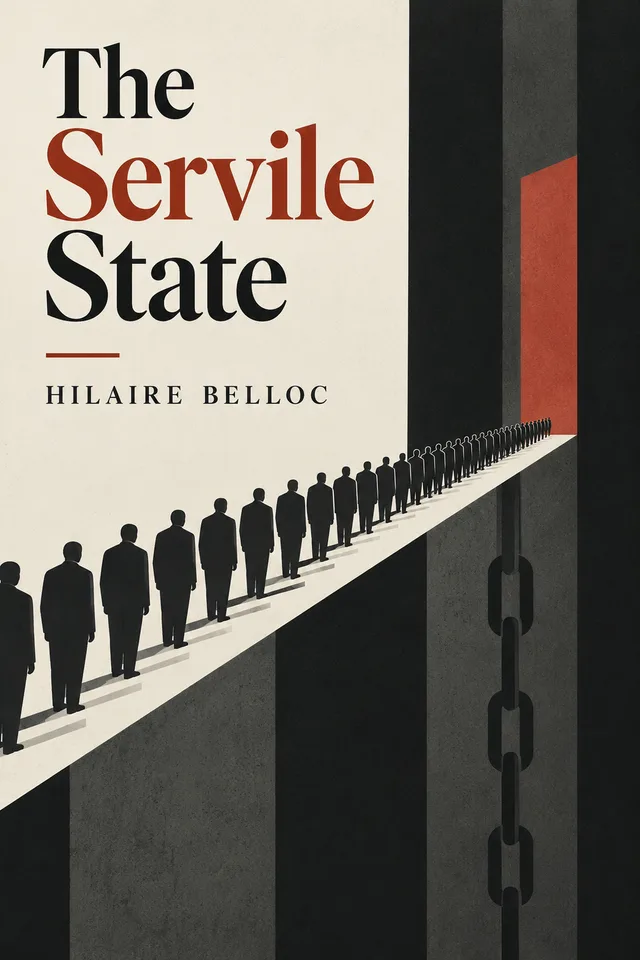
English Edition
Politics
The Servile State
English BooksWhale Edition by Hilaire Belloc
Belloc examines wage dependence, concentrated property, and the political forces that might turn free workers into a legally dependent class.
- Preview
- A sample from the prepared text
- Formats
- Online reader, EPUB, PDF
- Access
- Library claim
Book introduction
The Servile State
Hilaire Belloc traces the movement from ancient slavery through widely distributed property to modern capitalism. He argues that concentrated ownership and economic insecurity can produce a new social order in which workers receive protection in exchange for compulsory service. The introduction, nine sections, and conclusion develop his criticism of both capitalist arrangements and proposed collectivist reforms, placing property and personal freedom at the center of the argument.
BooksWhale edition
How this edition was prepared
This edition is based on a public domain text and has been prepared for digital reading by BooksWhale.
Public domain basis
Why this edition can be shared
Hilaire Belloc died in 1953. The work was first published in 1912. This edition uses the public-domain English original.
Read preview
A sample from the prepared text
Preview selected from the prepared reader text.
Preview chapterIntroduction — The Subject of This BookRead preview
This book is written to maintain and prove the following truth:—
That our free modern society in which the means of production are owned by a few being necessarily in unstable equilibrium, it is tending to reach a condition of stable equilibrium by the establishment of compulsory labour legally enforcible upon those who do not own the means of production for the advantage of those who do. With this principle of compulsion applied against the non-owners there must also come a difference in their status; and in the eyes of society and of its positive law men will be divided into two sets: the first economically free and politically free, possessed of the means of production, and securely confirmed in that possession; the second economically unfree and politically unfree, but at first secured by their very lack of freedom in certain necessaries of life and in a minimum of well-being beneath which they shall not fall.
Society having reached such a condition would be released from its present internal strains and would have taken on a form which would be stable: that is, capable of being indefinitely prolonged without change. In it would be resolved the various factors of instability which increasingly disturb that form of society called Capitalist, and men would be satisfied to accept, and to continue in, such a settlement.
To such a stable society I shall give, for reasons which will be described in the next section, the title of The Servile State.
I shall not undertake to judge whether this approaching organisation of our modern society be good or evil. I shall concern myself only with showing the necessary tendency towards it which has long existed and the recent social provisions which show that it has actually begun.
This new state will be acceptable to those who desire consciously or by implication the re-establishment among us of a difference of status between possessor and non-possessor: it will be distasteful to those who regard such a distinction with ill favour or with dread.
My business will not be to enter into the discussion between these two types of modern thinkers, but to point out to each and to both that that which the one favours and the other would fly is upon them.
I shall prove my thesis in particular from the case of the industrial society of Great Britain, including that small, alien, and exceptional corner of Ireland, which suffers or enjoys industrial conditions to-day.
I shall divide the matter thus:—
(1) I shall lay down certain definitions.
(2) Next, I shall describe the institution of slavery and The Servile State of which it is the basis, as these were in the ancient world. I shall then:
(3) Sketch very briefly the process whereby that age-long institution of slavery was slowly dissolved during the Christian centuries, and whereby the resulting medieval system, based upon highly divided property in the means of production, was
(4) wrecked in certain areas of Europe as it approached completion, and had substituted for it, in practice though not in legal theory, a society based upon Capitalism.
(5) Next, I shall show how Capitalism was of its nature unstable, because its social realities were in conflict with all existing or possible systems of law, and because its effects in denying sufficiency and security were intolerable to men; how being thus unstable, it consequently presented a problem which demanded a solution: to wit, the establishment of some stable form of society whose law and social practice should correspond, and whose economic results, by providing sufficiency and security, should be tolerable to human nature.
(6) I shall next present the only three possible solutions:—
(a) Collectivism, or the placing of the means of production in the hands of the political officers of the community.
(b) Property, or the re-establishment of a Distributive State in which the mass of citizens should severally own the means of production.
Preview chapterSection One — DefinitionsPreview
Man, like every other organism, can only live by the transformation of his environment to his own use. He must transform his environment from a condition where it is less to a condition where it is more subservient to his needs.
That special, conscious, and intelligent transformation of his environment which is peculiar to the peculiar intelligence and creative faculty of man we call the Production of Wealth.
Wealth is matter which has been consciously and intelligently transformed from a condition in which it is less to a condition in which it is more serviceable to a human need.
Without Wealth man cannot exist. The production of it is a necessity to him, and though it proceeds from the more to the less necessary, and even to those forms of production which we call luxuries, yet in any given human society there is a certain kind and a certain amount of wealth without which human life cannot be lived: as, for instance, in England to-day, certain forms of cooked and elaborately prepared food, clothing, warmth, and habitation.
Therefore, to control the production of wealth is to control human life itself. To refuse man the opportunity for the production of wealth is to refuse him the opportunity for life; and, in general, the way in which the production of wealth is by law permitted is the only way in which the citizens can legally exist.
This human energy so applicable to the material world and its forces we will call Labour. As for that material and those natural forces, we will call them, for the sake of shortness, by the narrow, but conventionally accepted, term Land.
It would seem, therefore, that all problems connected with the production of wealth, and all discussion thereupon, involve but two principal original factors, to wit, Labour and Land, But it so happens that the conscious, artificial, and intelligent action of man upon nature, corresponding to his peculiar character compared with other created beings, introduces a third factor of the utmost importance.
Man proceeds to create wealth by ingenious methods of varying and often increasing complexity, and aids himself by the construction of implements. These soon become in each new department of the production as truly necessary to that production as labour and land. Further, any process of production takes a certain time; during that time the producer must be fed, and clothed, and housed, and the rest of it. There must therefore be an accumulation of wealth created in the past, and reserved with the object of maintaining labour during its effort to produce for the future.
Whether it be the making of an instrument or tool, or the setting aside of a store of provisions, labour applied to land for either purpose is not producing wealth for immediate consumption. It is setting aside and reserving somewhat, and that somewhat is always necessary in varying proportions according to the simplicity or complexity of the economic society to the production of wealth.
To such wealth reserved and set aside for the purposes of future production, and not for immediate consumption, whether it be in the form of instruments and tools, or in the form of stores for the maintenance of labour during the process of production, we give the name of Capital.
There are thus three factors in the production of all human wealth, which we may conventionally term Land, Capital, and Labour.
When we talk of the Means of Production we signify land and capital combined. Thus, when we say that a man is “dispossessed of the means of production,” or cannot produce wealth save by the leave of another who “possesses the means of production,” we mean that he is the master only of his labour and has no control, in any useful amount, over either capital, or land, or both combined.
A man politically free, that is, one who enjoys the right before the law to exercise his energies when he pleases (or not at all if he does not so please), but not possessed by legal right of control over any useful amount of the means of production, we call proletarian, and any considerable class composed of such men we call a proletariat.
Preview chapterSection Two — Our Civilisation Was Originally ServilePreview
In no matter what field of the European past we make our research, we find, from two thousand years ago upwards, one fundamental institution whereupon the whole of society reposes; that fundamental institution is Slavery.
There is here no distinction between the highly civilised City-State of the Mediterranean, with its letters, its plastic art, and its code of laws, with all that makes a civilisation—and this stretching back far beyond any surviving record,—there is here no distinction between that civilised body and the Northern and Western societies of the Celtic tribes, or of the little known hordes that wandered in the Germanies. All indifferently reposed upon slavery. It was a fundamental conception of society. It was everywhere present, nowhere disputed.
There is a distinction (or would appear to be) between Europeans and Asiatics in this matter. The religion and morals of the one so differed in their very origin from those of the other that every social institution was touched by the contrast—and Slavery among the rest.
But with that we need not concern ourselves. My point is that our European ancestry, those men from whom we are descended and whose blood runs with little admixture in our veins, took slavery for granted, made of it the economic pivot upon which the production of wealth should turn, and never doubted but that it was normal to all human society.
It is a matter of capital importance to seize this.
An arrangement of such a sort would not have endured without intermission (and indeed without question) for many centuries, nor have been found emerging fully grown from that vast space of unrecorded time during which barbarism and civilisation flourished side by side in Europe, had there not been something in it, good or evil, native to our blood.
There was no question in those ancient societies from which we spring of making subject races into slaves by the might of conquering races. All that is the guess-work of the universities. Not only is there no proof of it, rather all the existing proof is the other way. The Greek had a Greek slave, the Latin a Latin slave, the German a German slave, the Celt a Celtic slave. The theory that “superior races” invaded a land, either drove out the original inhabitants or reduced them to slavery, is one which has no argument either from our present knowledge of man’s mind or from recorded evidence. Indeed, the most striking feature of that Servile Basis upon which Paganism reposed was the human equality recognised between master and slave. The master might kill the slave, but both were of one race and each was human to the other.
This spiritual value was not, as a further pernicious piece of guess-work would dream, a “growth” or a “progress.” The doctrine of human equality was inherent in the very stuff of antiquity, as it is inherent in those societies which have not lost tradition.
We may presume that the barbarian of the North would grasp the great truth with less facility than the civilised man of the Mediterranean, because barbarism everywhere shows a retrogression in intellectual power; but the proof that the Servile Institution was a social arrangement rather than a distinction of type is patent from the coincidence everywhere of Emancipation with Slavery. Pagan Europe not only thought the existence of Slaves a natural necessity to society, but equally thought that upon giving a Slave his freedom the enfranchised man would naturally step, though perhaps after the interval of some lineage, into the ranks of free society. Great poets and great artists, statesmen and soldiers were little troubled by the memory of a servile ancestry.
On the other hand, there was a perpetual recruitment of the Servile Institution, just as there was a perpetual emancipation from it, proceeding year after year; and the natural or normal method of recruitment is most clearly apparent to us in the simple and barbaric societies which the observation of contemporary civilised Pagans enables us to judge.
Table of contents
Inside this edition
- 01Introduction — The Subject of This Book
- 02Section One — Definitions
- 03Section Two — Our Civilisation Was Originally Servile
- 04Section Three — How the Servile Institution Was for a Time Dissolved
- 05Section Four — How the Distributive State Failed
- 06Section Five — The Capitalist State in Proportion as It Grows Perfect Grows Unstable
- 07Section Six — The Stable Solutions of This Instability
- 08Section Seven — Socialism Is the Easiest Apparent Solution of the Capitalist Crux
- 09Section Eight — The Reformers and Reformed Are Alike Making for the Servile State
- 10Appendix on “Buying-Out”
- 11Section Nine — The Servile State Has Begun
- 12Conclusion
Language availability
Other languages
Additional language editions are not published yet. This section will link to other BooksWhale editions when they become available.
Request another language