English Edition
Literature
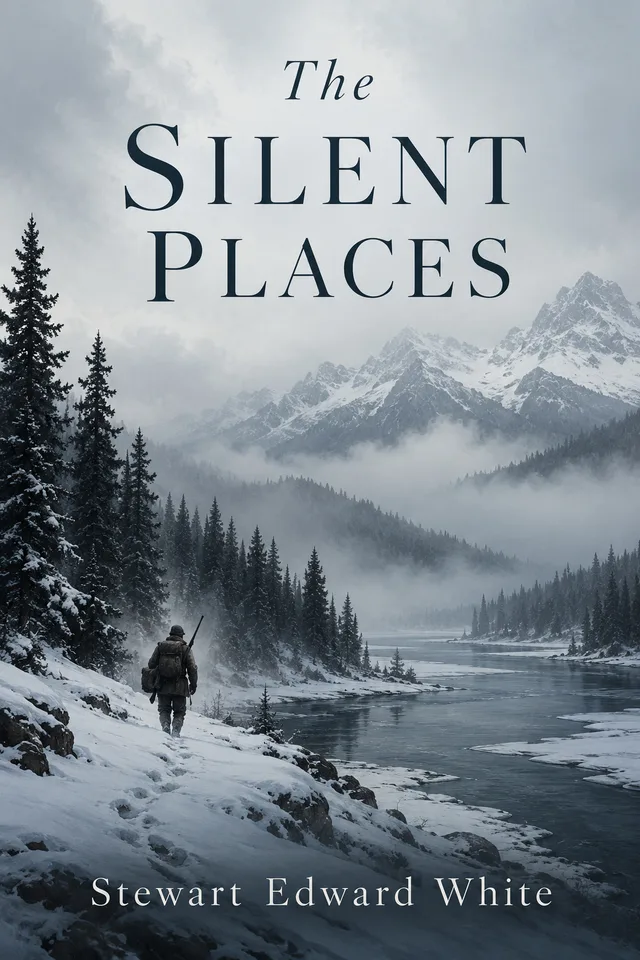
The Silent Places
English BooksWhale Edition by Stewart Edward White
Two men pursue a fugitive through the Canadian wilderness, where endurance, divided loyalties, and local knowledge shape an unforgiving journey.
- Preview
- A sample from the prepared text
- Formats
- Online reader, EPUB, PDF
- Access
- Library claim
Book introduction
The Silent Places
In The Silent Places, Stewart Edward White sends Sam Bolton and Dick Herron into the northern wilderness on a mission for the Hudson’s Bay Company. Rivers, forests, weather, and the knowledge of Indigenous communities determine the pace of their pursuit. The thirty-two-chapter novel combines the practical detail of travel with a study of loyalty, isolation, and the human cost of completing an assigned task.
BooksWhale edition
How this edition was prepared
This edition is based on a public domain text and has been prepared for digital reading by BooksWhale.
Public domain basis
Why this edition can be shared
Stewart Edward White died in 1946; the work was first published in 1904. This edition uses the public-domain English original from Project Gutenberg, without later notes, illustrations, or publisher material.
Read preview
A sample from the prepared text
Preview selected from the prepared reader text.
Preview chapterCHAPTER ONERead preview
At about eight o'clock one evening of the early summer a group of men were seated on a grass-plot overlooking a broad river. The sun was just setting through the forest fringe directly behind them.
Of this group some reclined in the short grass, others lay flat on the bank's slope, while still others leaned against the carriages of two highly ornamented field-guns, whose embossed muzzles gaped silently at an eastern shore nearly two miles distant.
The men were busy with soft-voiced talk, punctuating their remarks with low laughter of a singularly infectious character. It was strange speech, richly embroidered with the musical names of places, with unfamiliar names of beasts, and with unintelligible names of things. Kenógami, Mamátawan, Wenebógan, Kapúskasíng, the silver-fox, the sea-otter, the sable, the wolverine, the musk-ox, parka, babiche, tump-line, giddés,—these and others sang like arrows cleaving the atmosphere of commoner words. In the distant woods the white-throats and olive thrushes called in a language hardly less intelligible.
There scarcely needed the row of glistening birch-barks below the men, the warehouse with its picketed lane, the tall flag-staff, the block-house stockade, the half-bred women chatting over the low fences of the log-houses, the squaws wandering to and fro in picturesque silence, the Indian children playing noisily or standing in awe before the veranda of the white house, to inform the initiated that this little forest- and river-girt settlement was a post of the Honourable the Hudson's Bay Company. The time of sunset and the direction of the river's flow would have indicated a high latitude. The mile-long meadow, with its Indian camp, the oval of forest, the immense breadth of the river identified the place as Conjuror's House. Thus the blue water in the distance was James Bay, the river was the Moose; enjoying his Manila cheroot on the Factory veranda with the other officers of the Company was Galen Albret, and these men lounging on the river bank were the Company's post-keepers and runners, the travellers of the Silent Places.
They were of every age and dressed in a variety of styles. All wore ornamented moccasins, bead garters, and red sashes of worsted. As to the rest, each followed his taste. So in the group could be seen bare heads, fillet-bound heads, covered heads; shirt sleeves, woollen jerseys, and long, beautiful blanket coats. Two things, however, proved them akin. They all possessed a lean, wiry hardness of muscle and frame, a hawk-like glance of the eye, an almost emaciated spareness of flesh on the cheeks. They all smoked pipes of strong plug tobacco.
Whether the bronze of their faces, thrown into relief by the evening glow, the frowning steadiness of their eyes, or more fancifully the background of the guns, the flag-staff and the stockade was most responsible, the militant impression persisted strongly. These were the veterans of an hundred battles. They were of the stuff forlorn hopes are fashioned from. A great enemy, a powerful enemy, an enemy to be respected and feared had hardened them to the unyielding. The adversary could almost be measured, the bitterness of the struggle almost be gauged from the scars of their spirits; the harshness of it, the cruelty of it, the wonderful immensity of it that should so fashion the souls and flesh of men. For to the bearing of these loungers clung that hint of greater things which is never lacking to those who have called the deeps of man's nature to the conquering.
The sun dipped to the horizon, and over the landscape slipped the beautiful north-country haze of crimson. From the distant forest sounded a single mournful wolf-howl. At once the sledge-dogs answered in chorus. The twilight descended. The men gradually fell silent, smoking their pipes, savouring the sharp snow-tang, grateful to their toughened senses, that still lingered in the air.
Suddenly out of the dimness loomed the tall form of an Indian, advancing with long, straight strides. In a moment he was among them responding composedly to their greetings.
Preview chapterCHAPTER TWOPreview
The men stood looking vaguely upward at the stars.
Dick Herron whipped the grasses with a switch he had broken in passing a willow-bush. His mind was little active. Chiefly he regretted the good time he had promised himself here at the Post after the labour of an early spring march from distant Winnipeg. He appreciated the difficulties of the undertaking, but idly, as something that hardly concerned him. The details, the planning, he dismissed from his mind, confident that his comrade would rise to that. In time Sam Bolton would show him the point at which he was to bend his strength. Then he would stoop his shoulders, shut his eyes, and apply the magnificent brute force and pluck that was in him. So now he puckered his lips to the sibilance of a canoe-song, and waited.
But the other, Sam Bolton, the veteran woodsman, stood in rapt contemplation, his wide-seeing, gentle eyes of the old man staring with the magnitude of his revery.
Beyond the black velvet band lay the wilderness. There was the trackless country, large as the United States itself, with its great forests, its unmapped bodies of water, its plains, its barren grounds, its mountains, its water courses wider even than the Hudson River. Moose and bear, true lords of the forest, he might see any summer day. Herds of caribou, sometimes thousands strong, roamed its woodlands and barrens. Wolves, lurking or bold as their prey was strong or weak, clung to the caribou bands in hope of a victim. Wolverines,—unchanged in form from another geological period—marten, mink, fisher, otter, ermine, muskrat, lynx, foxes, beaver carried on their varied affairs of murder or of peaceful industry. Woods Indians, scarcely less keen of sense or natural of life than the animals, dwelt in their wigwams of bark or skins, trapped and fished, made their long migrations as the geese turn following their instinct. Sun, shadow, rain, cold, snow, hunger, plenty, labour, or the peaceful gliding of rivers, these had watched by the Long Trail in the years Sam Bolton had followed it. He sensed them now dimly, instinctively, waiting by the Trail he was called upon to follow.
Sam Bolton had lived many years in the forest, and many years alone. Therefore he had imagination. It might be of a limited quality, but through it he saw things in their essences.
Now from the safe vantage ground of the camp, from the breathing space before the struggle, he looked out upon the wilderness, and in the wilderness he felt the old, inimical Presence as he had felt it for forty years. The scars of that long combat throbbed through his consciousness. The twisting of his strong hands, the loosening of the elasticity, the humbling of the spirit, the caution that had displaced the carelessness of youth, the keenness of eye, the patience,—all these were at once the marks of blows and the spoils of victory received from the Enemy. The wilderness, calm, ruthless, just, terrible, waited in the shadow of the forest, seeking no combat, avoiding none, conquering with a lofty air of predestination, yielding superbly as though the moment's victory for which a man had strained the fibres of his soul were, after all, a little, unimportant thing; never weary, never exultant, dispassionate, inevitable, mighty, whose emotions were silence, whose speech was silence, whose most terrible weapon was the great white silence that smothered men's spirits. Sam Bolton clearly saw the North. He felt against him the steady pressure of her resistance. She might yield, but relentlessly regained her elasticity. Men's efforts against her would tire; the mechanics of her power remained constant. What she lost in the moments of her opponent's might, she recovered in the hours of his weakness, so that at the last she won, poised in her original equilibrium above the bodies of her antagonists. Dimly he felt these things, personifying the wilderness in his imagination of the old man, arranging half-consciously his weapons of craft in their due order.
Preview chapterCHAPTER THREEPreview
In the selection of paddles early next morning Sam insisted that the Indian rule be observed, measuring carefully that the length of each implement should just equal the height of its wielder. He chose the narrow maple blade, that it might not split when thrust against the bottom to check speed in a rapid. Further the blades were stained a brilliant orange.
Dick Herron had already picked one of a dozen birch-bark canoes laid away under the bridge over the dry coulee. He knew a good canoe as you would know a good horse. Fourteen feet it measured, of the heavy winter-cut of bark, and with a bottom all of one piece, without cracks or large knots.
The canoe and the paddles they laid at the water's edge. Then they went together to the great warehouse, behind the grill of whose upper room MacDonald was writing. Ordinarily the trappers were not allowed inside the grill, but Dick and Sam were told to help themselves freely. The stocking Dick left to his older companion, assuring himself merely of an hundred rounds of ammunition for his new model Winchester rifle, the 44-40 repeater, then just entering the outskirts of its popularity.
In the obscurity of the wide, low room the old woodsman moved to and fro, ducking his head to avoid things hanging, peering into corners, asking an occasional question of MacDonald, who followed him silently about. Two small steel traps, a narrow, small-meshed fish-net, a fish-line and hooks, powder, ball, and caps for the old man's muzzle-loader, a sack of salt were first laid aside. This represented subsistence. Then matches, a flint-and-steel machine, two four-point blankets. These meant warmth. Then ten pounds of plug tobacco and as many of tea. These were necessary luxuries. And finally a small sack of flour and a side of bacon. These were merely a temporary provision; when they should be exhausted, the men would rely wholly on the forest.
Sam Bolton hovered over the pile, after it was completed, his eyes half shut, naming over its items again and again, assuring himself that nothing lacked. At his side MacDonald made suggestions.
"Got a copper pail, Sam? a frying-pan? cups? How about the axe? Better have an extra knife between you. Need any clothes? Compass all right?"
To each of these questions Sam nodded an assent. So MacDonald, having named everything—with the exception of the canvas square to be used as a tarpaulin or a tent, and soap and towel—fell silent, convinced that he could do nothing more.
But Dick, who had been drumming his fingers idly against the window, turned with a suggestion of his own.
"How're we fixed for shoe pacs? I haven't got any."
At once MacDonald looked blank.
"By George, boys, I ain't got but four or five pairs of moccasins in the place! There's plenty of oil tan; I can fix you all right there. But smoke tans! That Abítibi gang mighty near cleaned me out. You'll have to try the Indians."
Accordingly Bolton and Herron took their way in the dusty little foot-trodden path—there were no horses in that frontier—between the Factor's residence and the Clerk's house, down the meandering trail through the high grasses of the meadow to where the Indian lodges lifted their pointed tops against the sky.
The wigwams were scattered apparently at random. Before each a fire burned. Women and girls busied themselves with a variety of camp-work. A tame crow hopped and fluttered here and there just out of reach of the pointed-nosed, shaggy wolf-dogs.
The latter rushed madly forward at the approaching strangers, yelping in a curious, long-drawn bay, more suggestive of their wolf ancestors than of the domestic animal. Dick and Sam laid about them vigorously with short staffs they had brought for the purpose. Immediately the dogs, recognising their dominance, slunk back. Three men sauntered forward, grinning broadly in amiable greeting. Two or three women, more bashful than the rest, scuttled into the depths of wigwams out of sight. A multitude of children concealed themselves craftily, like a covey of quail, and focussed their bright, bead-like eyes on the new-comers. The rest of the camp went its way unmoved.
Table of contents
Inside this edition
- 01CHAPTER ONE
- 02CHAPTER TWO
- 03CHAPTER THREE
- 04CHAPTER FOUR
- 05CHAPTER FIVE
- 06CHAPTER SIX
- 07CHAPTER SEVEN
- 08CHAPTER EIGHT
- 09CHAPTER NINE
- 10CHAPTER TEN
- 11CHAPTER ELEVEN
- 12CHAPTER TWELVE
- 13CHAPTER THIRTEEN
- 14CHAPTER FOURTEEN
- 15CHAPTER FIFTEEN
- 16CHAPTER SIXTEEN
- 17CHAPTER SEVENTEEN
- 18CHAPTER EIGHTEEN
- 19CHAPTER NINETEEN
- 20CHAPTER TWENTY
- 21CHAPTER TWENTY-ONE
- 22CHAPTER TWENTY-TWO
- 23CHAPTER TWENTY-THREE
- 24CHAPTER TWENTY-FOUR
- 25CHAPTER TWENTY-FIVE
- 26CHAPTER TWENTY-SIX
- 27CHAPTER TWENTY-SEVEN
- 28CHAPTER TWENTY-EIGHT
- 29CHAPTER TWENTY-NINE
- 30CHAPTER THIRTY
- 31CHAPTER THIRTY-ONE
- 32CHAPTER THIRTY-TWO
Language availability
Other languages
Additional language editions are not published yet. This section will link to other BooksWhale editions when they become available.
Request another language