English Edition
Religion
The Soul of a People
English BooksWhale Edition by H. Fielding Hall
Observations of Burmese daily life connect Buddhist beliefs with government, monastic communities, family relationships, compassion, and attitudes toward death.
- Preview
- A sample from the prepared text
- Formats
- Online reader, EPUB, PDF
- Access
- Library claim
Book introduction
The Soul of a People
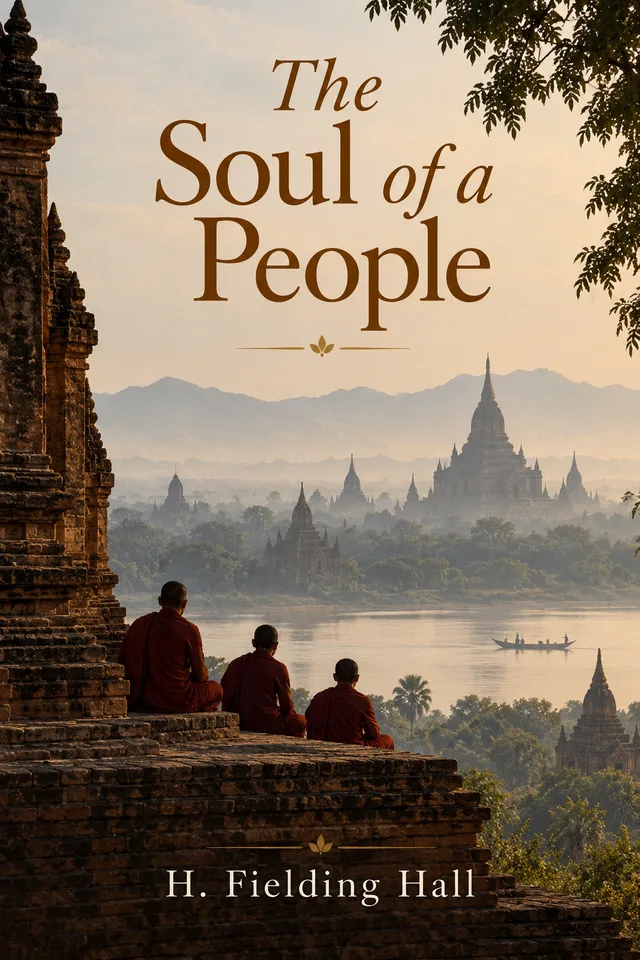
H. Fielding Hall describes the religious and social life of Burma through its Buddhist traditions and everyday practices. Chapters on kingship, warfare, monks, prayer, festivals, marriage, and compassion ask how belief shapes conduct. Personal observation and retold stories form a portrait of a society encountered during British colonial rule. This English text includes the author's preface and dedication to the second edition.
BooksWhale edition
How this edition was prepared
This edition is based on a public domain text and has been prepared for digital reading by BooksWhale.
Public domain basis
Why this edition can be shared
H. Fielding Hall died in 1917. The work was first published in 1898. This edition uses the historical English original from Project Gutenberg, excluding later editorial matter.
Read preview
A sample from the prepared text
Preview selected from the prepared reader text.
Preview chapterDEDICATION TO SECOND EDITIONRead preview
I dedicate this book to you about whom it is written. It has been made a reproach to me by the critics that I have only spoken well of you, that I have forgotten your faults and remembered only your virtues. If it is wrong to have done this, I must admit the wrong. I have written of you as a friend does of a friend. Where I could say kind things of you I have done so, where I could not I have been silent. You will find plenty of people who can see only your faults, and who like to tell you of them. You will find in the inexorable sequence of events a corrector of these faults more potent than any critics can be. But I am not your critic, but your friend. If many of you had not admitted me, a stranger, into your friendship during my many very solitary years, of what sort should I be now? How could I have lived those years alone? You kept alive my sympathies, and so saved me from many things. Do you think I could now turn round and criticise you? No; but this book is my tribute of gratitude for many kindnesses.
Preview chapterPREFACEPreview
In most of the quotations from Burmese books containing the life of the Buddha I am indebted, if not for the exact words, yet for the sense, to Bishop Bigandet's translation.
I do not think I am indebted to anyone else. I have, indeed, purposely avoided quoting from any other book and using material collected by anyone else.
The story of Ma Pa Da has appeared often before, but my version is taken entirely from the Burmese song. It is, as I have said, known to nearly every Burman.
I wanted to write only what the Burmese themselves thought; whether I have succeeded or not, the reader can judge.
I am indebted to Messrs. William Blackwood and Sons for permission to use parts of my article on 'Burmese Women'—Blackwood's Magazine, May, 1895—in the present work.
Preview chapterCHAPTER I — LIVING BELIEFSPreview
'The observance of the law alone entitles to the right of belonging to my religion.'—Saying of the Buddha.
For the first few years of my stay in Burma my life was so full of excitement that I had little care or time for any thought but of to-day. There was, first of all, my few months in Upper Burma in the King's time before the war, months which were full of danger and the exhilaration of danger, when all the surroundings were too new and too curious to leave leisure for examination beneath the surface. Then came the flight from Upper Burma at the time of the war, and then the war itself. And this war lasted four years. Not four years of fighting in Burma proper, for most of the Irrawaddy valley was peaceful enough by the end of 1889; but as the central parts quieted down, I was sent to the frontier, first on the North and then on the East by the Chin mountains; so that it was not until 1890 that a transfer to a more settled part gave me quiet and opportunity for consideration of all I had seen and known. For it was in those years that I gained most of whatever little knowledge I have of the Burmese people.
Months, very many months, I passed with no one to speak to, with no other companions but Burmese. I have been with them in joy and in sorrow, I have fought with them and against them, and sat round the camp-fire after the day's work and talked of it all. I have had many friends amongst them, friends I shall always honour; and I have seen them killed sometimes in our fights, or dead of fever in the marshes of the frontier. I have known them from the labourer to the Prime Minister, from the little neophyte just accepted into the faith to the head of all the Burmese religion. I have known their wives and daughters; have watched many a flirtation in the warm scented evenings; and have seen girls become wives and wives mothers while I have lived amongst them. So that although when the country settled down, and we built houses for ourselves and returned more to English modes of living, I felt that I was drifting away from them into the conventionality and ignorance of our official lives, yet I had in my memory much of what I had seen, much of what I had done, that I shall never forget. I felt that I had been—even if it were only for a time—behind the veil, where it is so hard to come.
In looking over these memories it seemed to me that there were many things I did not understand, acts of theirs and customs, which I had seen and noted, but of which I did not know the reason. We all know how hard it is to see into the heart even of our own people, those of our flesh and blood who are with us always, whose ways are our ways, and whose thoughts are akin to ours. And if this be so with them, it is ten thousand times harder with those whose ways are not our ways, and from whose thoughts we must be far apart. It is true that there are no dark places in the lives of the Burmese as there are in the lives of other Orientals. All is open to the light of day in their homes and in their religion, and their women are the freest in the world. Yet the barriers of a strange tongue and a strange religion, and of ways caused by another climate than ours, is so great that, even to those of us who have every wish and every opportunity to understand, it seems sometimes as if we should never know their hearts. It seems as if we should never learn more of their ways than just the outside—that curiously varied outside which is so deceptive, and which is so apt to prevent our understanding that they are men just as we are, and not strange creations from some far-away planet.
Table of contents
Inside this edition
- 01DEDICATION TO SECOND EDITION
- 02PREFACE
- 03CHAPTER I — LIVING BELIEFS
- 04CHAPTER II — HE WHO FOUND THE LIGHT—I
- 05CHAPTER III — HE WHO FOUND THE LIGHT—II
- 06CHAPTER IV — THE WAY TO THE GREAT PEACE
- 07CHAPTER V — WAR—I
- 08CHAPTER VI — WAR—II
- 09CHAPTER VII — GOVERNMENT
- 10CHAPTER VIII — CRIME AND PUNISHMENT
- 11CHAPTER IX — HAPPINESS
- 12CHAPTER X — THE MONKHOOD—I
- 13CHAPTER XI — THE MONKHOOD—II
- 14CHAPTER XII — PRAYER
- 15CHAPTER XIII — FESTIVALS
- 16CHAPTER XIV — WOMEN—I
- 17From a Man to a Girl.
- 18CHAPTER XV — WOMEN—II
- 19CHAPTER XVI — WOMEN—III
- 20CHAPTER XVII — DIVORCE
- 21CHAPTER XVIII — DRINK
- 22CHAPTER XIX — MANNERS
- 23CHAPTER XX — 'NOBLESSE OBLIGE'
- 24CHAPTER XXI — ALL LIFE IS ONE
- 25CHAPTER XXII — DEATH, THE DELIVERER
- 26CHAPTER XXIII — THE POTTER'S WHEEL
- 27CHAPTER XXIV — THE FOREST OF TIME
- 28CHAPTER XXV — CONCLUSION
Language availability
Other languages
Additional language editions are not published yet. This section will link to other BooksWhale editions when they become available.
Request another language