English Edition
Literature
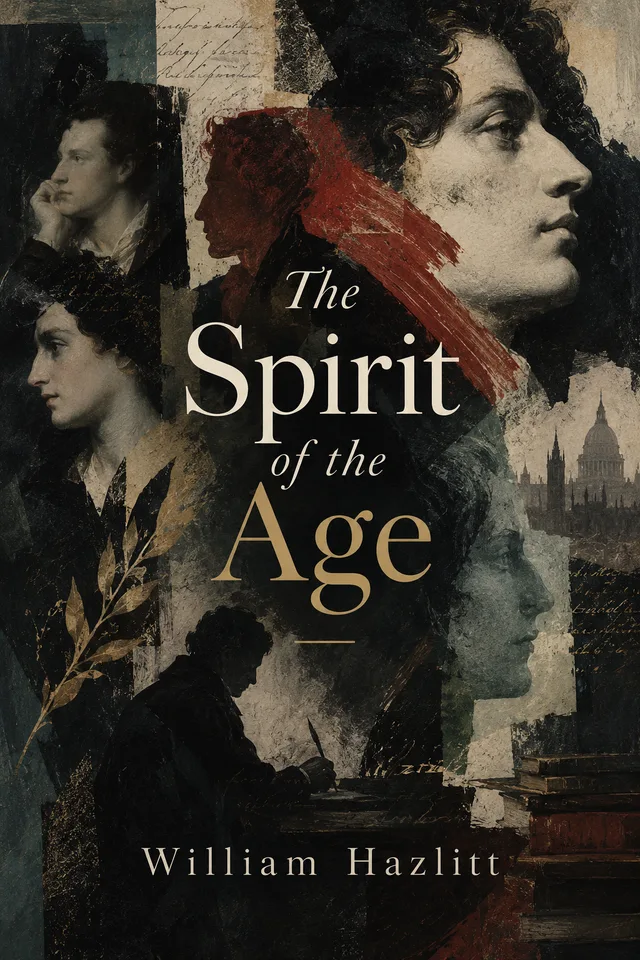
The Spirit of the Age
English BooksWhale Edition by William Hazlitt
A vivid portrait gallery of Romantic-era writers, thinkers, politicians, critics, and public personalities.
- Preview
- A sample from the prepared text
- Formats
- Online reader, EPUB, PDF
- Access
- Library claim
Book introduction
The Spirit of the Age
The Spirit of the Age gathers Hazlitt’s energetic portraits of major figures from the early nineteenth century, including poets, philosophers, reformers, and controversial public men. It remains a key work of English criticism, biography, and literary journalism.
BooksWhale edition
How this edition was prepared
This edition is based on a public domain text and has been prepared for digital reading by BooksWhale.
Public domain basis
Why this edition can be shared
William Hazlitt died in 1830, and The Spirit of the Age was first published in 1825. These dates support the public-domain basis for the original English text used in this edition.
Read preview
A sample from the prepared text
Preview selected from the prepared reader text.
Preview chapterFull textRead preview
The Spirit of the Age
William Hazlitt
Preview chapterJEREMY BENTHAM.Preview
Mr. Bentham is one of those persons who verify the old adage, that "A
prophet has no honour, except out of his own country." His reputation
lies at the circumference; and the lights of his understanding are
reflected, with increasing lustre, on the other side of the globe. His
name is little known in England, better in Europe, best of all in the
plains of Chili and the mines of Mexico. He has offered constitutions
for the New World, and legislated for future times. The people of
Westminster, where he lives, hardly know of such a person; but the
Siberian savage has received cold comfort from his lunar aspect, and may
say to him with Caliban--"I know thee, and thy dog and thy bush!" The
tawny Indian may hold out the hand of fellowship to him across the GREAT
PACIFIC. We believe that the Empress Catherine corresponded with him;
and we know that the Emperor Alexander called upon him, and presented
him with his miniature in a gold snuff-box, which the philosopher, to
his eternal honour, returned. Mr. Hobhouse is a greater man at the
hustings, Lord Rolle at Plymouth Dock; but Mr. Bentham would carry it
hollow, on the score of popularity, at Paris or Pegu. The reason is,
that our author's influence is purely intellectual. He has devoted
his life to the pursuit of abstract and general truths, and to those
studies--
"That waft a _thought_ from Indus to the Pole"--
and has never mixed himself up with personal intrigues or party
politics. He once, indeed, stuck up a hand-bill to say that he (Jeremy
Bentham) being of sound mind, was of opinion that Sir Samuel Romilly was
the most proper person to represent Westminster; but this was the whim
of the moment. Otherwise, his reasonings, if true at all, are true
everywhere alike: his speculations concern humanity at large, and are
not confined to the hundred or the bills of mortality. It is in moral as
in physical magnitude. The little is seen best near: the great appears
in its proper dimensions, only from a more commanding point of view, and
gains strength with time, and elevation from distance!
Mr. Bentham is very much among philosophers what La Fontaine was among
poets:--in general habits and in all but his professional pursuits, he
is a mere child. He has lived for the last forty years in a house
in Westminster, overlooking the Park, like an anchoret in his cell,
reducing law to a system, and the mind of man to a machine. He scarcely
ever goes out, and sees very little company. The favoured few, who have
the privilege of the _entrée_, are always admitted one by one. He does
not like to have witnesses to his conversation. He talks a great deal,
and listens to nothing but facts. When any one calls upon him, he
invites them to take a turn round his garden with him (Mr. Bentham is
an economist of his time, and sets apart this portion of it to air and
exercise)--and there you may see the lively old man, his mind still
buoyant with thought and with the prospect of futurity, in eager
conversation with some Opposition Member, some expatriated Patriot, or
Transatlantic Adventurer, urging the extinction of Close Boroughs, or
planning a code of laws for some "lone island in the watery waste,"
his walk almost amounting to a run, his tongue keeping pace with it in
shrill, cluttering accents, negligent of his person, his dress, and his
manner, intent only on his grand theme of UTILITY--or pausing, perhaps,
for want of breath and with lack-lustre eye to point out to the stranger
a stone in the wall at the end of his garden (overarched by two
beautiful cotton-trees) _Inscribed to the Prince of Poets_, which
marks the house where Milton formerly lived. To shew how little the
Preview chapterWILLIAM GODWINPreview
The Spirit of the Age was never more fully-shewn than in its treatment
of this writer--its love of paradox and change, its dastard submission
to prejudice and to the fashion of the day. Five-and-twenty years ago he
was in the very zenith of a sultry and unwholesome popularity; he blazed
as a sun in the firmament of reputation; no one was more talked of, more
looked up to, more sought after, and wherever liberty, truth, justice
was the theme, his name was not far off:--now he has sunk below the
horizon, and enjoys the serene twilight of a doubtful immortality. Mr.
Godwin, during his lifetime, has secured to himself the triumphs and the
mortifications of an extreme notoriety and of a sort of posthumous fame.
His bark, after being tossed in the revolutionary tempest, now raised to
heaven by all the fury of popular breath, now almost dashed in pieces,
and buried in the quicksands of ignorance, or scorched with the
lightning of momentary indignation, at length floats on the calm wave
that is to bear it down the stream of time. Mr. Godwin's person is not
known, he is not pointed out in the street, his conversation is not
courted, his opinions are not asked, he is at the head of no cabal, he
belongs to no party in the State, he has no train of admirers, no
one thinks it worth his while even to traduce and vilify him, he has
scarcely friend or foe, the world make a point (as Goldsmith used to
say) of taking no more notice of him than if such an individual had
never existed; he is to all ordinary intents and purposes dead and
buried; but the author of _Political Justice_ and of _Caleb Williams_
can never die, his name is an abstraction in letters, his works are
standard in the history of intellect. He is thought of now like any
eminent writer a hundred-and-fifty years ago, or just as he will be
a hundred-and-fifty years hence. He knows this, and smiles in silent
mockery of himself, reposing on the monument of his fame--
"Sedet, in eternumque sedebit infelix Theseus."
No work in our time gave such a blow to the philosophical mind of the
country as the celebrated _Enquiry concerning Political Justice_. Tom
Paine was considered for the time as a Tom Fool to him; Paley an old
woman; Edmund Burke a flashy sophist. Truth, moral truth, it was
supposed, had here taken up its abode; and these were the oracles of
thought. "Throw aside your books of chemistry," said Wordsworth to a
young man, a student in the Temple, "and read Godwin on Necessity." Sad
necessity! Fatal reverse! Is truth then so variable? Is it one thing at
twenty, and another at forty? Is it at a burning heat in 1793, and below
_zero_ in 1814? Not so, in the name of manhood and of common sense! Let
us pause here a little.--Mr. Godwin indulged in extreme opinions, and
carried with him all the most sanguine and fearless understandings of
the time. What then? Because those opinions were overcharged, were they
therefore altogether groundless? Is the very God of our idolatry all of
a sudden to become an abomination and an anathema? Could so many young
men of talent, of education, and of principle have been hurried away by
what had neither truth, nor nature, not one particle of honest feeling
nor the least shew of reason in it? Is the _Modern Philosophy_ (as it
has been called) at one moment a youthful bride, and the next a withered
beldame, like the false Duessa in Spenser? Or is the vaunted edifice
of Reason, like his House of Pride, gorgeous in front, and dazzling to
approach, while "its hinder parts are ruinous, decayed, and old?" Has
the main prop, which supported the mighty fabric, been shaken and given
Table of contents
Inside this edition
- 01Full text
- 02JEREMY BENTHAM.
- 03WILLIAM GODWIN
- 04MR. COLERIDGE.
- 05volume (perhaps it may be an immortal one) and says, "My name is written
- 06REV. MR. IRVING.
- 07THE LATE MR. HORNE TOOKE.
- 08SIR WALTER SCOTT
- 09LORD BYRON.
- 10MR. CAMPBELL AND MR. CRABBE.
- 11SIR JAMES MACKINTOSH.
- 12MR. WORDSWORTH.
- 13MR. MALTHUS.
- 14MR. GIFFORD.
- 15EVE OF ST. AGNES.
- 16MR. JEFFREY
- 17introduction of party-spirit)--while Lord Byron is called to a grave
- 18MR. BROUGHAM--SIR F. BURDETT.
- 19introduction to the celebrated Carnot in this latter character, when the
- 20LORD ELDON AND MR. WILBERFORCE.
- 21act and infringement of the Constitution, for abridging it at home: he
- 22MR. SOUTHEY.
- 23MR. T. MOORE.--MR. LEIGH HUNT.
- 24CAMPBELL.
- 25ELIA, AND GEOFFREY CRAYON.
- 26THE END.
Language availability
Other languages
Additional language editions are not published yet. This section will link to other BooksWhale editions when they become available.
Request another language