English Edition
Education
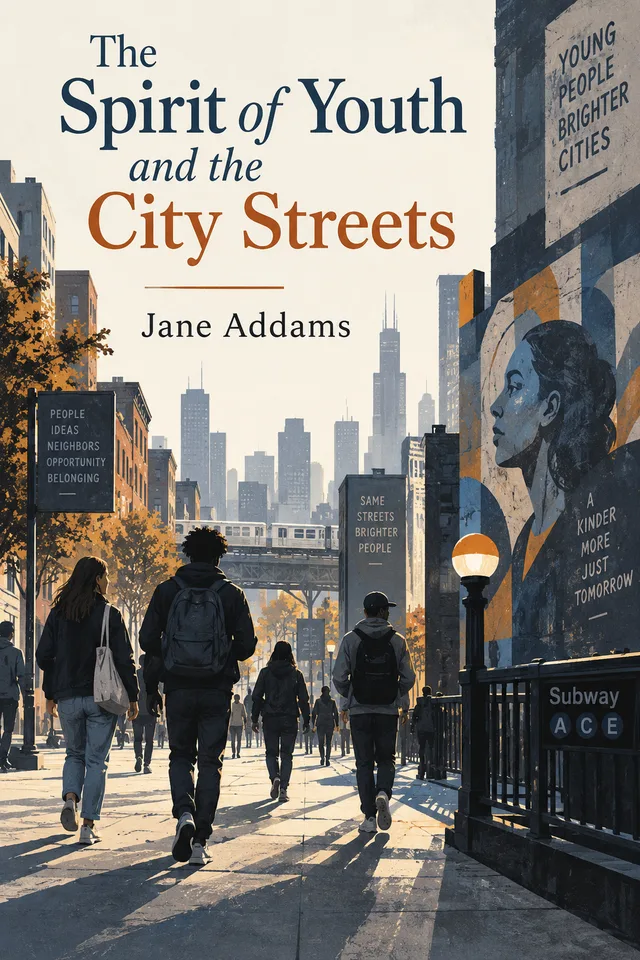
The Spirit of Youth and the City Streets
English BooksWhale Edition by Jane Addams
Jane Addams explores how city streets, commercial entertainment, work, and community institutions shape young people’s hopes and conduct.
- Preview
- A sample from the prepared text
- Formats
- Online reader, EPUB, PDF
- Access
- Library claim
Book introduction
The Spirit of Youth and the City Streets
Drawing on her experience at Hull House, Jane Addams follows the energies of young people growing up in industrial cities. Six chapters consider recreation, weakened domestic ties, the desire for adventure, imaginative life, employment, and moral aspiration. Her argument connects individual choices with the opportunities offered by streets, workplaces, theaters, and public institutions. The book combines concrete encounters with a call to give youthful enthusiasm constructive forms of expression.
BooksWhale edition
How this edition was prepared
This edition is based on a public domain text and has been prepared for digital reading by BooksWhale.
Public domain basis
Why this edition can be shared
Jane Addams died in 1935. The work was first published in 1909. This edition uses the public-domain English original.
Read preview
A sample from the prepared text
Preview selected from the prepared reader text.
Preview chapterFOREWORDRead preview
Much of the material in the following pages has appeared in current publications. It is here presented in book form in the hope that it may prove of value to those groups of people who in many cities are making a gallant effort to minimize the dangers which surround young people and to provide them with opportunities for recreation.
Preview chapterCHAPTER I — YOUTH IN THE CITYPreview
Nothing is more certain than that each generation longs for a reassurance as to the value and charm of life, and is secretly afraid lest it lose its sense of the youth of the earth. This is doubtless one reason why it so passionately cherishes its poets and artists who have been able to explore for themselves and to reveal to others the perpetual springs of life's self-renewal.
And yet the average man cannot obtain this desired reassurance through literature, nor yet through glimpses of earth and sky. It can come to him only through the chance embodiment of joy and youth which life itself may throw in his way. It is doubtless true that for the mass of men the message is never so unchallenged and so invincible as when embodied in youth itself. One generation after another has depended upon its young to equip it with gaiety and enthusiasm, to persuade it that living is a pleasure, until men everywhere have anxiously provided channels through which this wine of life might flow, and be preserved for their delight. The classical city promoted play with careful solicitude, building the theater and stadium as it built the market place and the temple. The Greeks held their games so integral a part of religion and patriotism that they came to expect from their poets the highest utterances at the very moments when the sense of pleasure released the national life. In the medieval city the knights held their tourneys, the guilds their pageants, the people their dances, and the church made festival for its most cherished saints with gay street processions, and presented a drama in which no less a theme than the history of creation became a matter of thrilling interest. Only in the modern city have men concluded that it is no longer necessary for the municipality to provide for the insatiable desire for play. In so far as they have acted upon this conclusion, they have entered upon a most difficult and dangerous experiment; and this at the very moment when the city has become distinctly industrial, and daily labor is continually more monotonous and subdivided. We forget how new the modern city is, and how short the span of time in which we have assumed that we can eliminate public provision for recreation.
A further difficulty lies in the fact that this industrialism has gathered together multitudes of eager young creatures from all quarters of the earth as a labor supply for the countless factories and workshops, upon which the present industrial city is based. Never before in civilization have such numbers of young girls been suddenly released from the protection of the home and permitted to walk unattended upon city streets and to work under alien roofs; for the first time they are being prized more for their labor power than for their innocence, their tender beauty, their ephemeral gaiety. Society cares more for the products they manufacture than for their immemorial ability to reaffirm the charm of existence. Never before have such numbers of young boys earned money independently of the family life, and felt themselves free to spend it as they choose in the midst of vice deliberately disguised as pleasure.
This stupid experiment of organizing work and failing to organize play has, of course, brought about a fine revenge. The love of pleasure will not be denied, and when it has turned into all sorts of malignant and vicious appetites, then we, the middle aged, grow quite distracted and resort to all sorts of restrictive measures. We even try to dam up the sweet fountain itself because we are affrighted by these neglected streams; but almost worse than the restrictive measures is our apparent belief that the city itself has no obligation in the matter, an assumption upon which the modern city turns over to commercialism practically all the provisions for public recreation.
Preview chapterCHAPTER II — THE WRECKED FOUNDATIONS OF DOMESTICITYPreview
"Sense with keenest edge unused Yet unsteel'd by scathing fire: Lovely feet as yet unbruised On the ways of dark desire!"
These words written by a poet to his young son express the longing which has at times seized all of us, to guard youth from the mass of difficulties which may be traced to the obscure manifestation of that fundamental susceptibility of which we are all slow to speak and concerning which we evade public responsibility, although it brings its scores of victims into the police courts every morning.
At the very outset we must bear in mind that the senses of youth are singularly acute, and ready to respond to every vivid appeal. We know that nature herself has sharpened the senses for her own purposes, and is deliberately establishing a connection between them and the newly awakened susceptibility of sex; for it is only through the outward senses that the selection of an individual mate is made and the instinct utilized for nature's purposes. It would seem, however, that nature was determined that the force and constancy of the instinct must make up for its lack of precision, and that she was totally unconcerned that this instinct ruthlessly seized the youth at the moment when he was least prepared to cope with it; not only because his powers of self-control and discrimination are unequal to the task, but because his senses are helplessly wide open to the world. These early manifestations of the sex susceptibility are for the most part vague and formless, and are absolutely without definition to the youth himself. Sometimes months and years elapse before the individual mate is selected and determined upon, and during the time when the differentiation is not complete—and it often is not—there is of necessity a great deal of groping and waste.
This period of groping is complicated by the fact that the youth's power for appreciating is far ahead of his ability for expression. "The inner traffic fairly obstructs the outer current," and it is nothing short of cruelty to over-stimulate his senses as does the modern city. This period is difficult everywhere, but it seems at times as if a great city almost deliberately increased its perils. The newly awakened senses are appealed to by all that is gaudy and sensual, by the flippant street music, the highly colored theater posters, the trashy love stories, the feathered hats, the cheap heroics of the revolvers displayed in the pawn-shop windows. This fundamental susceptibility is thus evoked without a corresponding stir of the higher imagination, and the result is as dangerous as possible. We are told upon good authority that "If the imagination is retarded, while the senses remain awake, we have a state of esthetic insensibility,"—in other words, the senses become sodden and cannot be lifted from the ground. It is this state of "esthetic insensibility" into which we allow the youth to fall which is so distressing and so unjustifiable. Sex impulse then becomes merely a dumb and powerful instinct without in the least awakening the imagination or the heart, nor does it overflow into neighboring fields of consciousness. Every city contains hundreds of degenerates who have been over-mastered and borne down by it; they fill the casual lodging houses and the infirmaries. In many instances it has pushed men of ability and promise to the bottom of the social scale. Warner, in his American Charities, designates it as one of the steady forces making for failure and poverty, and contends that "the inherent uncleanness of their minds prevents many men from rising above the rank of day laborers and finally incapacitates them even for that position." He also suggests that the modern man has a stronger imagination than the man of a few hundred years ago and that sensuality destroys him the more rapidly.
It is difficult to state how much evil and distress might be averted if the imagination were utilized in its higher capacities through the historic paths. An English moralist has lately asserted that "much of the evil of the time may be traced to outraged imagination. It is the strongest quality of the brain and it is starved. Children, from their earliest years, are hedged in with facts; they are not trained to use their minds on the unseen."
Table of contents
Inside this edition
- 01FOREWORD
- 02CHAPTER I — YOUTH IN THE CITY
- 03CHAPTER II — THE WRECKED FOUNDATIONS OF DOMESTICITY
- 04CHAPTER III — THE QUEST FOR ADVENTURE
- 05CHAPTER IV — THE HOUSE OF DREAMS
- 06CHAPTER V — THE SPIRIT OF YOUTH AND INDUSTRY
- 07CHAPTER VI — THE THIRST FOR RIGHTEOUSNESS
Language availability
Other languages
Additional language editions are not published yet. This section will link to other BooksWhale editions when they become available.
Request another language