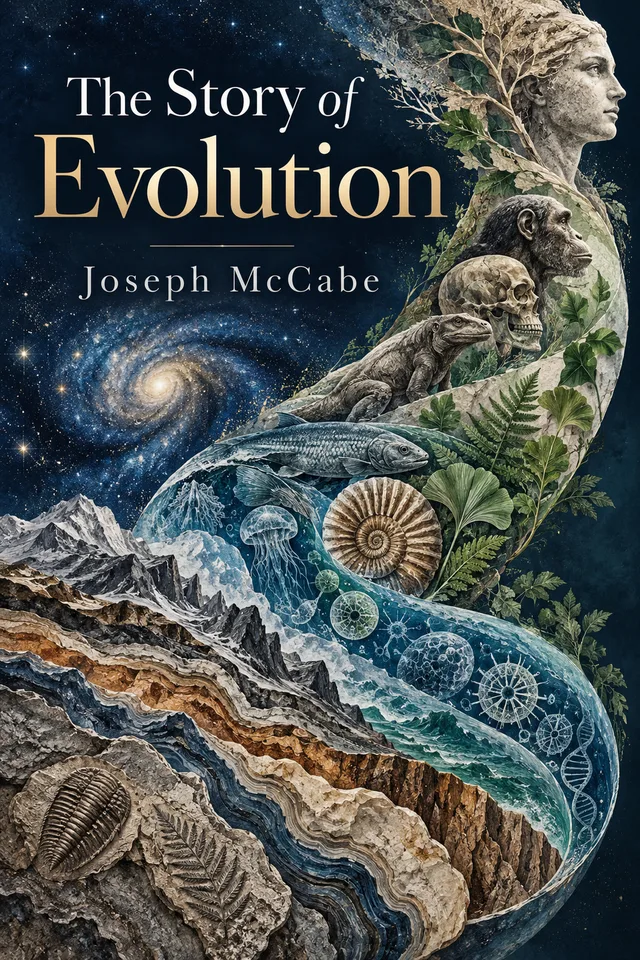
English Edition
Science
The Story of Evolution
English BooksWhale Edition by Joseph McCabe
Joseph McCabe traces cosmic, geological, biological, and human development in an early twentieth-century account of evolutionary science.
- Preview
- A sample from the prepared text
- Formats
- Online reader, EPUB, PDF
- Access
- Library claim
Book introduction
The Story of Evolution
Joseph McCabe presents evolution as a connected history of the universe, Earth, living organisms and human society. Twenty-one chapters move from the formation of worlds through geological ages, reptiles, mammals and the origins of humanity. The book offers a historical view of scientific explanation in 1912, combining descriptions of evidence with the author’s arguments about change, adaptation and civilisation.
BooksWhale edition
How this edition was prepared
This edition is based on a public domain text and has been prepared for digital reading by BooksWhale.
Public domain basis
Why this edition can be shared
Joseph McCabe died in 1955. This edition uses the public-domain English original from Project Gutenberg, without later editorial notes or illustrations.
Read preview
A sample from the prepared text
Preview selected from the prepared reader text.
Preview chapterPREFACERead preview
An ingenious student of science once entertained his generation with a theory of how one might behold again all the stirring chapters that make up the story of the earth. The living scene of our time is lit by the light of the sun, and for every few rays that enter the human eye, and convey the image of it to the human mind, great floods of the reflected light pour out, swiftly and indefinitely, into space. Imagine, then, a man moving out into space more rapidly than light, his face turned toward the earth. Flashing through the void at, let us say, a million miles a second, he would (if we can overlook the dispersion of the rays of light) overtake in succession the light that fell on the French Revolution, the Reformation, the Norman Conquest, and the faces of the ancient empires. He would read, in reverse order, the living history of man and whatever lay before the coming of man.
Few thought, as they smiled over this fairy tale of science, that some such panoramic survey of the story of the earth, and even of the heavens, might one day be made in a leisure hour by ordinary mortals; that in the soil on which they trod were surer records of the past than in its doubtful literary remains, and in the deeper rocks were records that dimly lit a vast abyss of time of which they never dreamed. It is the supreme achievement of modern science to have discovered and deciphered these records. The picture of the past which they afford is, on the whole, an outline sketch. Here and there the details, the colour, the light and shade, may be added; but the greater part of the canvas is left to the more skilful hand of a future generation, and even the broad lines are at times uncertain. Yet each age would know how far its scientific men have advanced in constructing that picture of the growth of the heavens and the earth, and the aim of the present volume is to give, in clear and plain language, as full an account of the story as the present condition of our knowledge and the limits of the volume will allow. The author has been for many years interested in the evolution of things, or the way in which suns and atoms, fishes and flowers, hills and elephants, even man and his institutions, came to be what they are. Lecturing and writing on one or other phase of the subject have, moreover, taught him a language which the inexpert seem to understand, although he is not content merely to give a superficial description of the past inhabitants of the earth.
The particular features which, it is hoped, may give the book a distinctive place in the large literature of evolution are, first, that it includes the many evolutionary discoveries of the last few years, gathers its material from the score of sciences which confine themselves to separate aspects of the universe, and blends all these facts and discoveries in a more or less continuous chronicle of the life of the heavens and the earth. Then the author has endeavoured to show, not merely how, but why, scene succeeds scene in the chronicle of the earth, and life slowly climbs from level to level. He has taken nature in the past as we find it to-day: an interconnected whole, in which the changes of land and sea, of heat and cold, of swamp and hill, are faithfully reflected in the forms of its living population. And, finally, he has written for those who are not students of science, or whose knowledge may be confined to one branch of science, and used a plain speech which assumes no previous knowledge on the reader's part.
For the rest, it will be found that no strained effort is made to trace pedigrees of animals and plants when the material is scanty; that, if on account of some especial interest disputable or conjectural speculations are admitted, they are frankly described as such; and that the more important differences of opinion which actually divide astronomers, geologists, biologists, and anthropologists are carefully taken into account and briefly explained. A few English and American works are recommended for the convenience of those who would study particular chapters more closely, but it has seemed useless, in such a work, to give a bibliography of the hundreds of English, American, French, German, and Italian works which have been consulted.
Preview chapterCHAPTER I. THE DISCOVERY OF THE UNIVERSEPreview
The beginning of the victorious career of modern science was very largely due to the making of two stimulating discoveries at the close of the Middle Ages. One was the discovery of the earth: the other the discovery of the universe. Men were confined, like molluscs in their shells, by a belief that they occupied the centre of a comparatively small disk—some ventured to say a globe—which was poised in a mysterious way in the middle of a small system of heavenly bodies. The general feeling was that these heavenly bodies were lamps hung on a not too remote ceiling for the purpose of lighting their ways. Then certain enterprising sailors—Vasco da Gama, Maghalaes, Columbus—brought home the news that the known world was only one side of an enormous globe, and that there were vast lands and great peoples thousands of miles across the ocean. The minds of men in Europe had hardly strained their shells sufficiently to embrace this larger earth when the second discovery was reported. The roof of the world, with its useful little system of heavenly bodies, began to crack and disclose a profound and mysterious universe surrounding them on every side. One cannot understand the solidity of the modern doctrine of the formation of the heavens and the earth until one appreciates this revolution.
Before the law of gravitation had been discovered it was almost impossible to regard the universe as other than a small and compact system. We shall see that a few daring minds pierced the veil, and peered out wonderingly into the real universe beyond, but for the great mass of men it was quite impossible. To them the modern idea of a universe consisting of hundreds of millions of bodies, each weighing billions of tons, strewn over billions of miles of space, would have seemed the dream of a child or a savage. Material bodies were "heavy," and would "fall down" if they were not supported. The universe, they said, was a sensible scientific structure; things were supported in their respective places. A great dome, of some unknown but compact material, spanned the earth, and sustained the heavenly bodies. It might rest on the distant mountains, or be borne on the shoulders of an Atlas; or the whole cosmic scheme might be laid on the back of a gigantic elephant, and—if you pressed—the elephant might stand on the hard shell of a tortoise. But you were not encouraged to press.
The idea of the vault had come from Babylon, the first home of science. No furnaces thickened that clear atmosphere, and the heavy-robed priests at the summit of each of the seven-staged temples were astronomers. Night by night for thousands of years they watched the stars and planets tracing their undeviating paths across the sky. To explain their movements the priest-astronomers invented the solid firmament. Beyond the known land, encircling it, was the sea, and beyond the sea was a range of high mountains, forming another girdle round the earth. On these mountains the dome of the heavens rested, much as the dome of St. Paul's rests on its lofty masonry. The sun travelled across its under-surface by day, and went back to the east during the night through a tunnel in the lower portion of the vault. To the common folk the priests explained that this framework of the world was the body of an ancient and disreputable goddess. The god of light had slit her in two, "as you do a dried fish," they said, and made the plain of the earth with one half and the blue arch of the heavens with the other.
So Chaldaea lived out its 5000 years without discovering the universe. Egypt adopted the idea from more scientific Babylon. Amongst the fragments of its civilisation we find representations of the firmament as a goddess, arching over the earth on her hands and feet, condemned to that eternal posture by some victorious god. The idea spread amongst the smaller nations which were lit by the civilisation of Babylon and Egypt. Some blended it with coarse old legends; some, like the Persians and Hebrews, refined it. The Persians made fire a purer and lighter spirit, so that the stars would need no support. But everywhere the blue vault hemmed in the world and the ideas of men. It was so close, some said, that the birds could reach it. At last the genius of Greece brooded over the whole chaos of cosmical speculations.
Preview chapterCHAPTER II. THE FOUNDATIONS OF THE UNIVERSEPreview
To the mind of the vast majority of earlier observers the phrase "foundations of the universe" would have suggested something enormously massive and solid. From what we have already seen we are prepared, on the contrary, to pass from the inconceivably large to the inconceivably small. Our sun is, as far as our present knowledge goes, one of modest dimensions. Arcturus and Canopus must be thousands of times larger than it. Yet our sun is 320,000 times heavier than the earth, and the earth weighs some 6,000,000,000,000,000,000,000 tons. But it is only in resolving these stupendous masses into their tiniest elements that we can reach the ultimate realities, or foundations, of the whole.
Modern science rediscovered the atoms of Democritus, analysed the universe into innumerable swarms of these tiny particles, and then showed how the infinite variety of things could be built up by their combinations. For this it was necessary to suppose that the atoms were not all alike, but belonged to a large number of different classes. From twenty-six letters of the alphabet we could make millions of different words. From forty or fifty different "elements" the chemist could construct the most varied objects in nature, from the frame of a man to a landscape. But improved methods of research led to the discovery of new elements, and at last the chemist found that he had seventy or eighty of these "ultimate realities," each having its own very definite and very different characters. As it is the experience of science to find unity underlying variety, this was profoundly unsatisfactory, and the search began for the great unity which underlay the atoms of matter. The difficulty of the search may be illustrated by a few figures. Very delicate methods were invented for calculating the size of the atoms. Laymen are apt to smile—it is a very foolish smile—at these figures, but it is enough to say that the independent and even more delicate methods suggested by recent progress in physics have quite confirmed them.
Take a cubic millimetre of hydrogen. As a millimetre is less than 1/25th of an inch, the reader must imagine a tiny bubble of gas that would fit comfortably inside the letter "o" as it is printed here. The various refined methods of the modern physicist show that there are 40,000 billion molecules (each consisting of two atoms of the gas) in this tiny bubble. It is a little universe, repeating on an infinitesimal scale the numbers and energies of the stellar universe. These molecules are not packed together, moreover, but are separated from each other by spaces which are enormous in proportion to the size of the atoms. Through these empty spaces the atoms dash at an average speed of more than a thousand miles an hour, each passing something like 6,000,000,000 of its neighbours in the course of every second. Yet this particle of gas is a thinly populated world in comparison with a particle of metal. Take a cubic centimetre of copper. In that very small square of solid matter (each side of the cube measuring a little more than a third of an inch) there are about a quadrillion atoms. It is these minute and elusive particles that modern physics sets out to master.
At first it was noticed that the atom of hydrogen was the smallest or lightest of all, and the other atoms seemed to be multiples of it. A Russian chemist, Mendeleeff, drew up a table of the elements in illustration of this, grouping them in families, which seemed to point to hydrogen as the common parent, or ultimate constituent, of each. When newly discovered elements fell fairly into place in this scheme the idea was somewhat confidently advanced that the evolution of the elements was discovered. Thus an atom of carbon seemed to be a group of 12 atoms of hydrogen, an atom of oxygen 16, an atom of sulphur 32, an atom of copper 64, an atom of silver 108, an atom of gold 197, and so on. But more correct measurements showed that these figures were not quite exact, and the fraction of inexactness killed the theory.
Table of contents
Inside this edition
- 01PREFACE
- 02CHAPTER I. THE DISCOVERY OF THE UNIVERSE
- 03CHAPTER II. THE FOUNDATIONS OF THE UNIVERSE
- 04CHAPTER III. THE BIRTH AND DEATH OF WORLDS
- 05CHAPTER IV. THE PREPARATION OF THE EARTH
- 06CHAPTER V. THE BEGINNING OF LIFE
- 07CHAPTER VI. THE INFANCY OF THE EARTH
- 08CHAPTER VII. THE PASSAGE TO THE LAND
- 09CHAPTER VIII. THE COAL-FOREST
- 10CHAPTER IX. THE ANIMALS OF THE COAL-FOREST
- 11CHAPTER X. THE PERMIAN REVOLUTION
- 12CHAPTER XI. THE MIDDLE AGES OF THE EARTH
- 13CHAPTER XII. THE AGE OF REPTILES
- 14CHAPTER XIII. THE BIRD AND THE MAMMAL
- 15CHAPTER XIV. IN THE DAYS OF THE CHALK
- 16CHAPTER XV. THE TERTIARY ERA
- 17CHAPTER XVI. THE FLOWER AND THE INSECT
- 18CHAPTER XVII. THE ORIGIN OF OUR MAMMALS
- 19CHAPTER XVIII. THE EVOLUTION OF MAN
- 20CHAPTER XIX. MAN AND THE GREAT ICE-AGE
- 21CHAPTER XX. THE DAWN OF CIVILISATION
- 22CHAPTER XXI. EVOLUTION IN HISTORY
Language availability
Other languages
Additional language editions are not published yet. This section will link to other BooksWhale editions when they become available.
Request another language